
Unlock the Editor’s Digest for free
Roula Khalaf, Editor of the FT, selects her favourite stories in this weekly newsletter.
All 18-year-old German men will be summoned to medical inspections to determine their fitness to serve in the military under a deal struck between the country’s ruling parties and aimed at boosting the armed forces.
The EU’s largest nation will initially seek only volunteers to join a new form of military service as it seeks to grow its army in response to Nato fears of Russian aggression.
But, after months of political wrangling over the details of the plan, defence minister Boris Pistorius has agreed to present an update to the Bundestag every six months on the progress of the recruitment drive.
If it fails to secure enough voluntary soldiers, members of parliament will be asked to consider other options — including the idea of a lottery system that would select people at random for compulsory service.
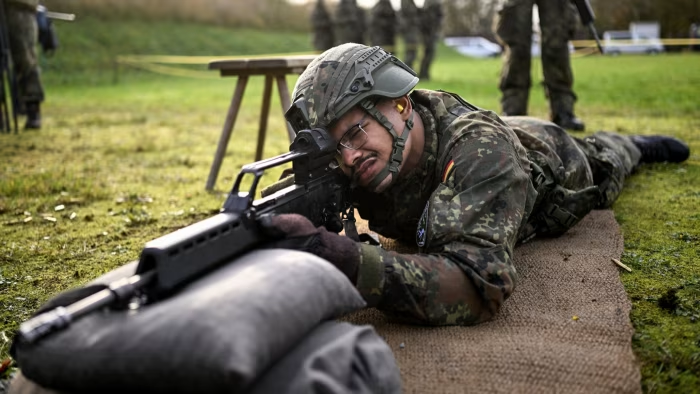
 German army recruits line up during live-fire training © Leon Kuegeler/Reuters
Announcing the agreement, Pistorius said that the rest of Europe looked towards Germany not only because it was unleashing hundreds of billions of euros to overhaul its military equipment in the years ahead but also because of its efforts to boost personnel. “I am very, very confident that all of this will succeed,” he said.
German Chancellor Friedrich Merz promised after taking office in May that he would make his nation’s military the strongest conventional armed forces in Europe.
Military officials have said that the size of the Bundeswehr needs to grow from 182,000 today to 260,000 by 2035. It also needs to expand the reserves who can be called upon in a crisis from 60,000 to 200,000.
Germany suspended conscription in 2011. The coalition agreement struck by Merz’s Christian Democrats (CDU) and their junior partners the Social Democrats (SPD) promised to introduce a new voluntary form of military service.
Turning that pledge into law has proved fraught. Many in the CDU warned that a voluntary model would not be sufficient given the tense security situation in Europe. The SPD, which has a strong pacifist wing, resisted calls for obligatory military service.
The parties appeared to have reached a deal last month, only to see it derailed by Pistorius, who was unhappy with several elements of the plan.
Under the new deal negotiated late on Wednesday night, from January 2026 all 18-year-olds will receive a questionnaire asking for details about their physical and mental health, as well as their willingness and ability to serve in the armed forces.
Men will be required by law to fill it out. For women it will be voluntary. This is the legacy of the previous system of military service that applied only to men. Removing that gender provision would mean changing the constitution, a step that requires a two-thirds majority in the Bundestag, which the current coalition would be unlikely to secure.
After filling out their form, all young men will be required to attend physical examinations even if they do not want to volunteer to serve.
Pistorius has stressed the importance of this aspect in order to prepare for a crisis in which it could be necessary to call up all capable young men. Speaking on Thursday, he said that this step would “provide a complete picture” of German young men, adding that this was “essential for assessing defence capabilities”.
The military will seek to entice recruits with competitive pay and other benefits such as subsidies to make it cheaper to obtain a driving licence.
SPD general secretary Matthias Miersch emphasised that the model was “an offer, not an obligation”, adding that all families with children born from 2008 would now “have this discussion” about whether or not young people wanted to serve in the military.
CDU parliamentary leader Jens Spahn said that the twice-yearly reporting requirement would mean that “we as a society always know where we stand in terms of the growth of our armed forces so that we are able to defend ourselves”.