
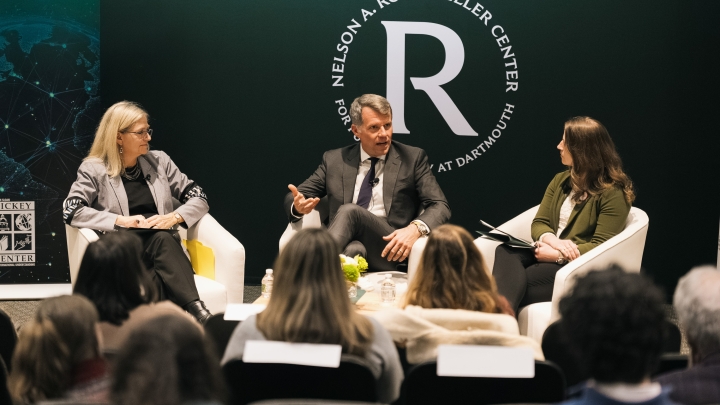
Nathaniel Fick ’99 earned high honors majoring in ancient history at Dartmouth but says he was feeling a bit “adrift” as an undergraduate in the late 1990s.
Then he attended a talk at the Nelson A. Rockefeller Center for Public Policy by then-Wall Street Journal military reporter Thomas Ricks, who shared about his experience covering the U.S. Marines in Somalia.
“I felt like kids came in (to Dartmouth) with 1,000 different interests,” Fick said in a Nov. 12 talk in the Law and Democracy: The United States at 250 series co-sponsored by the Rockefeller Center and Dartmouth Dialogues. “I wasn’t especially interested in some of those paths (other students were pursuing), so I joined the Marines.”
Fick returned to Dartmouth for the talk to share his own experiences in the military, as a tech executive, and as the inaugural U.S. ambassador at large for the State Department’s Bureau of Cyberspace and Digital Policy from 2022 to 2025.
Nathaniel Fick ’99 talks with students after his Nov. 12 talk, timed around Veterans Day, in Filene Auditorium. (Photo by Eli Burakian ’00)
The conversation, timed around Veterans Day to honor all who served, was moderated by Dickey Center Obenshain Family Distinguished Visitor and Diplomat in Residence Erica Barks Ruggles, a former ambassador to Rwanda, and Assistant Dean of Undergraduate Students Morgan Ogreen, a former Navy helicopter pilot.
Fick, who also served for eight years on Dartmouth’s Board of Trustees, talked about the impact of technology on military service and foreign policy, citing Ukraine’s use of technology in its war against Russia as a prime example of how technology can bolster military campaigns.
High-tech warfare is still “brutal and ugly and painful,” he said.
“We fall into the trap sometimes of thinking that cyberwarfare is somehow going to be clean, or that AI-enabled, it’s going to allow us somehow to fight wars without killing people or fight wars limiting civil damage to civilians. I don’t buy it,” Fick said.
Barks Ruggles asked Fick what the U.S. should be doing to address the issues ahead, particularly China’s threats. “How do we manage competition versus conflict?” she added.
Quote
I think tech’s that battleground, and the Chinese are running a very concerted cybersecurity campaign against us.
Attribution
Nathaniel Fick ’99, former U.S. ambassador at large for cyberspace and digital policy
“I think tech’s that battleground, and the Chinese are running a very concerted cybersecurity campaign against us that involves IP theft and personal data aggregation to build a social graph of Americans, and planting access capabilities in our critical infrastructure that allows them to do destructive things in the event of a contingency,” Fick told the 90 people attending the talk in Filene Auditorium, and another 180 watching the livestream.
Fick advocated for a balanced approach between innovation and regulation, stressing the need for voluntary commitments from tech companies to ensure safety, security, and trust. He also underscored the necessity of a robust industrial policy to stay competitive globally.
Asked about the importance of immigration in helping America maintain a global edge in tech, Fick noted that a number of tech companies were founded by or funded by immigrants, and that the nation is stronger because of them.
“So I would go so far as to say we cannot win a global technology competition over time without a steady stream of people who want to come here and build and support great businesses,” he said.
Another student asked about threats to food supply chains. Fick said the introduction of state-sponsored parasitic worms and fungus aimed at the food supply are real concerns.
Fick, who served in the infantry and as a reconnaissance officer, including combat tours in Afghanistan and Iraq, wrote about his military experiences in his award-winning book, One Bullet Away: The Making of a Marine Officer. His unit’s experience in Iraq was the basis for the award-winning HBO miniseries Generation Kill.
“What message do you have for the veteran community, but also specifically the students that are here tonight, or anyone who has a desire to get into military service or civic leadership roles?” asked Ogreen.
A former ambassador and Marine combat officer, Nathaniel Fick ’99 wore a Dartmouth camo hat that had been given to him earlier in the day for most of his talk. He said there were no such Dartmouth hats when he was a student back in the 1990s. (Photo by Eli Burakian ’00)
Fick praised Dartmouth’s long connection to the military and added that there are many ways to serve in addition to the military.
“You know, there were dozens of Dartmouth students who fought in the Civil War, on both sides,” he said. “Actually, 3,400 Dartmouth alums fought in World War I. More fought in World War II than the college can keep track of; 90% of the class of 1942 was in uniform. And that tradition has continued.”
Fick, who also holds an MPA from the Harvard Kennedy School and an MBA from Harvard Business School, led tech companies after his military career, including as CEO of the cybersecurity software company Endgame.
“I was telling some students earlier today, I think careers often only seem linear in hindsight, but when you’re looking forward, we’re all kind of grasping in the proverbial dark room trying to figure out the next step,” Fick said.
“But I’ve been really grateful to maintain a connection with Dartmouth, and it’s always good to be back.”
Fick’s experiences resonated deeply with Ryan Joseph ’29, who is leaning toward a degree in government and public policy.
“Ambassador Fick said that it is more important than ever for young people to serve—whether in uniform, in public office, or in other capacities,” Joseph said after the talk.
“He emphasized that we are at a critical moment in the global race for advancements in AI and cybersecurity, particularly with major powers like China, and that unity will be key to winning it. I found that to be the main takeaway from his talk. We’re living in an increasingly polarized time. I believe finding ways to bring people together is essential, and service, in my view, has the power to unite us.”