
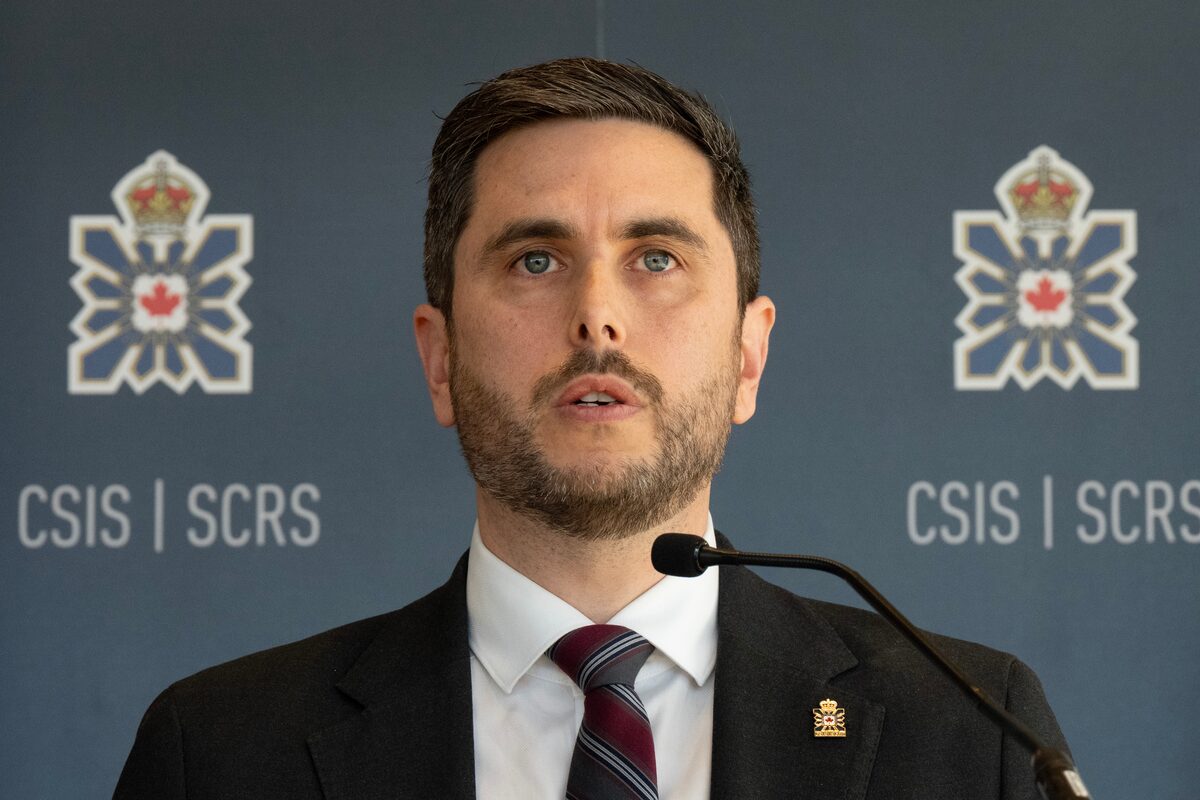
CSIS Director Daniel Rogers.Adrian Wyld/The Canadian Press
China and Russia continue to target Canada for sensitive government and private-sector intelligence and high-tech goods and are seeking to gain a strategic foothold in the Arctic, the country’s spy agency head said Thursday.
The warning about China was laid out as Prime Minister Mark Carney has embarked on a diplomatic effort to repair relations with Beijing, including a planned trip to the country next year at the invitation of President Xi Jinping.
“Chinese spies have tried to recruit Canadians with information and military expertise,” Dan Rogers, director of the Canadian Security Intelligence Service, said in his annual speech on threats to Canada.
Mr. Rogers also warned that Russia and China “have significant intelligence interest” in Canada’s Arctic.
“It is not a surprise that CSIS has observed both cyber and non-cyber intelligence collection efforts targeting both governments and the private sector in the region,” he said.
CSIS director Dan Rogers.Sean Kilpatrick/The Canadian Press
The CSIS director also singled out Moscow for using illicit procurement schemes to purchase Canadian technology for Russia’s war against Ukraine.
Mr. Rogers said CSIS has informed several Canadian companies that “Europe-based front companies seeking to acquire their goods were in fact connected to Russian agents.”
“Once in Russia, these Canadian products are then used to support Russian military efforts in Ukraine and elsewhere,” he said.
He also referred to a Globe and Mail report last month that millions of dollars of Canadian technology have been shipped through a sprawling network of Hong Kong-based shell companies to Russia’s war machine.
The Washington-based Committee for Freedom in Hong Kong Foundation, in collaboration with the Raoul Wallenberg Centre for Human Rights, combed through Ukrainian battlefield forensics, Hong Kong public records and three years of Russian customs data.
The 49-page report maps out where Canadian electronic and aerospace parts appear in Russian weapons in Ukraine, who moves them and how Canada’s sanctions and enforcement measures have failed to stop the flow of technology to Moscow’s military.
A police expert examines the site of a Russian drone strike on Wednesday. Moscow was singled out by CSIS for using illicit procurement schemes to purchase Canadian technology for Russia’s war against Ukraine.Vyacheslav Madiyevskyy/Reuters
In his speech outlining threats to Canada, Mr. Rogers also pointed out that Iran has not abandoned its clandestine effort to carry out lethal threats against Canadians.
The Globe reported last year that Iran allegedly plotted to assassinate Irwin Cotler, a noted Canadian human-rights advocate and harsh critic of the clerical regime. The attempt on his life was foiled by law-enforcement authorities.
Mr. Cotler, a former Liberal justice minister, remains under RCMP security watch because of possible threats to his life from Iran.
The danger to other Canadians persists as well, although Mr. Rogers did not identify who the Iranian regime has been trying to kill.
“In particularly alarming cases over the last year, we’ve had to prioritize our operations to counter the actions of Iranian intelligence services and their proxies who have targeted individuals they perceive as threats to their regime,” he said. “In more than one case, this involved detecting, investigating and disrupting potentially lethal threats against individuals in Canada.”
The CSIS director also highlighted concerns about the rise in violent extremism, particularly among younger people.
“Worryingly, nearly one in ten terrorism investigations at CSIS now includes at least one subject investigation under the age of 18,” he said. “Fortunately, only a small number of youth or adults with extreme views resort to violence. But when they do, the consequences are devastating.”
Since 2014, Mr. Rogers said there have been 20 violent extremist attacks in Canada resulting in 29 deaths, and at least 60 victims. CSIS has disrupted 24 violent extremist actions since 2022, he said.
Mr. Rogers also raised alarm bells that Canadians’ data are increasingly being held in the hands of foreign governments and corporations in their jurisdictions.
He warned that some of these governments and corporations could “choose to act against Canada’s interest with new ways to weaponize data and information.”
A recent Treasury Board of Canada white paper said Ottawa can’t maintain full control over its data if its data-storage supplier is subject to the laws of another country.
The federal government can only maintain full legal control if it delivers the service itself or uses service providers that operate completely under Canadian jurisdiction, the paper said.