
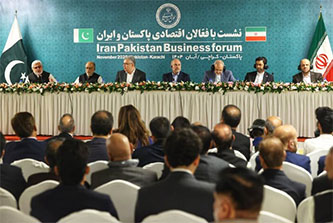
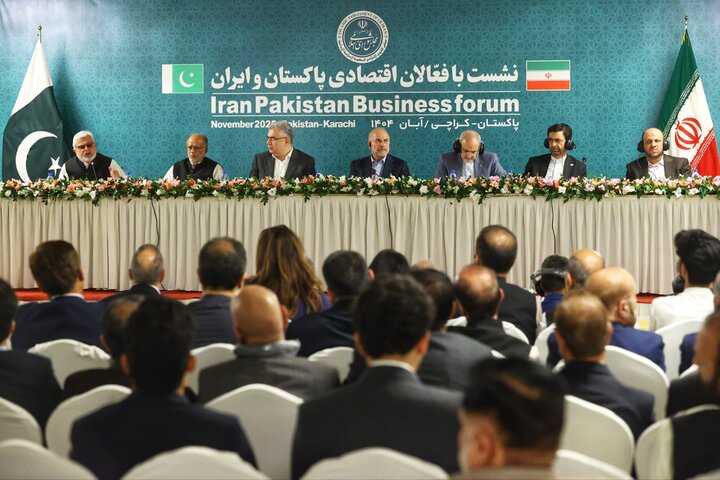
 Iranian Majles Speaker at the meeting in Pakistan (Mehr, November 7, 2025)
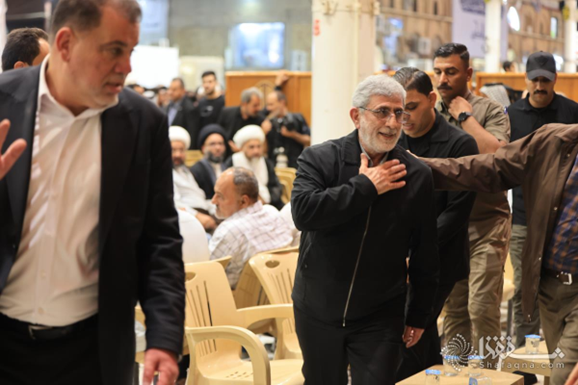 Qods Force commander Qaani visits Najaf, Iraq (ISNA, October 1, 2025)Highlights[1]
The Iranian Foreign Ministry strongly condemned the extensive attacks carried out by the IDF in Lebanon. Iranian media warned of Israel’s intention to conduct a large-scale operation against Hezbollah in Lebanon and threatened a harsh response from Hezbollah and the “resistance front” in case of such action.
The US Department of Treasury has stated that Iran has transferred one billion dollars to Hezbollah since the beginning of 2025. The Iranian Embassy in Beirut rejected the American claims.
Iranian Majles Speaker Mohammad Baqer Qalibaf called for a firm stance against Israel and for exacting a price from countries seeking to normalize relations with it. The Houthi leader accused the United States of being complicit in the Israeli “aggression” in the Gaza Strip even after the ceasefire. The Houthi chief of staff sent a letter to Hamas’ military wing, praising its victory over “the strongest empires.”
Iran has reportedly increased the supply of weapons, including missiles, to pro-Iranian Shiite militias in Iraq, in preparation for the possibility of a resumption of hostilities between Iran and Israel. It was also reported that the IRGC encourages major Shiite militias to integrate into Iraq’s political system while at the same time supporting smaller militias so they can continue military activity within the “resistance front.”
Mexican security forces thwarted an IRGC attempt to assassinate Israel’s ambassador to Mexico. Iran strongly denied the report.
Senior Houthi officials warned they are preparing for a new round of fighting against Israel and confirmed they have suspended their attacks against Israel and against vessels in view of the ceasefire in the Gaza Strip.
The Houthis claimed to have uncovered an espionage network operating on behalf of a “joint operations room” of Israel, the United States, and Saudi Arabia, which had been collecting intelligence on Houthi military and security infrastructure as well as senior government officials.
Iran and the Militias amid Developments in the Lebanese Arena
Iran
The Iranian Foreign Ministry strongly condemned the extensive attacks carried out by the IDF in Lebanon. The ministry’s statement said that the attacks by the “Zionist regime” against Lebanon have led, since the ceasefire at the end of November 2024, to the death and injury of over a thousand innocent Lebanese civilians, as well as the destruction of infrastructure and homes, constituting “blatant aggression” against Lebanon’s national sovereignty and territorial integrity and a “horrific crime” against international peace and security. The ministry emphasized the responsibility of the UN, the international community, and regional countries to confront the “escalation policy of the occupying regime” and punish it, warning of the dangerous consequences of the continuation of its “aggressive and imperialistic” policy on regional peace and security. It was also noted that “these criminal attacks,” undoubtedly planned and executed with full support and cooperation from the US, constitute further proof of the “criminal, terrorist, and hegemonic nature of the Zionist regime” and have no purpose other than weakening Lebanon’s sovereignty and security and preventing its reconstruction and development. The Iranian Foreign Ministry emphasized the Islamic Republic’s support for Lebanon’s “legitimate resistance” and the country’s efforts to maintain its sovereignty, security, and territorial integrity (Iranian Foreign Ministry Telegram channel, November 7, 2025).
Amid reports regarding the possibility of a large-scale Israeli operation against Hezbollah, the hardline Iranian daily Vatan Emrooz published an opinion piece titled “Fear of the New Hezbollah.” The article stated that since the ceasefire between Hezbollah and Israel in November 2024, the organization has managed to restore its capabilities; rebuild its military and political command structure based on the lessons of the war; create new and secure communications channels between senior command and lower-ranking commanders; acquire new military equipment, including upgrading drone systems; and make fundamental changes to its military strategy. Additionally, pressures to disarm it have been unsuccessful because of its strong social influence in Lebanon, its deep integration into the Lebanese Army, and the widespread fear across the Arab world, including in Lebanon, of Israel and its perceived expansionist ambitions in the region The article stated that a renewed military attack against Hezbollah would lead to a decisive response from it, which raises significant concern in Israel. Moreover, unlike the previous war, Hezbollah will not show restraint as it did in the past to avoid expanding the fighting to Beirut and exposing all its capabilities, but will employ all the means at its disposal and is even planning several surprises that will change the battlefield against Israel and affect the balance of power in the Middle East. According to the article, Prime Minister Netanyahu’s greatest nightmare in case of a new war against Hezbollah is that his claims regarding the elimination of the threat from Hezbollah will be shattered before the eyes of the Israeli public and the world, and a “new Hezbollah” will appear ready to demonstrate its strength. The “resistance front’s” response to another war between Israel and Hezbollah will not be limited to Iraq or Yemen, and it remains to be seen what decisions the “resistance commanders” will make at this stage, at what scale, and with what capabilities they will enter the arena. At the same time, the US presence alongside Israel and its support for it in an attack on Hezbollah will make American bases and forces in the region a legitimate target for the “resistance” (Vatan Emrooz, November 6, 2025).
In an opinion piece published on the hardline news site Alef, it was written that Israel seeks to intensify pressure on Hezbollah in Lebanon and present it with significant challenges. At the same time, the United States is trying to prevent Iran from acting significantly against the backdrop of the possibility of escalating regional confrontations in Lebanon or Iraq. According to the article, “the enemy” seeks to control the region but faces numerous obstacles. The “resistance front” still possesses many capabilities that instill fear in both the US and Israel. Therefore, it was noted that the path to ensuring peace and calm in the region passes through taking initiative and full readiness to confront the “adventures of the resistance front’s enemies” (Alef, November 8, 2025).
The US Department of Treasury reported that since the beginning of 2025, the IRGC’s Qods Force managed to transfer nearly one billion dollars to Hezbollah through money exchange agencies. Consequently, the Treasury Department imposed sanctions on two Hezbollah operatives and a Syrian businessman who were involved in the transfer of funds (US Department of Treasury website, November 6, 2025). The Iranian Embassy in Beirut denied the US claims regarding Iran’s involvement in Lebanon. In its statement, the embassy said that it would have been better if the American authorities had fulfilled their promises to the Lebanese people, such as finding a solution to the electricity crisis, instead of wasting their time on empty talk. The statement further said that instead of leveling baseless accusations against Iran, the United States should restrain “the malicious acts of the Israeli regime and its barbaric and ongoing aggression against Lebanon and its people” (ISNA, November 11, 2025).
The Houthis
Houthi leader Abd al-Malik al-Houthi, in a recorded speech before the 34th session of the Arab National Conference held in Beirut, addressed the issue of Hezbollah’s disarmament. According to al-Houthi, “the Israeli enemy” is attempting to strip away the weapons that defend Lebanon, as well as those that have, for the past two years, prevented Israel from controlling the Gaza Strip. He said that “the acts of aggression by the enemy” in “Palestine,” in Lebanon, and throughout the region are clear facts within the framework of its plan, and that the supporters of “the Israeli enemy” are cooperating with it regardless of the terrible losses inflicted on the Arab nation (Al-Masirah, November 7, 2025).
The Houthi political bureau strongly condemned the “ongoing Israeli aggression in Lebanon.” In its statement, the bureau said that the negligence of the Lebanese government and its failure to respond to the “enemy’s” attacks encouraged Israel to violate Lebanese sovereignty and renege on its commitments. The statement further noted that the Houthis emphasize their full support for Beirut’s right to resist the “Israeli aggression” and call on the international community to demonstrate genuine solidarity and support Lebanon (Saba News Agency, November 6, 2025).
Iran and the Militias amid Developments in the Palestinian Arena
Iran
Majles Speaker Mohammad Baqer Qalibaf said in a meeting with businessmen during his visit to the city of Karachi, Pakistan, that it is imperative to take a firm stand against the “Zionist regime.” He stated that the “Zionist regime,” which he called a “cancerous growth,” has exerted heavy pressure on the Muslim world since 1948, especially on the Palestinian people, and has carried out “acts of killing and crimes” that culminated in the Gaza Strip. He added that the Palestinian issue is not only an Islamic matter but a humanitarian and global one. Qalibaf said the “Zionist regime” understands only the language of force and seeks to eliminate every independent and strong Muslim state in the region because it views them as a threat to its existence. The Speaker of the Majles noted that the Islamic nation must exact a heavy price from countries seeking to normalize relations with Israel (Mehr, November 7, 2025).
Iranian Majles Speaker at the meeting in Pakistan (Mehr, November 7, 2025)
The Houthis
Houthi movement leader Abd al-Malik al-Houthi claimed in a speech that “the Zionists continue their aggression and killing” even after the ceasefire agreement in the Gaza Strip, accusing them of not honoring the terms of the agreement. He added that the United States, which guaranteed the agreement, is complicit in Israel’s “crimes” in the Gaza Strip, while the other guarantors stand by helplessly (Telegram channel of the Houthi movement, November 4, 2025). In another speech before the 34th session of the Arab National Conference held in Beirut, al-Houthi said that it is regrettable that some members of the Islamic nation still ignore and shirk their responsibilities at this stage, as well as toward the “Zionist aggression” that has been taking place over the past two years in the Gaza Strip (Al-Masirah, November 7, 2025).
The new Houthi chief of staff, Yusuf al-Madani, sent a letter to Hamas’ military wing thanking the movement for its condolences following the death of the previous chief of staff, Muhammad Abd al-Karim al-Ghamari, who was killed in an Israeli strike. Al-Madani praised Hamas’ steadfast stance, its determination, and its victory over “the strongest empires of wealth, weapons, and technology,” while forcing its enemies to negotiate with it after they realized they could not eliminate the movement. Al-Madani also made clear that they are determined to stand firm alongside Hamas, no matter what they must sacrifice for this purpose (Telegram channel of the Houthis’ combat media arm, November 9, 2025).
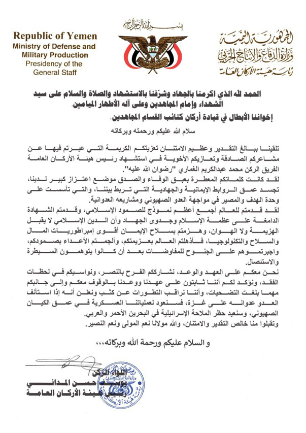
Letter from the Houthi chief of staff to Hamas’ military wing
(Telegram channel of the Houthis’ combat media arm, November 9, 2025)
Iran and the Iraqi Arena
“Political sources in Iraq” noted that in recent months, the IRGC has been examining, together with some of the major pro-Iranian Shiite militias, the possibility of focusing their efforts on the Iraqi political arena. This is in light of the growing pressures from the central government in Baghdad and the United States on the militias. According to the report, at the same time, Iran is working to encourage and support small Iraqi militias that do not belong to the Popular Mobilization Forces (the umbrella framework of pro-Iranian Shiite militias) so they can continue military activity within the framework of the “resistance” (Amwaj Media, November 3, 2025).
A “security source in Iraq” revealed that Iran has increased its supply of weapons to the main pro-Iranian militias in the country over the past two months, including ballistic missiles and thousands of drones far more advanced than those the militias used in their launches toward Israel during the war in the Gaza Strip. According to the report, this trend followed two secret visits to Iraq in recent weeks by Qods Force commander Esmail Qaani. Qaani emphasized to the militias that they would play a central role in any future confrontation between Iran and Israel or the United States, and that the IRGC relies primarily on the Iraqi front more than on any other front in the region. He added that the new weapons Iran has begun transferring to the militias will constitute a key component in any future confrontation, since Tehran assesses that another round of fighting may turn into a long and painful war. According to the Iraqi source, Iran is seeking to concentrate its influence operations in Iraq in response to the setbacks faced by its proxies in Lebanon and the Gaza Strip, and in light of the collapse of the Assad regime in Syria. The report further stated that in addition to the military dimension, Iran is also trying to consolidate its influence in Iraq through the parliamentary elections (held on November 11, 2025). According to the report, Tehran pressured the leader of the Sadrist movement, Muqtada al-Sadr, to boycott the elections and not participate in them, since his participation could harm the chances of victory for the Iran-backed Shiite “Coordination Framework.” It was also noted that Iran is planning a political move following the elections aimed at ensuring its full control over Iraq and enabling it to influence the identity of the next prime minister (Asas Media, November 6, 2025).
Qods Force commander Qaani visits Najaf, Iraq (ISNA, October 1, 2025)
In this context, Iraqi Defense Minister Thabet Muhammad al-Abbasi stated that he spoke with US Secretary of Defense Pete Hegseth, during which Hegseth announced “imminent military actions in the region.” Al-Abbasi also noted that Hegseth warned against interference by militias in Iraq in these operations. According to al-Abbasi, Hegseth said, “You know what the administration’s response will be in the event of such interference” (Al-Sharqiya, November 1, 2025).
Iranian Terrorism Against Israel
Mexican security forces thwarted an IRGC plan to assassinate Israel’s ambassador to Mexico, Einat Kranz Neiger. An “American source” reported that the Iranian plan was scheduled to be executed in the first half of 2025 and was thwarted last summer. The plan was led by Hassan Izadi, an operative in Unit 11000 of the Qods Force, who served for several years at the Iranian embassy in Venezuela and played a role in recruiting and managing Iranian agents in Latin America (Reuters; Axios, November 7, 2025). The Iranian embassy in Mexico strongly denied the reports. The statement claimed it is a “media fabrication and big lie” aimed at damaging the friendly and historic relations between Iran and Mexico (ISNA, November 8, 2025). Iranian Foreign Ministry spokesman Esmail Baghaei called the report “baseless and fabricated.” He noted it is an attempt by Israel to damage Iran’s relations with countries that adopt an independent policy and a moral stance toward “the Zionist regime’s crimes” (Iranian Foreign Ministry Telegram account, November 10, 2025). Following this, Israeli Foreign Minister Gideon Sa’ar revealed that additional Iranian attempts to target Israeli embassies, ambassadors, and diplomatic representatives abroad have been identified (Israeli media, November 11, 2025).
The Houthis in Yemen
Direct confrontation with Israel
Houthi movement leader Abd al-Malik al-Houthi reported that they recognize the importance of continuing to build their readiness for the next round of confrontation with “the enemy” and those who collaborate with it. In a speech delivered by al-Houthi, he made clear that they emerged from this round “stronger than before” and noted they are inevitably advancing toward another round of confrontation with “the Israeli enemy.” He emphasized that “we are a nation that is a target, whether we want it or not – nothing protects us except jihad.” He also incorporated antisemitic statements saying that “our most bitter enemies in this era are the Jews, who work, among other things, to destroy, corrupt, and enslave this nation,” and that “the Jews want to shift blame within the nation against those who do not accept their domination and do not submit to them” (Houthi movement Telegram channel, November 4, 2025)
In a letter sent by the new Houthi chief of staff, Yusuf al-Madani, to Hamas’ military wing, he emphasized that if “the enemy” renews its “aggression” against the Gaza Strip, the Houthis will return to military activity deep inside “the Zionist entity” and will restore “the ban on Israeli shipping” in the Red Sea and Arabian Sea. In doing so, he confirmed that the Houthis have suspended their attacks against Israel and against vessels due to the ceasefire in the Gaza Strip (Telegram channel of the Houthi combat media arm, November 9, 2025).
Hezam al-Asad, a member of the Houthi political bureau, published a statement in Hebrew following threats made in Israel against the Houthis. The statement read: “Those who will be removed from our region are the ones brought here by the Balfour Declaration, whose hands are stained with the blood of children and women. We are the destiny of God and the promise of the End of Days, and upon you is the curse of the eighth decade. We act under Allah’s guidance to liberate the weak from your corruption and crimes, and then it will become clear who will prevail in the end – the weak, who have the right, or you, the criminal occupiers” (Hezam al-Asad’s X account, November 2, 2025). In an interview, al-Asad stated that the Houthi movement is committed to the ceasefire agreement signed between the Palestinian “resistance” factions and Israel, including regarding Israeli ships in the Red Sea. He said that they continue to uphold it despite Israel’s “violations” in the Gaza Strip (Sputnik News Agency, November 12, 2025).
Muhammad al-Bukhaiti, a member of the Houthi political bureau, threatened that they would respond immediately to any “Israeli aggression” against them. He added that they would prefer direct confrontation as it “benefits us more than internal wars and will strengthen the nation’s unity” (Muhammad al-Bukhaiti’s X account, November 2, 2025).
Exposing a “spy network”
The Houthi Ministry of Interior announced that it had recently carried out a “high-quality security operation” that led to the capture of a joint espionage network belonging to the American CIA, the Israeli Mossad, and Saudi intelligence. It was further stated that the “operations room” of the spy network operated from Saudi Arabia, and that elements from the Israeli Military Intelligence Directorate and the Mossad were also involved in its activities. According to the statement, the espionage network operated to spy on Yemen and, in doing so, established numerous small cells that acted independently and received sophisticated equipment and tools from the network. The ministry added that the spy cells worked to expose the Houthis’ military and security infrastructure and to collect information on senior government, security, and military officials in Yemen. It was reported that these cells took part in several American and Israeli operations targeting “homes, markets, and public places.” Finally, the Ministry of Interior thanked the Yemeni people for their vigilance and called on them “to further increase their alertness in the face of the enemy’s actions, which aim to undermine security and stability” (Telegram channel of the Houthi Ministry of Defense, November 8, 2025). It was claimed that Nasser al-Shaybah headed the network, recruited and trained agents, carried out orders from the enemy’s operations center, and planted cameras to spy on citizens and national leaders (SA24 News website, November 11, 2025).
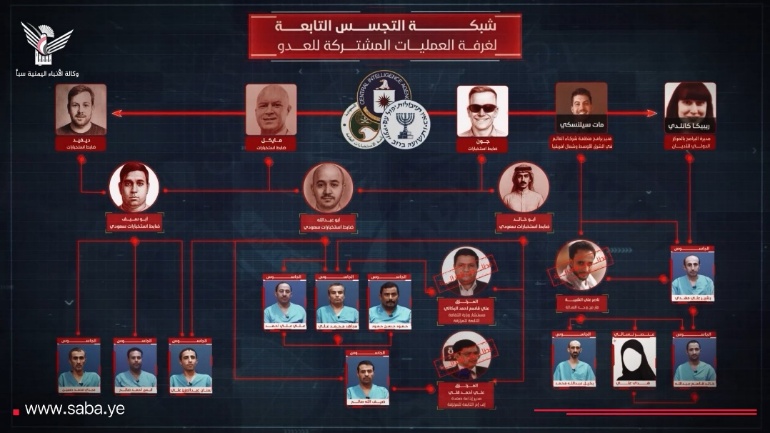
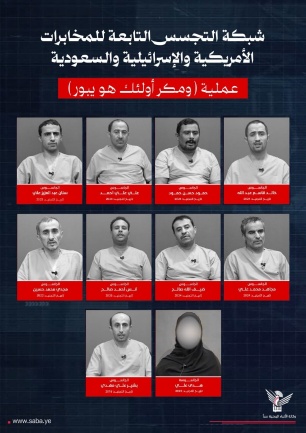
Members of the “spy network” and its command structure
(Saba News Agency Telegram channel, November 8, 2025)
Pro-Iranian Militias in Iraq
Disarming the militias
Iraqi Prime Minister Mohammed Shia al-Sudani reported that Iraq committed to transferring all weapons under state institutions, but this will not succeed as long as the international coalition, which some Iraqis view as an occupying force, remains in the country. He claimed there is a plan under which the international coalition will withdraw from Iraq by September 2026. He explained that “the threat from Islamic militant groups has significantly decreased,” and that there is no ISIS presence, and there is security and stability in the country, and therefore, there is no reason for the presence of foreign forces. Al-Sudani added that there will “certainly” be a clear plan to end the possession of weapons outside state institutions. He noted that groups that lay down their weapons will be able to integrate into official security forces and engage in politics in Iraq. He emphasized that Iraq is clear in its position to maintain security and stability – no one can drag it into the conflict (Reuters, November 3, 2025).
In response to al-Sudani’s words, the US State Department spokesperson called on the Iraqi government to disarm the militias. According to him, confronting pro-Iranian militias is the duty of the Iraqi government and is not related to the presence of American forces or the future of the coalition. The spokesperson referred to the militias as “terrorists” and claimed they harm Iraq’s relations with the US, neighboring countries, and the international community (Shafaq News, November 5, 2025).
[1] The weekly study includes the activities of Iran, the Shiite militias in Iraq, and the Houthis in Yemen.
Related Articles