


Listen to this article
Estimated 5 minutes
The audio version of this article is generated by text-to-speech, a technology based on artificial intelligence.
Prime Minister Mark Carney on Thursday announced seven more initiatives he’s recommending for fast-tracked approval by the government’s Major Projects Office (MPO) — including multibillion-dollar energy and natural resources proposals that Ottawa hopes will deliver a jolt to the tariff-hit economy.
Carney said this latest round of projects will help the country become more economically self-sufficient, in the face of U.S. aggression, and a powerhouse player in high-demand critical minerals.
The seven initiatives, combined with the five Carney recommended for approval in September, are worth a combined $116 billion to the economy, according to government figures.
Carney said each of the projects are “transformational” and will help Canada realize its “full potential as an energy superpower” while creating new economic and trade corridors to steer the country away from the U.S.
“Many of Canada’s strengths — based on close trade ties with the U.S. — have become our vulnerabilities,” Carney said. “With the world changing rapidly, Canada must change our economic strategy dramatically.”
WATCH | ‘This is real work:’ PM says: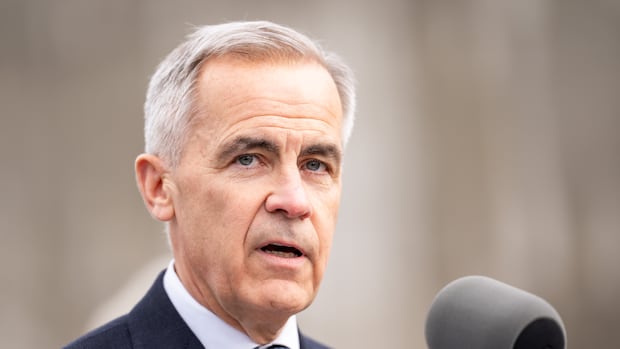
‘This is real work:’ PM says Major Projects Office will increase success, speed of federal projects
Prime Minister Mark Carney announced on Thursday a second tranche of federal projects to be referred to the newly created Major Projects Office (MPO). Carney said the MPO, which aims to fast-track project approvals, creates ‘a huge opportunity’ for local regions.
The MPO, created by Carney’s government this summer, will help shepherd the projects across the finish line, says Dawn Farrell, the federal body’s president and CEO.
Farrell’s team will streamline the approvals process, help proponents with the necessary Indigenous consultations, work to attract investor dollars to get these projects through to completion and co-ordinate labour supply, among other tasks, which will vary from project to project, Farrell said.
Here are the six projects and one concept being referred to the MPO:
Looking into the projects
The transmission line in B.C. is designed to deliver low-cost, clean electricity and better telecommunications to communities along the West Coast. It also includes a possible B.C.-Yukon link, to connect that territory to the larger Canadian electricity grid.
The Canadian Infrastructure Bank will loan B.C. Hydro, the line’s proponent, some $139 million to help get the project built.
That transmission line will also be used to deliver electricity to Ksi Lisims LNG on Pearse Island, B.C., an Indigenous-led $30-billion liquified natural gas (LNG) facility.
That project, which is being co-developed by the Nisga’a Nation, will produce some 12 million tonnes of LNG per year to be shipped to clients mostly in Asia.
Ksi Lisims LNG, along with previously approved LNG Canada phase 2 expansion in Kitimat, B.C., is part of the federal government’s plan — with support from the B.C. NDP — to turbocharge LNG development given strong demand from clients overseas for the fossil fuel.
The proponents, which include the Nisga’a’s U.S.-based partner Western LNG, say the project will employ about 800 construction workers and roughly 350 personnel when operational while also contributing about $3 billion to the economy.
They also maintain the project will be cleaner than other liquefaction plants elsewhere because it will be largely powered by hydro-electricity — allowing it to be net-zero by 2030.
Still, environmentalists panned Carney’s decision to back this project. Environmental Defence called it a “harmful and unnecessary project” that has not earned the consent of some of other Indigenous peoples in the area. The David Suzuki Foundation said LNG facilities like this one “fuels the climate crisis.”
Among the other projects approved are Canada Nickel’s Crawford Project in Timmins, Ont., which is a new mine that will produce some 240,000 tonnes of ore per day, integral to making batteries and steel.
Nouveau Monde Graphite’s Matawinie Mine, in Saint-Michel-des-Saints, Que., is a $1.8-billion graphite mine that will provide important inputs for defence applications and battery supply chains.
Northcliff Resources’ Sisson Mine in Sisson Brook, N.B., will produce tungsten, a critical mineral essential for high-strength steel production, defence and industrial applications.
The Iqaluit Nukkiksautiit Project will be Nunavut’s first entirely Inuit-owned hydro energy project, meant to replace the territory’s reliance on 15 million litres of imported diesel each year, much of it from the U.S.
The Northwest Critical Conservation Corridor, meanwhile, is not a specific project but is nonetheless being referred to the MPO, because the government wants it to explore the corridor’s potential for economic development given the huge deposits of critical minerals in the area.