
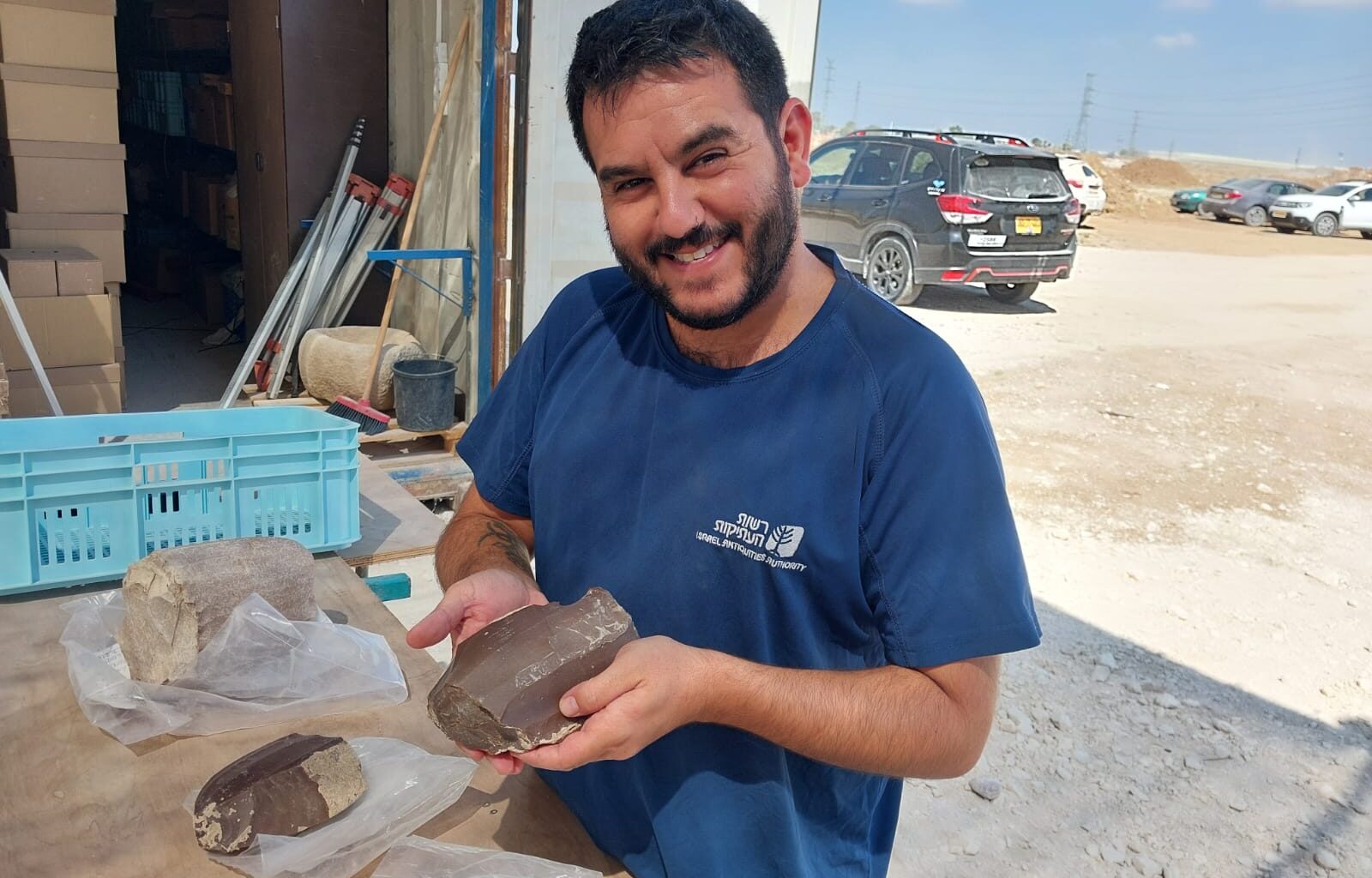
A rare manufacturing workshop for Canaanite blades — distinct flint tools primarily used for agricultural tasks — has been uncovered at Nahal Qomem, near the southern Israel city of Kiryat Gat, the Israel Antiquities Authority (IAA) announced on Monday.
“This is the first time a Canaanite workshop has been uncovered in its full context,” Dudu Biton, an IAA expert on flint tools and Canaanite blades, told The Times of Israel by phone. “It’s truly extraordinary.”
Dating to the Early Bronze Age, approximately 5,500 years ago, the site features hundreds of subterranean pits, some of which are lined with bricks.
The sheer quantity of artifacts, along with the flint cores used to produce them, offers invaluable insight into the early stages of urbanization and the rise of trade specialization in ancient Israel.
“Canaanite blades and cores had been uncovered in other sites across Israel, but only isolated ones and out of context,” said Biton. “This time, however, we’ve discovered not just a few, but hundreds of them, along with the full range of materials related to their production.”
Get The Times of Israel’s Daily Edition
by email and never miss our top stories
By signing up, you agree to the terms
The site was first identified around two years ago during preparatory work for a new neighborhood in Kiryat Gat.
“I remember when Martin [Pasternak], the head of the excavation, sent us a photo of three flint cores — we couldn’t believe that all three had been found in the same location,” Biton recalled. “Then more and more began to surface, and the site just kept expanding.”
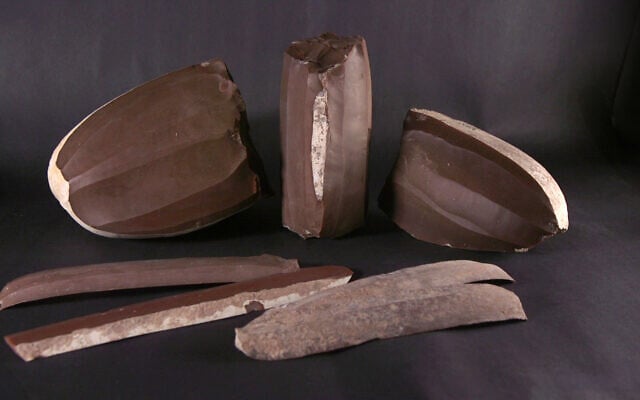
Flint blades and cores found at a 5500-year-old Canaanite manufacturing workshop uncovered at Nahal Qomem, near Kiryat Gat, in a discovery announced by the Israel Antiquities Authority announced on July 28, 2025. (Emil Aladjem/Israel Antiquities Authority)
Experts use the term “Canaanite” to refer to the Semitic population that inhabited the region for millennia, developing a local culture distinct from that of neighboring civilizations — most notably, during the Early Bronze Age, the Egyptians, who at the time dominated the area. Centuries later, the Canaanites would be recorded in the Bible and other ancient texts.
According to Biton, there is currently no evidence that Nahal Qomem was also home to a residential settlement.
“There are some remains of walls, houses, and small installations,” he said. “But if we’re talking about a large settlement, either it never existed, it was destroyed by modern development — especially since the area has seen extensive agricultural activity — or we simply haven’t found it yet.”
The main structures uncovered by archaeologists at the site are the numerous pits.
“There are many pits of various sizes and shapes, and they seem to have served different purposes,” Biton explained. “Some were likely used to store food and keep it cool, while others functioned as trash pits.”
The archaeologists also uncovered a cache of hundreds of unused blades buried together — a rare find.
“It’s only speculation at this point, but we’re exploring the possibility that this was some kind of ritual offering,” Biton said. “That could explain why so many unused blades were intentionally buried together.”
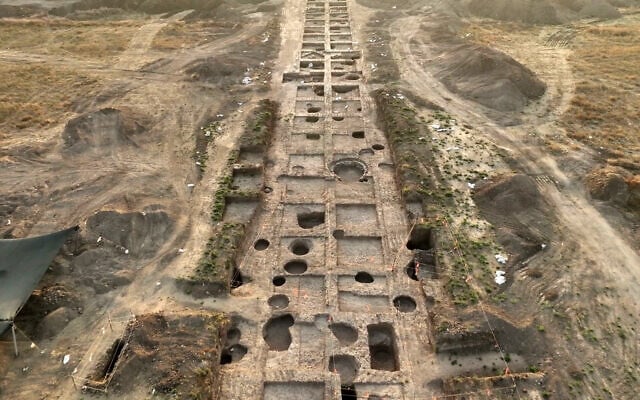
A rare 5500-year-old manufacturing workshop for Canaanite flint blades has been uncovered at Nahal Qomem, near Kiryat Gat, the Israel Antiquities Authority announced on July 28, 2025. (Emil Aladjem/Israel Antiquities Authority)
Extremely sharp, the blades required highly specialized craftsmanship to produce. They were primarily used as harvesting tools — especially as sickle blades — and occasionally served as butchering knives.
When asked whether they might have also been used as weapons, Biton said there is no evidence to support that.
“When the blade comes into contact with wheat or other vegetation, it develops a distinctive gloss along its side,” he explained, noting that this feature helps identify artifacts used for agricultural purposes.
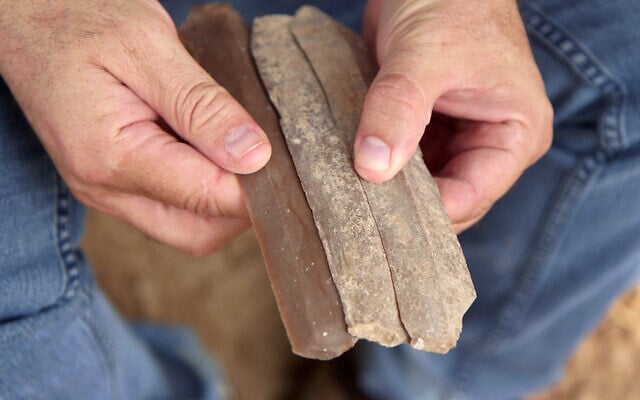
Flint blades found at a 5500-year-old Canaanite manufacturing workshop uncovered at Nahal Qomem, near Kiryat Gat, in a discovery announced by the Israel Antiquities Authority announced on July 28, 2025. (Emil Aladjem/Israel Antiquities Authority)
According to Biton, this type of tool remained in use for at least another thousand years — until the end of the Early Bronze Age, around 2000 BCE.
Excavations at Nahal Qomem are ongoing, with archaeologists hopeful that further digs and analysis of the artifacts will provide deeper insight into the ancient Canaanites — particularly the relationship between the blades workshop and the wider region.
“We are especially interested in determining whether the blades produced here were only used locally or traded to other sites across the region,” Biton said.
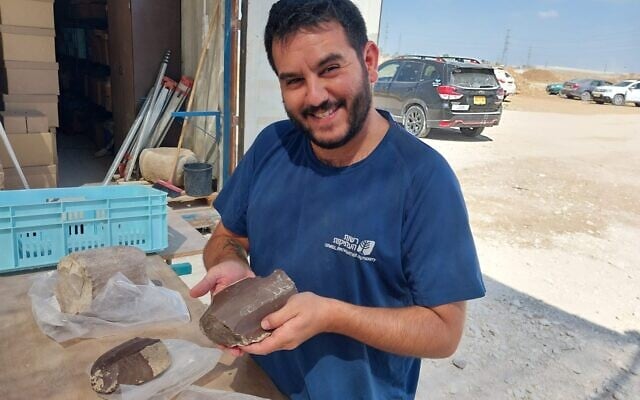
Dudu Biton from the Israel Antiquities Authority holds a flint core to manufacture Canaanite blades found at Nahal Qomem, near Kiryat Gat, in a discovery made public in July 2025. (Shira Lifshitz/Israel Antiquities Authority)
A geologist has identified that the flint used at the site originated from the Beit Guvrin area, roughly 15 kilometers (9 miles) away.
If blades discovered at other locations can be traced back to this workshop, it could reveal new perspectives on the connections between settlements and trade networks in ancient Canaan.
“We might not be able to find out,” Biton said, “but we hope that by the time we complete our analysis of all the excavation findings, we will know more.”
Is The Times of Israel important to you?
If so, we have a request.
Every day, even during war, our journalists keep you abreast of the most important developments that merit your attention. Millions of people rely on ToI for fast, fair and free coverage of Israel and the Jewish world.
We care about Israel – and we know you do too. So today, we have an ask: show your appreciation for our work by joining The Times of Israel Community, an exclusive group for readers like you who appreciate and financially support our work.
Already a member? Sign in to stop seeing this
You appreciate our journalism

You clearly find our careful reporting valuable, in a time when facts are often distorted and news coverage often lacks context.
Your support is essential to continue our work. We want to continue delivering the professional journalism you value, even as the demands on our newsroom have grown dramatically since October 7.
So today, please consider joining our reader support group, The Times of Israel Community. For as little as $6 a month you’ll become our partners while enjoying The Times of Israel AD-FREE, as well as accessing exclusive content available only to Times of Israel Community members.
Thank you,
David Horovitz, Founding Editor of The Times of Israel