
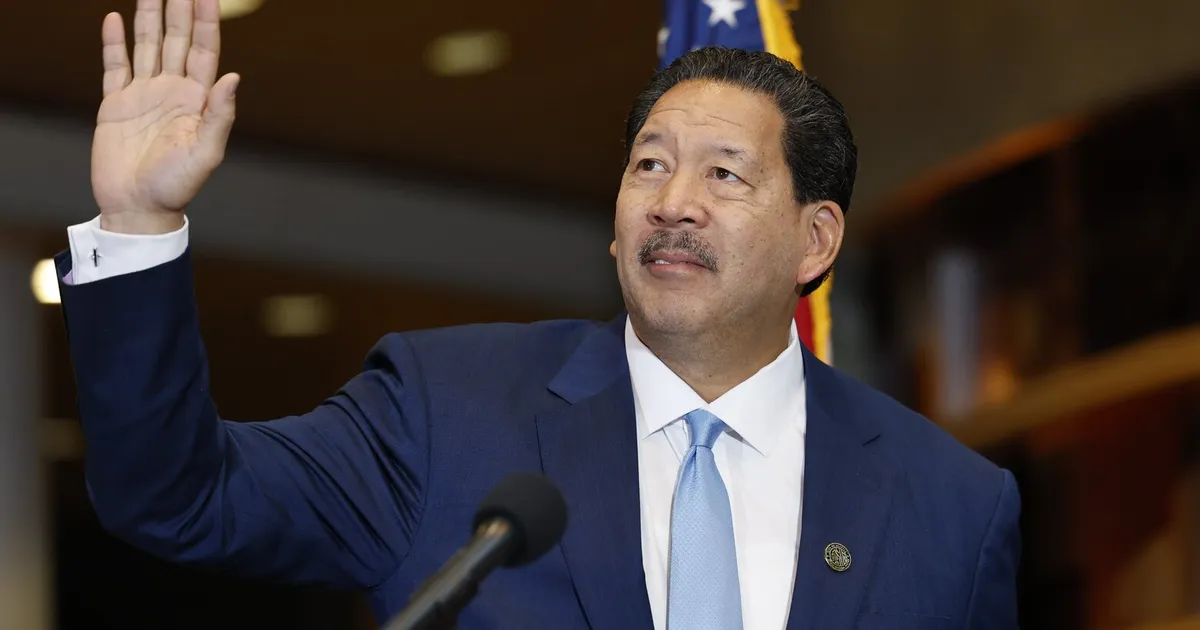
Before a crowd of supporters and staff in the lobby of City Hall, an emotional Mayor Bruce Harrell conceded the election Thursday, marking the approaching end of this chapter in his long political career in Seattle and kicking off the formal transition to Mayor-elect Katie Wilson.
He said he spoke to Wilson on Thursday morning to congratulate her and offer assistance with her transition.
“The Wilson administration will have new ideas,” he said. “It will have a new vision. By winning the election, they have earned that right. We must listen to the young voters.”
The race was over Wednesday evening, when the gap between Harrell and Wilson exceeded the number of remaining ballots. But Harrell stayed quiet after the latest round of results, opting instead to speak directly to those who’d surrounded him during his nearly four years as mayor.
Harrell had hoped to break the streak of one-term mayors, but is on track to fall roughly 2,000 votes short — the closest mayoral race in modern Seattle politics.
As Harrell walked onto a stage set out for his farewell speech, he received a thunderous ovation from the hundreds of staff, department heads and members of City Council who had gathered to see him off.
His speech was an optimistic, if at times defiant, one in which he rattled off his achievements and thanked those around him.
“This job does not belong to one person,” he said. “It certainly didn’t belong to me. I simply borrowed the title of the mayor to enjoy a wonderful opportunity to serve the people. And it’s been my absolute honor, the honor of my lifetime, to serve in this role.”
Shortly after Harrell finished speaking, Wilson held her own news conference at the Seattle Labor Temple in Sodo, where she fully accepted the role of mayor for the first time.
“I am delighted — beyond delighted — to be your next mayor,” she said. “It is an honor and a privilege that I will do my very best to be worthy of.”
Wilson thanked Harrell for his phone call, as well as his speech, and congratulated him on his nearly two decades in service. She said she also heard from Gov. Bob Ferguson and King County Executive-elect Girmay Zahilay.
Regarding her election, she acknowledged the “anxiety and fear” some may feel. She promised to work to ease those fears.
“I know that we are in this together, and we cannot tackle the major challenges facing our city unless we do it together,” she said.
That the race was so close was itself a bit of a comeback for Harrell, who finished nearly 10 percentage points behind Wilson in the primary. Nevertheless, Harrell will exit City Hall after three terms as a City Council member and one as mayor.
Harrell’s legacy in government is, in some ways, a complicated one. Though there’s a tendency to sort elected officials into de facto parties — labor and business, progressive and moderate, endorsed by The Stranger or The Seattle Times Editorial Board — Harrell never fit quite so cleanly into those categories.
Early in his time on the City Council, he was a voice for police reform and led the charge to equip officers with body cameras. He also helped outlaw questions about a person’s criminal history on tenant applications and voted against a proposal to crack down on panhandling.
As mayor, he pushed for and helped pass two of the city’s largest tax levies, for housing and transportation, while pitching a rewrite of the city’s business tax code to land more heavily on the city’s largest companies.
At the same time, he embraced a more law-and-order vision of Seattle during his 2021 campaign — promising to clear more homeless encampments and invest heavily in a larger police presence in the city. He loudly rejected any calls to cut the police budget, marking an end to a progressive demand of the 2020 protests.
As mayor, he gave police enormous raises over the last year while clearing significantly more encampments than his predecessors had.
Even with some late tacks to the left, Harrell was never a darling to progressives, who saw him as overly transactional at the expense of lasting solutions. And among some of those who voted for him in 2021, there was frustration that there was still so much criminal activity in areas like downtown and the Chinatown International District.
At the same time, voter priorities shifted between 2021 and 2025. Public safety, though still important, shared top billing with affordability — an issue Wilson built her campaign around and that Harrell only addressed head-on in the campaign after his disappointing primary.
The region’s real estate, development and business community threw everything it had at saving Harrell from being ousted. A committee on his behalf raised nearly $2 million — a mountain in Seattle elections — on the backs of major donations from developer groups, tech titans and the owners of the Seattle Mariners.
It would not be enough.
The campaign between Harrell and Wilson was ugly at times, with personal attacks between the two.
Nevertheless, Harrell struck a soft tone toward the incoming Wilson administration.
“For the Wilson administration, we may have different tactics on how to get there, but I believe our core values are the same,” he said, “and I cannot say that in other states. I cannot say that in other cities.”
Harrell is the son of a Black father who worked in city government and left the Jim Crow South, and a Japanese American mother who was held in an incarceration camp during World War II. He attended Garfield High School before becoming a star linebacker for the University of Washington Huskies. He went on to law school before spending years as a lawyer for a large telecommunications firm.
After starting his own practice, he ran for and narrowly won a seat on the Seattle City Council in 2007. He was elected two more times, including by fewer than 400 votes in 2015.
Election results 2025 | Election 2025
David Kroman: 206-464-3196 or dkroman@seattletimes.com. David Kroman is a reporter at The Seattle Times who covers politics and Seattle City Hall, focusing on the City Council, mayor, city attorney’s office and other city agencies.