
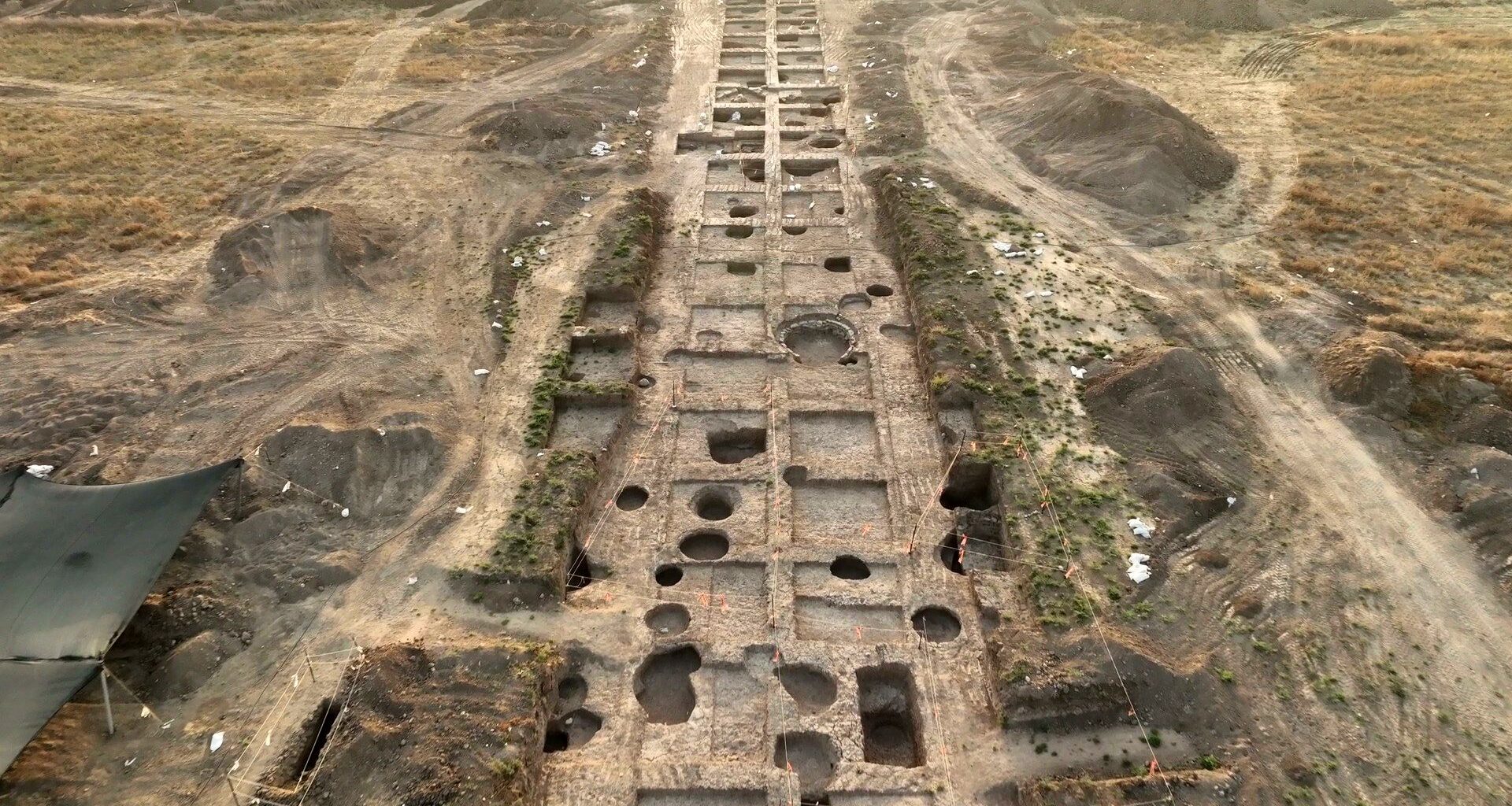
The Israel Antiquities Authority has uncovered an ancient blade manufacturing site, along with the flint cores from which the blades were once made, in an archeological excavation conducted ahead of the construction of a new neighborhood in the southern Israeli city Kiryat Gat.
The site was an advanced flint industry dating back approximately 5,500 years, offering evidence of the technological sophistication already around during the Early Bronze Age.
“The discovery of a sophisticated workshop indicates a society with a complex social and economic structure already at the beginning of the Early Bronze Age. This is an important find in that it deepens the understanding of both the beginnings of urbanization and of professional specialization in the Land of Israel – phenomena that led to the establishment of large settlements and that catalyzed the creation of new social structures,” said Dr. Martin David Pasternak, Shira Lifshitz and Dr. Nathan Ben-Ari, Excavation Directors on behalf of the Israel Antiquities Authority.
The ancient factory and its items were uncovered in an Israel Antiquities Authority salvage excavation, funded by the Israel Lands Authority, at the Naẖal Qomem site (aka Gat-Govrin, Zeita) before the construction of the new neighborhood of Carmei Gat commenced.
“This archaeological site we excavated was used as an active settlement continuously for hundreds of years – from the Chalcolithic period through to the Early Bronze Age,” added the excavation directors. “The excavation shows that the settlement covered a much larger area than previous estimates – over half a kilometer – and it includes hundreds of underground pits, some lined with mud bricks. These pits served a variety of purposes: storage, dwellings, production crafts and cultic/social rituals.”
The items unearthed at the site will be on display for the first time this summer as part of the tours at the Jay and Jeanie Schottenstein National Campus for the Archaeology of Israel in Jerusalem.