
 Jonathan Watts
If we continue destroying everything on this earth, there will be chaos
Sitting by the edge of a tree-lined lake in Belém, the world’s most venerable rainforest defender Raoni Metukire, articulated a message to Brazilian president Lula da Silva and the Cop30 delegates.
“Please reflect on Nature, on the Forest,” he said in a shaking but powerful voice. “Listen to me, and demarcate Indigenous territories, so that the forests can be protected by us, to guarantee our survival on this land in the future.”
The words of the Kayapo leader are intended as a reminder that this first Cop in the Amazon rainforest must reach far beyond the air-conditioned conference rooms and discussions of mechanisms, schedules and roadmaps.
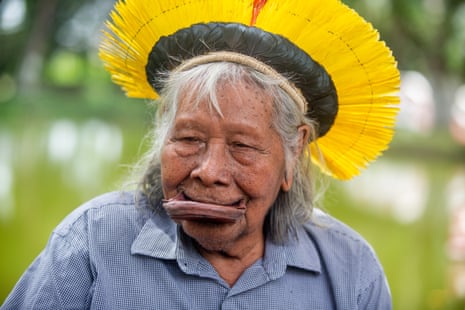 Raoni Metuktire attends Cop30 in Belem, Brazil. Photograph: Lela Beltrão/Sumauma
Recognised around the world for his distinctive lip disc and yellow-and-red feathered headdress, Raoni has been fighting for the Amazon since his youth. In the 1980s and 1990s, he built a global coalition of friends, admirers and supporters, including the rock singer Sting and Prince – how King – Charles of the United Kingdom, that encouraged the Brazilian government to demarcate swathes of Kayapo land.
Much of that is now under threat from illegal miners, land grabbers and the ravages of the climate crisis, which is pushing up temperatures, lengthening droughts and intensifying fires.
Raoni welcomed the climate summit as a chance to draw the world’s attention to these issues:
I think the first COP meeting in the Amazon can help the forest. We haven’t had an opportunity like this before. We can talk about what’s happening, the destruction, the deforestation. And I’m very happy, pleased, with this opportunity, which is important for all of us, to be able to speak, to be able to shout, so that the authorities can hear us. That’s important for us.
He also welcomed Brazil’s flagship initiative, the Tropical Forests Forever Fund, which has so far received promises of $5.5 bn of investment to conserve standing forests. For the first time, it was co-designed with Indigenous representatives and will include direct payments to indigenous and other traditional peoples for the work they do in maintaining this globally important ecosystem.
It will play an important role in defending the territorial rights of Indigenous peoples… [and] can strengthen our work and continue this fight that we are waging. For a long time I have been telling the world that if we continue destroying everything on this earth, there will be many consequences, there will be chaos on this earth.
Although Raoni is grateful to Lula for launching this initiative, he had harsher words for the government’s recent announcement that it would approve oil exploration off the Amazon coast. “These large projects that affect us, Indigenous people, and I don’t accept it, I don’t agree, because it’s a very bad thing for us.”
Raoni’s age is uncertain, but he is thought to be in his nineties. Although he now needs a wheelchair and travels with a nurse, he will continue to fight.
I will continue defending the Amazon rainforest. And also ask that people respect the Amazon, that the forests within the Amazon remain alive and contribute to our lives, contribute to our survival. I will continue fighting. As long as I can, I will continue fighting.
Updated at 12.59 EST
Key events
Show key events only
Please turn on JavaScript to use this feature
 Damien Gayle
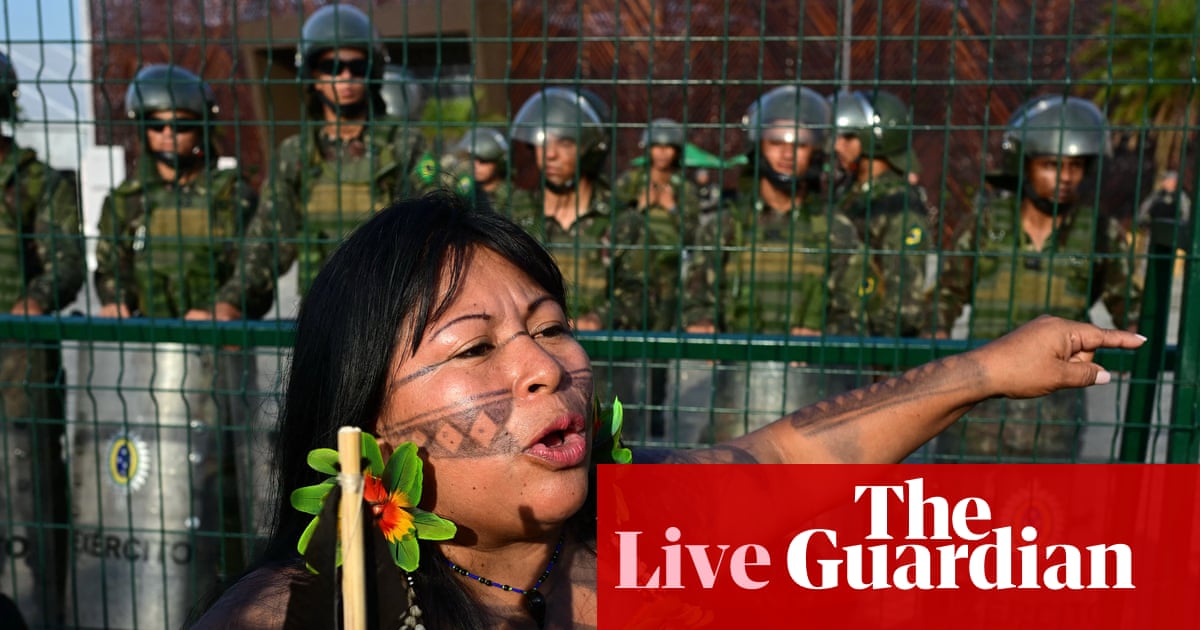
Indigenous activists bear the brunt of Cop30 militarization
Armed Forces with riot gear outside the the Cop30 conference venue on 14 November 2025. Photograph: Fraga Alves/EPA
My colleague Damien Gayle has been looking what’s behind the rise in armed security forces around the Cop30 venue. Spoiler: Simon Stiell
Civil society campaigners have said their ability to participate in Cop30 has been curtailed following a complaint by the UN climate chief to Brazilian authorities about security around the summit.
Designated protest spaces have been reduced, and numbers of armed security personnel around the conference centre where the summit is taking place have multiplied after Simon Stiell ordered the Brazilians to beef up security.
The shift in tone has been a disappointment to civil society groups who had hoped to for greater opportunities to communicate their messages in the first Cop summit in four years to be held in a democracy.
“There’s been a huge intensification of security,” Thomas Joseph of the Indigenous Environmental Network told the Guardian.
They are heavily armed as well, it’s not just riot gear like with batons and shields. They’re carrying weapons. And the military police is also here as well, and they have a tank out in front that you have to walk by in order to get in.
Joseph said the increased militarisation around the Cop begun on Wednesday, and then ramped up on Friday morning. He said Indigenous protesters had been particularly targeted by security forces.
We feel like we’re in a police state. We feel like we’re being overly policed and that they’re using intimidation tactics [to stop] being able to address the concerns that we find with Cop, with the operations of the UNFCCC.
Federal security forces outside the Cop30 venue after an entrance that was closed during an Indigenous-led demonstration was reopened, 14 Nov 2025 in Belem. Photograph: Fernando Llano/AP
Another campaigner, from the UK, said:
Now you can’t go anywhere without the really heavy military presence, which is quite intimidating. Inside it’s more militarised, too. It’s very tense. Security has ramped up massively. There was designated areas in which we [could] do actions, the next day they were cut down.
The increased securitisation follows a letter sent by Stiell to André Corrêa do Lago, the Cop30 president, on Wednesday outlining “urgent concerns” over security following an incident in which about Indigenous protesters and their supporters tried to gain access to the summit’s restricted zone.
According to the letter, now seen by the Guardian, about 150 protesters who had broken off from a sanctioned march “forced their way onto the UN premises causing damages to property and minor injuries to security staff tasked with securing the venue”.
Stiell complained that despite security pre-agreed security arrangements, security forces “failed to take action or enforce the agreed security plan” when protesters deviated from the arranged route of the march. Stiell wrote:
This represents a serious breach of the established security framework and raises significant concerns regarding compliance with the host country’s security obligations. The security forces and command structure required to execute the security plan were all present on the ground during the incident but failed to act.
Share Oliver Milman
Ana Toni, the chief executive of Cop30, has denied that this climate summit has not been inclusive to Indigenous communities – despite two separate protests in the past three days that have affected access to the Belem venue.
On Wednesday, protesters forced their way through security barriers and tussled with security guards and then, this morning, a group of around 50 people from the Munduruku community, an Indigenous people in the Amazon basin, blockaded the entrance for several hours. They only dispersed when André Corrêa do Lago, the Cop30 president, arrived to talk to them.
Toni said that the siting of the Cop in the Amazon rather than a major Brazilian city was to “celebrate” Indigenous people and claimed that it has been the most inclusive UN climate summit ever, with 900 Indigenous representatives accredited for the event.
We are in dialogue with them, they are there. We are probably going to hear from Indigenous people throughout this Cop, the reason to have a Cop in the Amazon is to hear from people who are most vulnerable, to embrace their different ways of protesting.
We will continue dialogue with the legitimate calls that indigenous people have, we are listening to them, the manifestation they had was legitimate. They were asking about processes not just about Cop but national policies.
We have been debating throughout with indigenous people, I think they feel included.
Munduruku Indigenous people, members of the Ipereg Ayu movement, shout slogans while blocking the entrance to the Cop30 venue on 14 Novembe 2025. Photo by Pablo PORCIUNCULA / AFP) Photograph: Pablo Porciúncula/AFP/Getty Images
This is in stark contrast to what Munduruku protesters, upset at plans to privatize rivers in their region, said this morning. “We were always barred, we were never listened to,” one community member said. “Enterprise is being brought without our ears. Every type of venture is being invested without listening to us.”
Security has been noticeably beefed up in the past few days, with large numbers of soldiers and riot police deployed on the roads leading to and around the convention center. Toni said that people will still be able to protest and fully access the talks despite the influx of military and police.
Updated at 13.32 EST
Dharna Noor
The US is mostly absent from Cop30 thanks to the Trump administration exiting Paris and boycotting proceedings, as well as the federal government shutdown which just ended after a record 43 days.
Dharna Noor, a Guardian US environment reporter, sat down with the only federal lawmaker who has made it, Sheldon Whitehouse, a Democratic senator for Rhode Island and long-time climate action advocate. Whitehouse said that the US absence might actually benefit negotiations:
When you consider how horribly corrupt the Trump administration is on this subject, it’s probably actually a great relief to everyone that they’re not here.
Senator Sheldon Whitehouse speaks at the Climate Action Now rally at the US Capitol on 13 Sept 2021. Photograph: Michael Brochstein/SOPA Images/REX/Shutterstock
Some countries are also concerned about potential backdoor meddling from the US. At an international maritime organization (IMO) meeting last month, American officials thwarted the enactment of a proposed carbon fee by threatening tariffs on supportive countries and even menacing global delegates during coffee breaks.
The Trump administration destroying that is consequential. But behind the immediate effect is the foul spectacle of the power and might of the United States government being used to bully and intimidate and humiliate other countries to achieve a political goal for a bunch of donors. It was a double blow to US decency and prestige and a signal of what to expect.”
Asked whether the US can build back its rapidly declining reputation on the global stage, Whitehouse said “the economic effects of climate change” are forcing Americans to wake up to the realities of the warming world. Homeowners insurance prices amid increasingly destructive extreme weather events, as are utility costs – a trend expected to pick up speed as Trump shoots down clean energy growth.
The fossil fuel industry is the cause of the affordability problem. The quicker that becomes clear to Americans and the quicker the complicity of the Republican Party in that becomes clear to Americans, the quicker we’ll make the political correction so that we no longer have a government we have to apologize for.
Updated at 13.52 EST
Jonathan Watts
If we continue destroying everything on this earth, there will be chaos
Sitting by the edge of a tree-lined lake in Belém, the world’s most venerable rainforest defender Raoni Metukire, articulated a message to Brazilian president Lula da Silva and the Cop30 delegates.
“Please reflect on Nature, on the Forest,” he said in a shaking but powerful voice. “Listen to me, and demarcate Indigenous territories, so that the forests can be protected by us, to guarantee our survival on this land in the future.”
The words of the Kayapo leader are intended as a reminder that this first Cop in the Amazon rainforest must reach far beyond the air-conditioned conference rooms and discussions of mechanisms, schedules and roadmaps.
Raoni Metuktire attends Cop30 in Belem, Brazil. Photograph: Lela Beltrão/Sumauma
Recognised around the world for his distinctive lip disc and yellow-and-red feathered headdress, Raoni has been fighting for the Amazon since his youth. In the 1980s and 1990s, he built a global coalition of friends, admirers and supporters, including the rock singer Sting and Prince – how King – Charles of the United Kingdom, that encouraged the Brazilian government to demarcate swathes of Kayapo land.
Much of that is now under threat from illegal miners, land grabbers and the ravages of the climate crisis, which is pushing up temperatures, lengthening droughts and intensifying fires.
Raoni welcomed the climate summit as a chance to draw the world’s attention to these issues:
I think the first COP meeting in the Amazon can help the forest. We haven’t had an opportunity like this before. We can talk about what’s happening, the destruction, the deforestation. And I’m very happy, pleased, with this opportunity, which is important for all of us, to be able to speak, to be able to shout, so that the authorities can hear us. That’s important for us.
He also welcomed Brazil’s flagship initiative, the Tropical Forests Forever Fund, which has so far received promises of $5.5 bn of investment to conserve standing forests. For the first time, it was co-designed with Indigenous representatives and will include direct payments to indigenous and other traditional peoples for the work they do in maintaining this globally important ecosystem.
It will play an important role in defending the territorial rights of Indigenous peoples… [and] can strengthen our work and continue this fight that we are waging. For a long time I have been telling the world that if we continue destroying everything on this earth, there will be many consequences, there will be chaos on this earth.
Although Raoni is grateful to Lula for launching this initiative, he had harsher words for the government’s recent announcement that it would approve oil exploration off the Amazon coast. “These large projects that affect us, Indigenous people, and I don’t accept it, I don’t agree, because it’s a very bad thing for us.”
Raoni’s age is uncertain, but he is thought to be in his nineties. Although he now needs a wheelchair and travels with a nurse, he will continue to fight.
I will continue defending the Amazon rainforest. And also ask that people respect the Amazon, that the forests within the Amazon remain alive and contribute to our lives, contribute to our survival. I will continue fighting. As long as I can, I will continue fighting.
Updated at 12.59 EST
Arina Bilai, a Fridays for Future activist from Ukraine. Photograph: Dharna Noor/The Guardian
Here’s more from the youth-led protest which my colleague Dharna Noor attended earlier
Arina Bilai, a Fridays for Future activist from Ukraine, reminded the crowd that that “Russia’s war on Ukraine is still happening”.
Just today, Russia attacked Ukraine.
Arina was among many activists calling for an end to conflict as a key aspect of climate justice.
“What do we want? Climate justice. When do we want it? Now,” went the chant.
Updated at 12.19 EST
One in every 25 Cop delegate is a fossil fuel lobbyst
My colleagues in Belém have been reporting on the efforts Indigenous people are having to go to get their voices heard at the climate talks. Meanwhile more than 1600 fossil fuel lobbyists representing among the worst polluters on the planet are swanning around the corridors of power and negotiating rooms. This is despite the Brazilian presidency claiming this would be the Indigenous Peoples Cop.
Munduruku Indigenous people of the Ipereg Ayu movement demand to meet Brazilian President Luiz Inacio Lula da Silva to discuss their plight in the Amazon at the Cop30 conference on 14 November 2025.
(Photo by MAURO PIMENTEL/AFP via Getty Images) Photograph: Mauro Pimentel/AFP/Getty Images
Tom BK Goldtooth, executive director of the Indigenous Environmental Network, told the Guardian:
The NDCs at this COP30 were supposed to be the ones to align with the 1.5⁰ C climate limit that science and climate justice demand. But no, this is the conference of the perpetrators representing more than 1600 fossil fuel lobbyists given access to COP30.
It is unethical to give access to these Big Polluters that continue a road of ecocide, terracide and genocide against Mother Earth, Father Sky, nature and humanity. It is immoral to call this the Indigenous Peoples Cop when local Indigenous Peoples are forced to lift their voices to gain entry when the fossil fuel lobbyists can freely waltz in with no struggle.
Pim Sullivan-Tailyour from the UK Youth Climate Coalition said:
To achieve a just transition, we must create the conditions by which fossil fuels can no longer have the social license to continue business as usual, making billions in profit, dwarfing the climate finance countries are scrambling to agree on. While local indigenous peoples struggled to enter the conference, fossil fuel lobbyists walk in freely. My generation deserves Just Transition policies that reflect what people and planet need, not what polluters’ profits demand.
Updated at 12.00 EST
Good afternoon friends and colleagues in Belém – and our readers across the world. This is Nina Lakhani in New York City taking over the blog for the next few hours. Thanks to Matt Taylor, he’ll be back with you next week.
Boa tarde, amigos e colegas em Belém – e nossos leitores em todo o mundo. Aqui é Nina Lakhani, em Nova York, assumindo o blog pelas próximas horas. Graças a Matt Taylor, ele estará de volta na próxima semana.
Brazil’s president has called Cop30 the “Cop of Truth,” and earlier this week 12 countries signed a Declaration on Information Integrity on Climate Change, marking the first time any states have formally committed to fighting against climate disinformation.
With this in mind it is worth reading this excellent piece from my Guardian colleague George Monbiot today, which uncovers the dark forces at work.
Share Fiona HarveyPresident Andre Correa do Lago holds a toddler during an indigenous protest at COP30 Photograph: Pablo Porciúncula/AFP/Getty Images
The sight of Andre Correa do Lago, president of Cop30, holding the baby of one of the protestors outside the conference centre on Friday morning, amid a heavy military presence and tense crowds, will surely be one of the abiding images of the Belem Cop.
The veteran Brazilian diplomat has been playing the same conciliatory role, minus infant, within the conference halls.
Delegates are stuck on the “big four” issues that emerged as countries tried to agree an agenda last Sunday, before the start of the two weeks of talks.
Do Lago’s idea was to hive off these issues – on climate finance; trade; transparency; and how to address the inadequacy of nations’ recently submitted national climate plans – into a separate set of “presidency consultations”, so that the rest of agenda could continue.
Now Brazil has gone a step further, by invoking the language of love and healing, to try to unstick the snarled-up consultations.
Delegates were reassured that the sessions were a “safe space”, where they could talk freely of their feelings about the contentious issues. They should think of the sessions not as negotiations but as “therapy”, where they would be listened to with empathy.
Do Lago wants parties to send him “love letters” – confidential missives, to be read only by the presidency, in which delegations can set out frankly their real feelings on the conduct of the negotiations and the issues, their fears and their hopes.
This is a new approach for Cops, where the restatement of entrenched positions is always far more likely than any kind of insight or forward movement.
But perhaps if negotiators can be encouraged to try to process the anger, grief and trauma of the last 29 Cops, they will be in better psychological shape to make some kind of progress at this one.
ShareOliver MilmanMaina Vakafua Talia, climate minister of Tuvalu Photograph: Oliver Milman/The Guardian
Of all the representatives from 193 countries present at crucial UN climate talks in Brazil, only one has summoned the courage to take the stage and publicly denounce the absent and hostile Trump administration – the climate minister of tiny Tuvalu.
On Monday, Maina Vakafua Talia told leaders and diplomats at the Cop30 summit that Trump had shown a “shameful disregard for the rest of the world” by withdrawing the US from the Paris climate agreement.
At a gathering where Trump has loomed large despite refusing to send a US delegation to Belem, Talia’s public rebuke is in stark contrast to mostly private murmurings from delegations aghast at attempts by America to halt climate action but wary of potential retribution from the White House.
“We can’t remain silent while our islands are sinking, we can’t remain silent while our people are suffering,” Talia told the Guardian. Tuvalu is a nation of atolls and reef islands in the south Pacific and is considered acutely vulnerable to sea level rise and fiercer storms caused by the climate crisis.
“The US has withdrawn from the Paris climate agreement and I think that’s a shameful thing to do,” he said. “We look to the US for options, for peace, but it seems they are going in the opposite direction and we should hold them accountable. Just because the US is a bigger country doesn’t mean we have to be silent. What matters to us is our survival.”
While other countries have been afraid to speak out, Talia doesn’t hold such anxieties, pointing out the Trump administration has already cut climate adaptation funding for his island nation. He said that he watched Trump’s speech to the UN in September, where the US president called the climate crisis a “con job”, and said he found it “entertaining.”
“The president is imposing sanctions, levies – for us, we have nothing to trade with the US,” Talia, who was wearing a geometric shirt and traditional islander teuga when we chatted. “This is a moral crisis. He has a moral duty to act, the world is looking at him, looking at the US.
“We listen to the president of the United States, we looked to find hopes and options but what we got was doom. It was condemning us and our ability to survive. We need the US in the equation, we need them to engage.”
Some more pictures from the conference in Belem which so far today has been dominated by protests – particularly by the demands of indigenous peoples who are calling on world leaders to listen to their concerns – rather than those of the ubiquitous fossil fuel lobbyists.
A group of indigenous protesters block the entrance to COP30 in protest at the destruction of their land Photograph: Fraga Alves/EPABrazilian indigenous leader and environmentalist chief Raoni during a protest boat trip at COP30 Photograph: Pablo Porciúncula/AFP/Getty ImagesMunduruku Indigenous people wait to meet Brazilian authorities during the COP30 Photograph: Mauro Pimentel/AFP/Getty ImagesMunduruku Indigenous women demand to meet Brazilian authorities during the COP30 Photograph: Mauro Pimentel/AFP/Getty ImagesShare
Dharna Noor
Joyce Koech, a youth climate activist, made the journey from Kenya to Brazil for Cop30 Photograph: Dharna Noor/The Guardian
Joyce Koech, a youth climate activist, made the journey from Kenya to Brazil for Cop30. The African continent is on the frontlines of the climate crisis, she noted.
“I’m here to for justice for my people, and also to highlight the atrocities in Sudan for everyone,” she said.
The ongoing war in Sudan has been exacerbated by the climate crisis, particularly the cycle of flooding and drought – a hallmark of global warming.
It’s not the only part of Africa being ravaged by climate and conflict, she noted: violence in the Congo has also been linked to environmental devastation. At Cop, she is calling on leaders to make those connections.
“We can’t address climate justice without addressing war,” she said. “We need leaders to see that.”
Updated at 09.15 EST
Oliver MilmanCOP30 President Andre Correa do Lago holds a Munduruku Indigenous toddler during a blockade of the conference on Friday. Photograph: Pablo Porciúncula/AFP/Getty Images
My colleague Oliver Milman has just filed this report on this morning’s blockade of Cop30.
Protesters demanding to speak to Brazil’s president about the plight of the country’s indigenous peoples blockaded the main entrance to the Cop30 venue here in Belem for several hours, eventually leading to an extraordinary meeting with André Corrêa do Lago, the summit’s chief.
A group of around 50 people from the Munduruku, an indigenous people in the Amazon basin, blocked the entrance with some assistance from international green groups. Behind them was a huge phalanx of riot police with shields, soldiers and military vehicles.
A huge swell of delegates and journalists jostled, sometimes aggressively, around the Munduruku as they sang and chanted, some holding babies or bows and arrows. They brandished signs reading ‘Munduruku indigenous territory is sacred. Enough of the invasion and disrespect’ and ‘No to predatory tourism in the territory of the Munduruku people.’
The group demanded to speak to Luiz Inácio Lula da Silva but instead had to settle for do Lago, the tall, amiable Cop president who spent over an hour listening and occasionally talking to the group’s representatives. At one point do Lago held one of the babies.
“We demand the presence of president Lula, but unfortunately we are unable to do so, as always,” said one of the protestors. “We were always barred, we were never listened to. Enterprise is being brought without our ears. Every type of venture is being invested without listening to us.”
Several protesters said that they were unhappy about their rivers being essentially privatized for commerce by Brazil’s government, a move they see as a threat to their way of life. Others mentioned they were being subjected to deforestation. mining and fish being killed by mercury poisoning.
“It’s not a negotiation meeting,” said one protester who spoke to the crowd. “We don’t negotiate the lives of our children, no. Ours was Munduruku. So we’re here to demand and we’re here to fight and know.”
She continued to say that “Brazil has a Constitution that does not respect the population” and that the privatization of rivers is “violating the right to our life, our culture and the way of life of the peoples.” She called the river “our lady” and said that “she is life, she is sacred. Nobody’s going to believe it here, bro. Nobody here is going to negotiate mining or work on our land.”
do Lago then held the hands of two of the protestors and led the entire group through a scrum of onlookers, some having to be pushed aside by the Munduruku so they could get past.
Amid the rather sweaty melee, I was able to get alongside a rather overwhelmed-looking do Lago and asked him what he had told the group. He just said “Yes, yes. I want to help, I want to help.”
The Cop president then led the entire Munduruku group to a building separate from the Cop venue, likely a presidential office, that sits behind a tall, secure gate. We will have to wait for the outcome of his talks with the group.
The venue has now reopened, albeit with a mass of people waiting in long lines to get in. A UN spokesman called the blockade a “peaceful demonstration” and that people should expect longer wait times. The incident comes after Simon Stiell, the UN’s climate chief, reportedly raised concerns with the Brazilian hosts about security, as well as air conditioning and the state of delegate offices, at Cop30.