
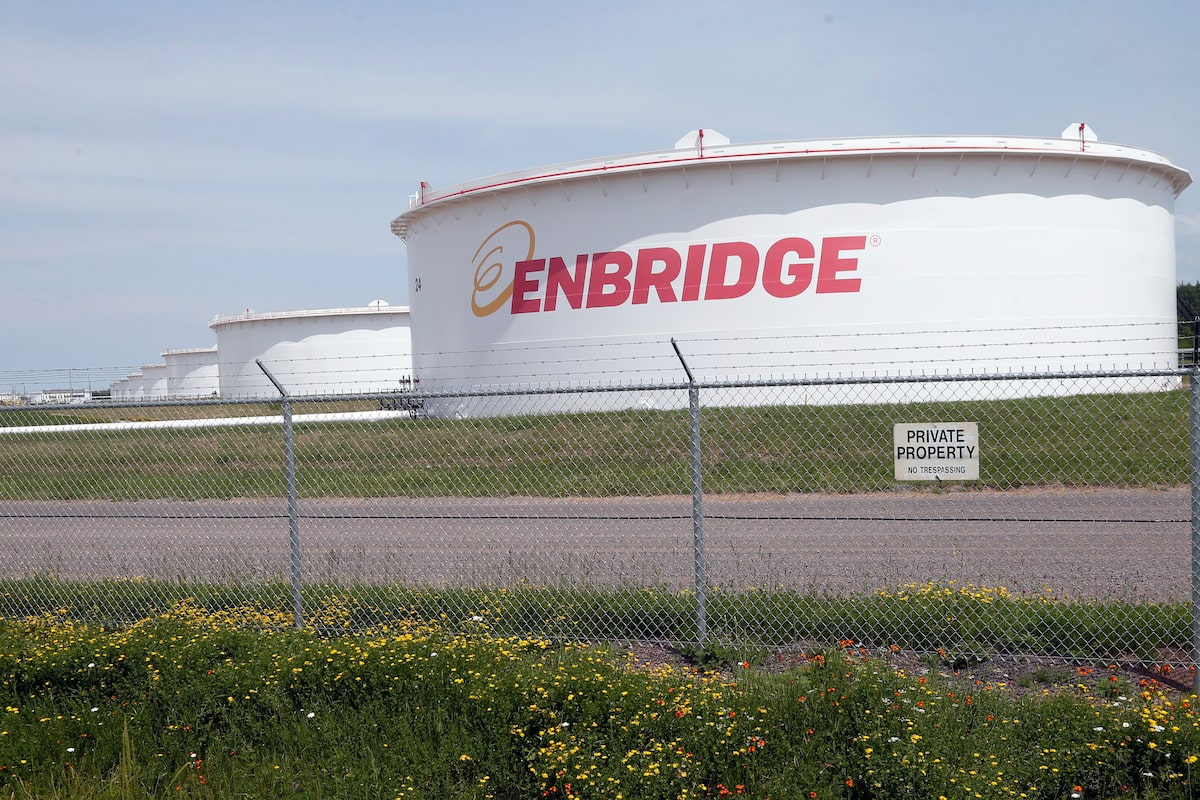
Enbridge has been tapped by Alberta to provide technical and regulatory expertise to help it with an application for a major new oil pipeline to the B.C. coast.Jim Mone/The Associated Press
Enbridge Inc. ENB-T will spend US$1.4-billion to increase capacity on two pipeline networks that connect the Alberta oil sands to U.S. refiners, it said Friday, underscoring the company’s focus on southbound systems to meet growing customer demand.
The Mainline Optimization Phase 1 project will boost capacity on Enbridge’s Mainline network and its Flanagan South Pipeline by roughly 250,000 barrels a day when complete in 2027. The company plans to use a combination of upgraded terminals, more pump stations and additives to help oil move faster through pipes to deliver more Canadian crude to the thirsty refining markets in the U.S. Midwest and Gulf Coast.
Enbridge is one of the companies that Alberta has tapped to provide technical and regulatory expertise to help it with an application for a major new oil pipeline to the B.C. coast.
Canadian companies are making energy-transition plans – but quietly
But Colin Gruending, president of liquids pipelines at Enbridge, said Friday that expanding access to the U.S. market makes the most sense right now.
Firstly, because there is huge demand for the heavy Canadian oil on which refiners south of the border rely to run their operations. Secondly, other foreign imports to the U.S. from Mexico and Venezuela are waning, giving Canadian crude a greater foothold, he said.
“While there is obviously interest in some other corridors … our view at this time is south first and west next,” Mr. Gruending told media.
A new pipeline to the West Coast would also take significant time to complete, he said, so “it makes sense to strengthen our relationship and grow our economy in the meantime.”
Enbridge has had two open “seasons” in the past seven months to solicit shipping commitments on its Southern Illinois Connector and Mainline systems. Both were oversubscribed, Mr. Gruending said, and he doesn’t see that changing any time soon as demand continues to grow.
Ottawa has increased its focus on building Canadian trade corridors and infrastructure in recent months.
Enbridge CEO urges Ottawa to remove barriers to building energy infrastructure
That includes establishing the Major Projects Office. It handles the regulatory fast-tracking of large energy, mining and infrastructure investments in a bid to shore up domestic supplies of minerals and expand Canada’s customer base in the face of the continuing trade war with the United States.
Asked whether Enbridge’s focus on the U.S. runs counter to Ottawa’s Canada-first policies, Mr. Gruending gestured to the Saskatchewan Roughriders jersey he was wearing ahead of Sunday’s Grey Cup.
“We’re all proud Canadians,” he said. But he added that the country needs to bolster its revenues any way it can, which means taking advantage of all potential customers for its fossil fuels.
“We’ve got this huge, trillions of dollars worth of reserve and resource that, if left, it’s kind of squandered,” he said.
While oil markets have been on edge in the face of a looming supply glut, Mr. Gruending said the consensus view is it would be temporary, and therefore unlikely to affect the Mainline project.
“We don’t really see a scenario where that would cause this pipe to be underutilized,” he said, even if chatter around reviving the cancelled Keystone XL pipeline project becomes a reality.
Alberta Premier Danielle Smith has long said she wants to see oil and gas production double in the province.
Alberta’s Danielle Smith says agreement with Ottawa expected to be signed in coming days
In January, she dangled the prospect of guaranteeing a “significant” volume of oil and gas for new or expanded pipelines in the hope of encouraging Enbridge to increase its transport capacity to the U.S. across the company’s more than 29,000 kilometres of pipelines.
She said at the time that guaranteeing barrels would give Enbridge and other companies the impetus to expand pipeline capacity, thereby encouraging producers to increase their output.
Mr. Gruending said Friday the oil and gas sector should ideally always have extra wiggle room in pipelines to get product to market.
“That’s not a luxury the basin has enjoyed the last 30 years, so we’re not used to it, but that’s a healthy dynamic.”
Analysts had widely expected Enbridge to give the Mainline optimization project a thumbs-up.
Their general consensus on Friday was that the decision would likely have a positive impact on Enbridge’s stock sentiment.
Maurice Choy at RBC Dominion Securities Inc. wrote in research note that the project reaffirmed Enbridge’s ability to introduce “capital-efficient and timely egress capacity from Canada,” and add incremental, low-risk projects to support its long-term growth outlook.
Aaron MacNeil at TD Securities echoed that the decision underscored Enbridge’s advantage in delivering oil from Canadian producers to refiners.