
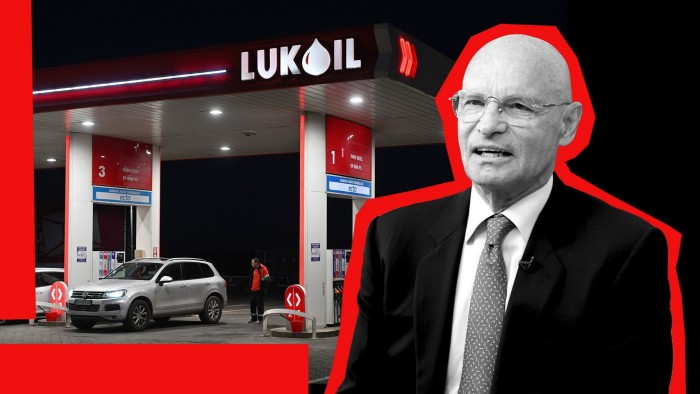
The billionaire commodities boss at the heart of an audacious bid for $22bn of Russian-owned oilfields, refineries and petrol stations arrived at the world’s leading energy forum last week confident and ready to talk.
Torbjörn Törnqvist, the 72-year-old head of trading house Gunvor, had earlier stunned the sector by swooping for Russian oil major Lukoil’s sprawling international business just days after it was hit by US sanctions.
The bold move was the talk of the Adipec conference in Abu Dhabi, as rivals asked whether Törnqvist — whose one-time Gunvor business partner Gennady Timchenko is a close ally of Russian President Vladimir Putin — was fronting for the Kremlin and safeguarding the assets until Lukoil could reclaim them.
Törnqvist came out fighting, defending his deal as a blow against Moscow, not a favour to it. “This is not something [we are doing] with Russia,” the Swede told the Financial Times. “This is something we’re taking away from Russia. It’s actually the opposite.”
He also promised a “clean break” from the past, insisting there was no path for Lukoil to buy back assets spanning the globe that it had spent decades acquiring. But he admitted one obstacle remained: persuading Washington.
“Certain things are not in our hands,” Törnqvist said.
By the end of the week, the US had reached its own verdict.
The Treasury posted a blunt message on X: “As long as Putin continues the senseless killings, the Kremlin’s puppet, Gunvor, will never get a licence to operate and profit.”
Gunvor immediately withdrew its offer in an attempt to limit the fallout, saying it had “always acknowledged that any deal would be 100 per cent contingent upon the approval” of the Treasury and enforcement agency Ofac.
“We believed our offer was in line with US sanctions and goals, which we support,” the company continued, adding it “wholly respects” Washington’s decision.
Yet the proposed deal, and its rapid collapse, sent nervous ripples through Gunvor’s trading partners and its lenders. Several of its banks, when contacted by the FT, reaffirmed their support, although one said it would “review new financing in a way we wouldn’t have previously”.
Santander, which initially participated in a $2.8bn loan for Gunvor’s US business, pulled out on news of the Lukoil transaction. “No other bank has made a request to withdraw from any other facility or reduce their existing credit lines,” Gunvor said.
Gunvor’s business has continued as normal, with other traders observing it in crude trading windows. But people in the industry said there would be reputational damage.
“Sooner or later, everyone will reconsider their relationship with Gunvor,” said Jean-François Lambert, a former head of commodity finance at HSBC. “If you ask me if Gunvor is now in a mess, they’re in a mess. Trying to do this deal was very naive.”
Lukoil was also at Adipec, where its stand featured a model of a globe under the slogan “Always moving forward”.
Sergey Kochkurov, Lukoil’s new chief executive who was appointed after his predecessor was blacklisted by the US, was at the event but Gunvor would not say whether Törnqvist met him.
The Russian oil major quietly began looking for buyers for its international business as early as 2023, according to several people familiar with the negotiations.
Gunvor was one of the parties in those early talks, which also included Azerbaijan’s Socar, KazMunayGas of Kazakhstan and MOL, the Hungarian state-owned energy group, alongside others.
US officials in charge of sanctions were regularly in touch with those involved, and visited the offices of Gunvor in Geneva and other energy traders to try to understand the impact of restrictions on Europe’s energy system.
“They were trying to give as much clarity as they could on what the rules were,” said Geoff Pyatt, former assistant secretary of state for energy resources, who was involved in the process.
 The Burgas refinery in Bulgaria is part of Lukoil’s sprawling international business © Nikolay Doychinov/AFP/Getty Images
But Lukoil saw little urgency in a deal. “Lukoil was holding out because they didn’t want to sell their asset at a discount,” Pyatt said of the Burgas refinery in Bulgaria that provides the majority of the EU country’s fuel.
One potential bidder, who travelled to Moscow for talks with Lukoil last year, said the negotiations stalled when the Russian side demanded the right to repurchase the asset for the same price at a later date.
Lukoil declined to comment.
The calculations changed on October 22, when President Donald Trump’s administration directly imposed sanctions on Lukoil and its rival Russian major Rosneft, and anyone doing business with them. “Now it’s more of a fire sale situation,” said Pyatt.
Gunvor, which made its fortune trading Russian oil in the early 2000s, moved quickest. Within days it had expanded its bid from two refineries to Lukoil’s entire international business, and pitched the plan to Washington as a way to preserve operations while a long-term solution was found.
At Adipec, Törnqvist admitted Gunvor might not be the natural owner for such a wide portfolio. “There are assets that we feel should be better preserved in other hands, if you know what I mean,” he told Bloomberg television.
A banker briefed on the Lukoil proposal said Gunvor planned no upfront payment and did not need additional financing. Instead, profits would be placed in escrow until sanctions were lifted.
But the timing was bad. With the US government shut down since the start of last month, the officials reviewing the deal were working from home, or not at all. “Treasury has been particularly rigorous about actually shutting down,” said Pyatt.
Recommended

As sanctions loomed, power brokers descended on Washington. Kirill Dmitriev, head of Russia’s sovereign wealth fund, met US officials two days after the Treasury announcement, while Daniel Jaeggi, co-founder of trading house Mercuria, visited the White House soon after as part of a Swiss business delegation.
Zsolt Hernádi, MOL chair and chief executive, accompanied Hungarian Prime Minister Viktor Orbán last week when he travelled to the US for talks with Trump.
MOL remains interested in several Russian assets as it seeks to capitalise on a shake-up of south-eastern Europe’s energy infrastructure, according to several people close to the situation.
For Gunvor, however, the optics were challenging, with the media focused on its past links to Moscow as US officials toured Europe as part of efforts to sell American energy and eliminate “every last molecule” of Russian gas from the continent.
Although Tornqvist bought out Timchenko just before the Russian was hit with sanctions in 2014 and now owns 86 per cent of the $6.6bn company, Gunvor never fully shook off US fears of its Kremlin ties. “Gunvor was well known to anyone familiar with Russia under Putin,” said Dan Fried, who was in charge of the US sanctions on Russia after its annexation of Crimea in 2014.
As Gunvor’s offer inched through a half-functioning bureaucracy, the decision to kill it came down from high up in the Treasury, according to two people familiar with what happened.
The “Kremlin puppet” tweet on November 7 left the deal stone dead.
The collapse of Gunvor’s bid has triggered a rush for Lukoil’s paralysed empire, as well as emergency measures and requests to the US for more time from those who rely on the Russian group’s refineries and filling stations.
The sanctions on Lukoil are due to kick in on November 21. With the deadline looming, the US Treasury issued waivers on Friday that would allow operations to continue at Lukoil’s petrol stations and its refinery in Bulgaria until mid-December.
It also granted a general licence for bidders to negotiate a deal for the Russian company’s international business. Any deal will have to sever all ties with Lukoil and place the funds from the sale in a blocked account that can only be accessed by the Russian company after sanctions are lifted.
US private equity firm Carlyle this week became the latest potential bidder, although it has yet to conduct due diligence. Lukoil on Friday confirmed “ongoing negotiations on the sale of its international assets with several potential buyers”, without providing more details.
At Gunvor, the shock of the past week has given way to “serious self-reflection” according to one person with knowledge of the situation.
The company is said to be determined to put its Russian links behind it and continue a pivot towards the US, where it has built a 200-person trading operation.
But Törnqvist may have to take a step back from his overwhelming control of the organisation if Gunvor is to secure a new image.
“It has to change its style very significantly,” said Lambert, the former HSBC executive. “And the only way to do that is to open up to third parties who have nothing to do with Russia.”