

With gratitude to the Jewish Center for their kind and gracious invitation, I am sharing the following for anyone who plans to be on the Upper West Side of New York this coming Shabbat.


[As promised earlier in the week, given the tragic events of last weekend and the attacks on Jews who had gone to help Palestinians with the olive crops, today’s post is excerpted from a chapter of my book Home to Stay: One American Family’s Chronicle of Miracles and Struggles in Contemporary Israel. It is portions of the chapter that covers my own experiences of heading out to the hinterlands to help them with their harvest. My situation ended up much better than the situation of last weekend, but the glimmers of what would eventually happen were already there.
One morning, in November 2002, an e-mail came across my desk asking people to come to an olive harvest on Friday. The idea was that with Jews in the crowd, settlers certainly wouldn’t shoot, and probably wouldn’t harass the Palestinians harvesting their crop. We could pick olives or just stand there, but our presence would make a difference. And as it had all been coordinated with the security forces, everything should be peaceful.
Helping people pick their olives – our government, to my knowledge, has not indicated that it’s opposed to that – seemed pretty harmless, and given the state of things around here, I figured it might be good to at least do something proactive about something. So I requested and received spousal dispensation permitting me to travel to the territories, and replied to the e-mail saying that I’d go along.
I didn’t pay much attention to where, exactly we were headed, but threw together a backpack with a sandwich, a water bottle, a map and a hat, and at the last minute, tossed my digital camera in for good measure, too. Friday morning, Elisheva drove me to the pickup spot with Avi in the car. Avi wanted to know where I was going, and why, so we told him. “So every year you’re going to have to help them pick their olives?” he wanted to know.
Elisheva reassured him that this wasn’t the case. “No, sweetie. It’s only for now. As soon as this mess is over, they’ll be able to harvest their own olives. For now, though, as long as the fighting goes on, we need to help them to make sure that a few Jews don’t get in the way of their having enough money to live during the entire year.”
Avi’s response was immediate. “That’s dumb. This will never be over.”
“Yes, it will,” his mother (my wife) told him. “Probably sooner than you think.”
“Ema,” he replied with incredulity, “Have you read any history? Have you heard of the Greeks, or the Romans? Do you know anything about the Crusaders, or the Turks? The British? The Palestinians are only the latest in a series. There’s always someone who wants this place, and people are always fighting to have it. You’re nuts if you think this is ever going to end.”
I didn’t know whether to be pleased that this kid, too, was actually absorbing something from his eighth-grade history class, or devastated by his sense of the futility of the whole thing. But, I figured, that’s the good thing about being married. Elisheva would have to handle this after I got out of the car. She dropped me off and reminded me that Shabbat came in early, so I’d better get home on time.
A friend was driving to the harvest in his car, and I went with him. We set out of Jerusalem, and in the midst of our chatting, I suddenly noticed that he was taking the Modi’in road, into the middle of the territories, where there have been more than a few shootings and murders. “Where are we headed?” I asked. “Farata,” he said.
“Where’s that?” I asked, scanning the map I’d taken off his dashboard. He looked over, moved his finger way up high, searched for a moment, and then said, “here.”
Uh-oh. We were headed to a small village just a bit west of Shechem (Nablus in international terminology), deep in the heart of the Palestinian Authority, or whatever’s left of it. Even in the “good old days,” we never, ever went to these places. They’re the big yellow blotches that are printed on all Israeli maps, meaning “no one in their right mind goes anywhere near here.”
But the day was gorgeous, and even after we crossed the green line, the scenery was so beautiful that you could almost forget where you were. About two hours from Jerusalem, we got to “downtown Farata” (above five small storefronts on a main drag) and were met by three Palestinians, one of whom got in the car to show us where to go. We meandered through the village, then out through some fields, and drove way past the village until the road was so rough that the vehicles literally could go no further. So we parked on the side of the road as best we could, grabbed our stuff, and walked about a hundred yards. There, about fifty or sixty of the villagers were waiting for us, tarps and buckets in hand for the harvest. Some had hats, a few had cell phones. None had food or water – this is Ramadan, and they fast between sunrise and sunset.
Some casual greetings followed, and even with my rudimentary Arabic, I was able to understand that we’d walk another half a kilometer or so to the grove that they’ve been unable to harvest for fear of the “settlers,” whoever they were. It was already hot, so this motley crowd of Jews and Palestinians walked slowly to the grove. It was quiet and deserted, and actually quite beautiful. Perfect, I thought.
Wrong.
Immediately, there was some upset among the elder Palestinians, who walked briskly to the trees and began to yell back to the rest of the group. Their olives, it turns out, were gone. They’d been stolen. The Palestinian elders showed us the trees. Any branches that could be reached from the ground were denuded of olives. At the tops of the trees, there were still thick bunches, giving a sense of how many olives had once been on each tree. In their eyes, you could see the devastation. The men muttered, a few of the woman cried softly, but there was nothing to do. The olives were gone, and although they clearly had their theory about what had happened, there was nothing they could prove. They could make a scene, or get to work harvesting whatever was left. They chose the second option.
A group of us went over to a particularly large tree to get to work. The younger Palestinian men laid out the tarps under the tree, and then everyone climbed around (or some, into) the tree, and began picking the olives and dropping them onto the tarps. The tree was huge, and it took some time. Gradually, we got into a groove, and people began to chat as we were working. There were Palestinians, of course, and Israelis, both native and immigrant. So with time, one could hear in the tree idle chatting in Arabic, Hebrew and English, and when I paused to listen for a moment, it actually sounded pretty idyllic. That chorus, with the sun, the clear skies and the beauty of the surrounding hills, made it feel like a pretty perfect way to end the week.
We finished the tree after a while, gathered the olives into a large sack, folded the tarps and went looking for another tree. Most of the trees had nothing left. The olives were gone before we got there. But we found another tree with some to pick, and set up the same system. We got to work, quietly rummaging in the branches for olives, and for a while, all you could hear was the rustling of the leaves and dropping of the olives onto the tarps.
A few minutes later, when I thought I heard barking, I figured I was wrong. So I kept picking. But then, it got louder, and couldn’t be ignored. There was definitely some barking, and then some shouting. Curious, I left the group of pickers and made my way up the hill to where I thought it was coming from. The first thing that I noticed was someone, apparently a teenager, with a black and green cloth wrapped around his entire head so that his face was completely hidden, holding four or five menacing dogs on leashes. He was screaming uncontrollably at the group of Israelis who had in the meantime gathered. For a moment, given the black and green, I assumed he was a Palestinian – but I just couldn’t figure out why a Palestinian would be angry with us. After all, we were here to help. Even if he didn’t like Israelis too much, we were basically the good guys.
But then, I realized, his Hebrew was perfect, and native. This was no Palestinian. And from what he was saying, it was clear – this was one of the famed “settlers.”
He ranted and raved that we should be ashamed of ourselves for helping them steal “his” land, though it wasn’t at all clear to me why if they were stealing from him, he had his face covered. Then I noticed the other two. One was a kid about seventeen or so, still wearing tefillin (phylacteries), also screaming at the top of his lungs. And behind him, a taller, very heavyset fellow, with long peyot (ear locks) and an M-16 at the ready. For a brief moment, it all looked like a scene from the “Frisco Kid” gone horribly awry. One hoodlum and two religious kids, all worked up and armed, screaming at a bunch of people with backpacks and water bottles.
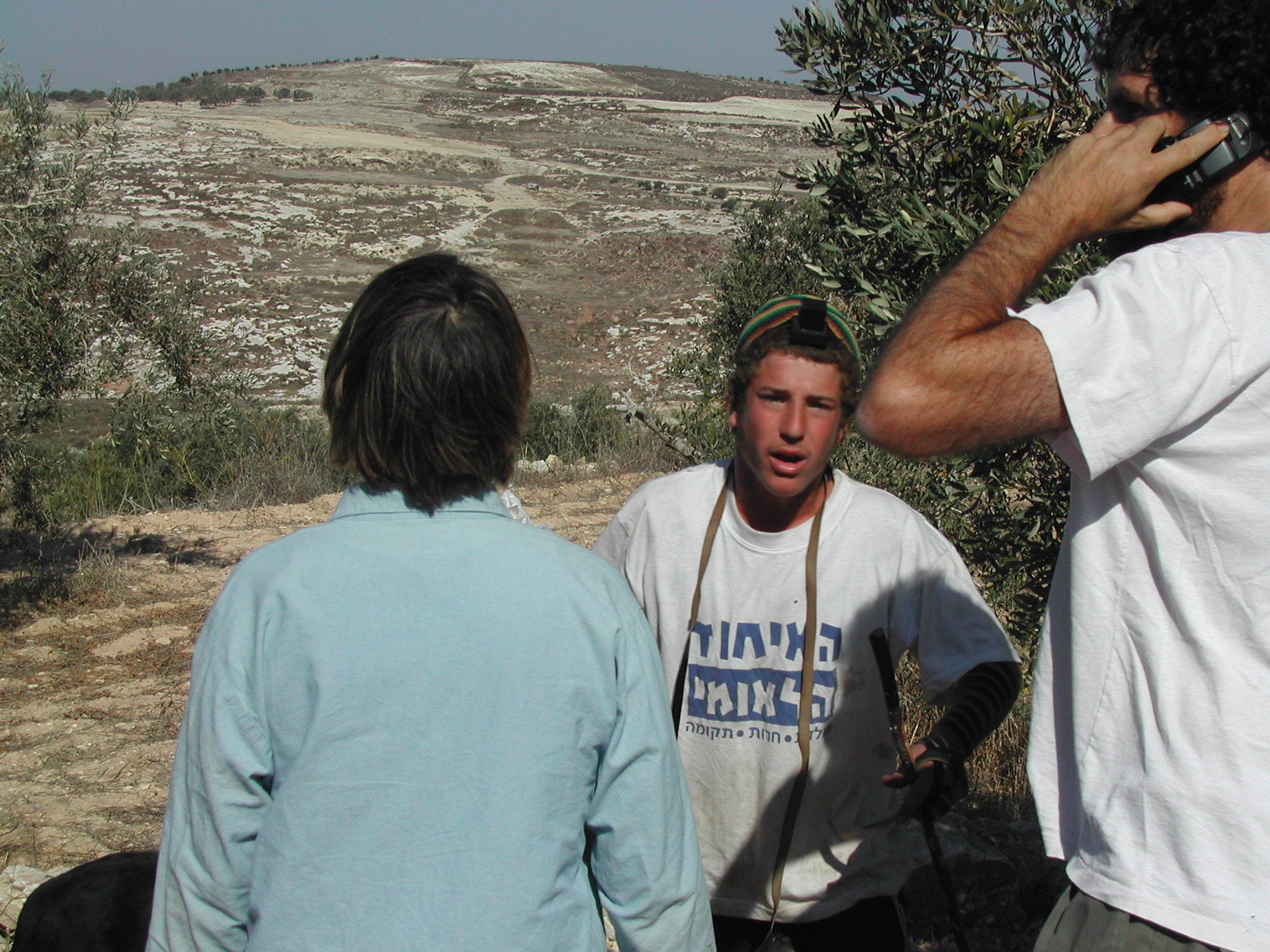 Photo Daniel Gordis 2002
Somewhat bemused by all this, and perplexed by the soldiers on an armored personnel carrier about two hundred yards away who could certainly see this all through their binoculars but did nothing, I decided that this was too bizarre not to photograph. I took my camera out of the backpack and started taking pictures. Big mistake. For some reason, this enraged the three. The one with the dogs started towards me in my direction and the one with the tefillin went even more berserk. The peyot-meister in the back started waving his gun around. Several of the others in our group moved in to buffer between us, but it was clear that this was getting out of hand. The organizer of our group quickly pulled out his cell phone and called his police contact.
I continued to try to photograph, when I suddenly realized that the center of activity had moved elsewhere. It turns out that the kid with the tefillin had stolen the pack of one of our group’s members, and run off with it. As all this was unfolding, two plainclothes policemen appeared out of nowhere from among the trees. They were filled in on the story, and promptly set out to arrest the two who had apparently taken the bag (which had been recovered when the thieves dropped it as members of our group chased them).
OK, a little excitement for the day. But all’s well that ends well, and we went back to work. The Palestinians, by the way, had worked all the way through. They’d called this human rights group for a reason – they wanted to harvest, and our job was to run interference if anyone showed up for trouble. They seemed perfectly content to let us deal with the visitors, and throughout, moved from tree to tree, salvaging whatever was left for them to pick. We went back down the hill to join them, and worked for a while.
But the fun wasn’t over. I heard some more shouting a short while later, and once again, scampered up the hill to see what was going on. This time, it was a different guy in a huge white kippah and an even bigger gun, and his wife, in a long skirt, long sleeves, hair covered – the full getup, right out of central casting. They were in their late twenties or so. He was screaming at police (the original two had remained on site, and had called in backups, so there was more than a bit of security) that this land belonged to Jews, that it was duly registered in Jews’ names, and that it was the Palestinians who were stealing. And, pointing to me and one other person wearing a kippah, “You two should be ashamed of yourselves. You’re killing Jews. We need these olives to live. You’ve got blood on your hands. . . .” This was a new one, and these guys were such classics that I couldn’t resist. Out with the camera, and a couple of quick photos.
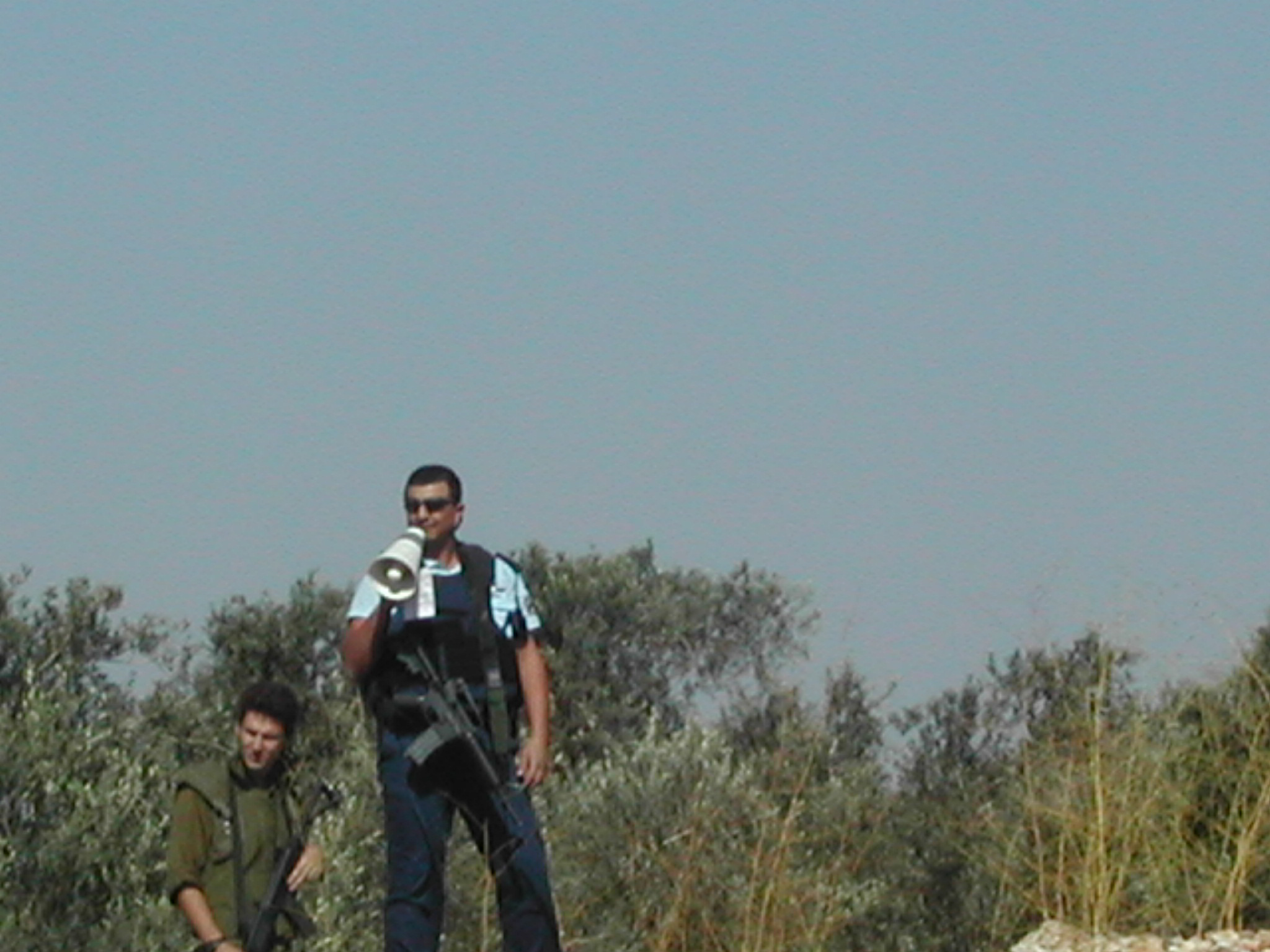 Photo Daniel Gordis 2002
Another mistake. The wife was completely enraged by the camera, and started to try to grab it. She grabbed my arm and wouldn’t let go. It wouldn’t have been hard to shake her off, but as her husband was standing about ten feet away with a loaded gun,