
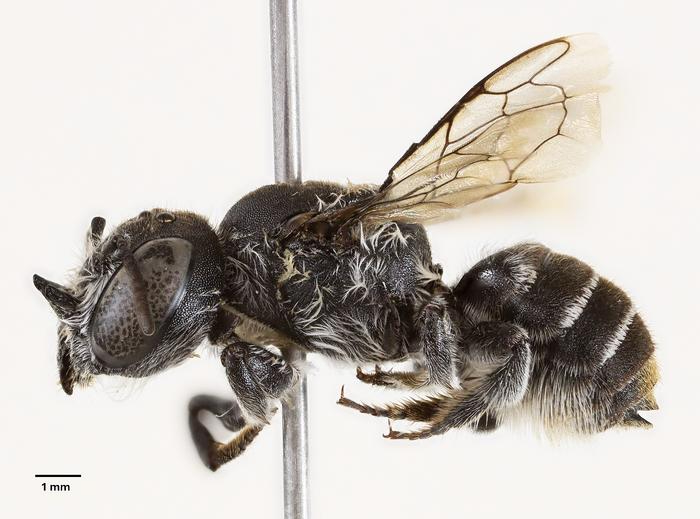
In 2019, researcher Kit Prendergast was surveying the insects visiting an incredibly rare plant in the Bremer Ranges of Western Australia when a bee grabbed her attention.
Prendergast and her colleague dug deeper and found that the native bee, now named Megachile lucifer, is a new-to-science species, according to a recent study. The species name refers to the female’s large, devil-like horns.
“The female had these incredible little horns on her face,” Prendergast, the study’s lead author from Curtin University, Australia, said in a statement. “When writing up the new species description I was watching the Netflix show Lucifer at the time, and the name just fit perfectly. I am also a huge fan of the Netflix character Lucifer so it was a no-brainer.”
Prendergast collected specimens from among bees that were visiting flowers of both the critically endangered plant Marianthus aquilonaris and the more common wandoo mallee (Eucalyptus livida). Both plants are found only in Western Australia state.
She compared the specimens with similar bees in museum collections and didn’t find a match. A DNA barcoding test also didn’t turn up a match with any known species in existing bee genetic databases, confirming the species was new to science.
One of the collected specimens turned out to be a male M. lucifer. Unlike the female, it didn’t have any horns. “This is the opposite of the situation in much of the animal kingdom, where the males are more likely to be armoured,” Prendergast writes in The Conversation.
The description of M. lucifer is particularly important for conservation, the study notes, because for many critically endangered plants in Australia, their pollinators remain unknown.
“In subsequent years of surveying this site, the mallee was not flowering, Megachile lucifer was not seen, and far fewer insects were recorded,” Prendergast writes in The Conversation. “With no monitoring of native bees, we also don’t know how their populations are faring in response to threatening processes, like climate change.”
Furthermore, M. lucifer is currently only known from the Bremer Ranges, which is at risk from threats like gold mining, wildfires and climate change. The researchers didn’t find additional specimens in museum collections, nor did Prendergast come across the species in surveys she conducted in other parts of Western Australia.
“Being associated with the Critically Endangered Marianthus aquilonaris, the area in and around where these species occur should be formally protected and gazetted as conservation land that cannot be cleared,” the study recommends. “Further surveys in the surrounding region during November should be undertaken, and if M. lucifer occurs, these areas likewise should not be cleared (e.g. for haul roads to access mining).”
Banner image: Female Megachile lucifer with devil-like horns. Image by Prendergast et al., 2025 (CC0).
