
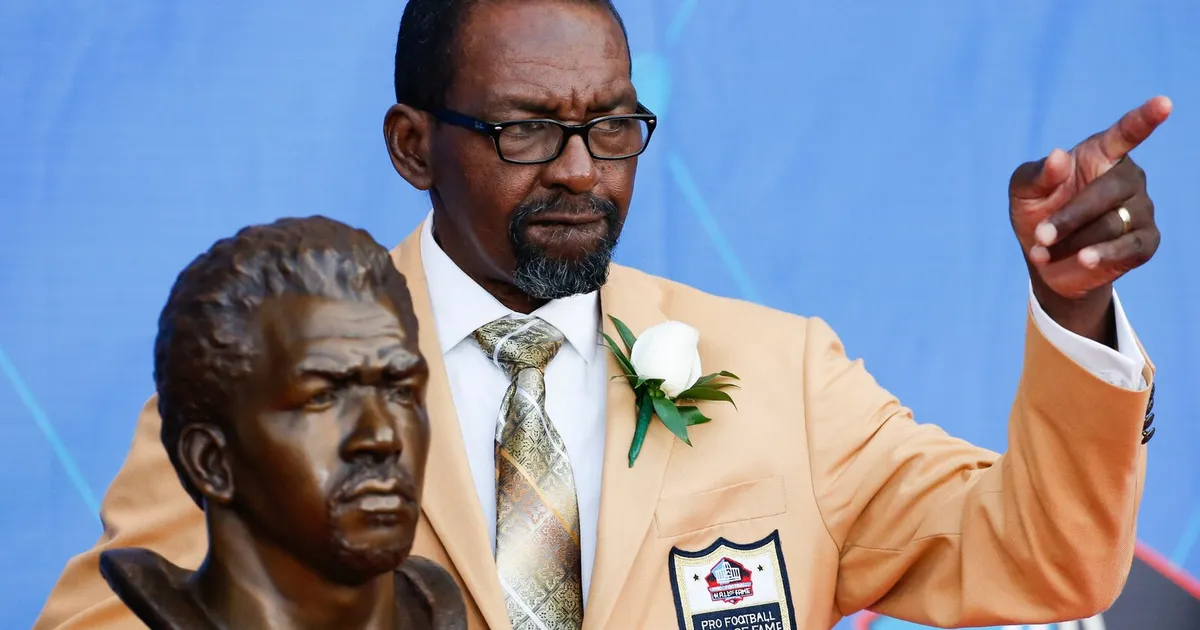
Kenny Easley, whose hard hitting and playmaking earned him the nickname “The Enforcer” and defined the first great era of Seahawks football in the 1980s, died Friday, the Pro Football Hall of Fame announced.
Easley was 66.
The cause of death was not immediately announced.
“We are deeply saddened by the passing of Seahawks Legend Kenny Easley,” the Seahawks said in a statement Saturday. “Kenny embodied what it meant to be a Seahawk through his leadership, intensity, and fearlessness. His intimidating nature and athletic grace made him one of the best players of all-time.”
The Seahawks further honored Easley by lowering the 12 flags at the Virginia Mason Athletic Center in Renton.
Easley was inducted into the Pro Football Hall of Fame in 2017 and had his No. 45 retired by the Seahawks that fall. It commemorated a career in which he earned five Pro Bowl bids, was named first-team All-Pro three times, was named to the Hall of Fame’s All-Decade team for the 1980s and was the 1984 Defensive Player of the Year when he led the Seahawks to a 12-4 record, the best for the team until 2005.
“Kenny Easley would have been a dominant safety in any era. When he was enshrined in 2017, he took his rightful place in the Pro Football Hall of Fame and embraced his football immortality,” said Jim Porter, president and CEO of the Hall of Fame. “Kenny possessed excellent ball skills, but make no mistake: His biggest strengths were his fearlessness and intensity. If you had the ball as an opposing offensive player, he was going to hit you hard — and you were going to feel it for a while.”
Easley, born and raised in Chesapeake, Va., was a three-time All-American safety at UCLA, where he earned a degree in political science, before he was drafted fourth overall by the Seahawks in 1981. He was recently honored as one of the Seahawks’ Top 50 players of all time.
Easley spent his first season playing for Jack Patera, recording three interceptions and four fumble recoveries.
His career took off when Chuck Knox became the Seahawks’ coach in 1983. Easley won the first of three consecutive first-team All-Pro honors that season as the Seahawks advanced to the AFC title game. He picked off seven passes, recovered three fumbles and had three sacks in headlining a secondary that was considered one of the best in the NFL.
His best season came in 1984 when he spearheaded a ballhawking defense that forced 63 turnovers, still a franchise record and the second-most in the Super Bowl era behind only the 67 of the 1985 Chicago Bears.
Easley led the NFL with 10 interceptions and returned two for touchdowns as the Seahawks advanced to the divisional round of the playoffs.
Easley was first-team All-Pro the following season.
A knee injury in 1986 limited him to 10 games and started a bitter ending to his NFL career.
Easley played 12 games in 1987, a season shortened by a players’ strike. He was the Seahawks’ player representative during his career and a vocal proponent of the strike.
Easley began suffering kidney problems that he alleged were because of prescribed painkillers to deal with his football injuries. He was traded to the Arizona Cardinals in 1988, but the trade was voided when he failed a physical because of kidney damage.
He never played again, his career over after 89 games. He sued the Seahawks, alleging the painkiller use led to his kidney issues. The case was resolved with an out-of-court settlement, and Easley received a kidney transplant in 1990.
It led to years of estrangement with the Seahawks.
That began to end when Seahawks owner Paul Allen called him in 2002 and told him that the team would induct no more players into its Ring of Honor until Easley agreed to be inducted.
Easley said yes and was inducted that fall.
“Thank you, sir, for reaching out to Kenny Easley in 2002 after a 15-year isolation from the organization,” Easley said of Allen in a speech that kicked off his Pro Football Hall of Fame enshrinement speech as part of the Class of 2017. “I believe in the old adage ‘Water runs downhill,’ and thus winning starts at the top, and you have run a great organization.’’
While at the Hall of Fame, Easley revealed that he had recently had a triple-bypass surgery to fix a heart ailment. He said that drove him into a deep funk but said “The Hall of Fame was the thing that pulled me out of it.”
Easley said then that any bitterness about his NFL career ending at the age of 29 and having played just seven seasons — and the long wait he endured to get into the Hall of Fame — had long passed.
“People say you should have gotten in earlier,” Easley said. “I’m here now. So that means that’s when I was supposed to be here.”
Easley is one of four Seahawks with their number retired, along with Steve Largent, Walter Jones and Cortez Kennedy. All are players who made the Hall of Fame and spent their entire careers as Seahawks.
After retirement, he returned to Virginia and, for a time, owned a Cadillac dealership and also worked in commercial real estate. He was co-owner of the Norfolk Nighthawks of the Arena Football League 2 from 1999-2003, along with fellow NFL Hall of Famer Bruce Smith.
He had three children with his wife, Gail — son Kendrick and daughters Gabrielle and Giordanna. Easley once said wanting to share his football career with his children was one reason he decided to smooth over relations with the Seahawks in 2002.
“It was the proper time to do it,” he said. “I’m glad my children got an opportunity to be part of it and learn about their father and what he had done and how successful he had done it.”
Tributes from former teammates, opponents and others poured in as the news spread of Easley’s passing, including from his former USC rival, Ronnie Lott.
After facing each other in each of the 1978, 1979 and 1980 seasons in college, each was taken in the 1981 draft — Easley at four to Seattle and Lott at eight to the 49ers.
“Condolences,’’ Lott wrote on X. “One of the best to ever do it.’’
The two were tied for years. Each went on to help define a new prototype for safety play in the NFL, each fast and agile enough to guard receivers all over the field but big enough to play close to the line and strike fear into opposing runners.
Easley was 6-foot-3, 206 pounds at a time when defensive backs were often a few inches shorter and a few pounds lighter, while Lott was 6-foot, 203.
Easley, in fact, returned punts for four seasons for Seattle with 302 yards on 26 attempts, volunteering to do so in the 1984 season when Paul Johns suffered a career-ending neck injury.
Easley was such a versatile athlete that he briefly took over punting duties for UCLA as a freshman in 1977 with three attempts for 99 yards. He also blocked a punt that led to a touchdown for UCLA in a 10-7 win over UW at Husky Stadium in 1978.
Among other college accolades, Easley was also named to the UCLA Athletic Hall of Fame and had his No. 5 retired, one of nine retired by the school.
And according to his College Football Hall of Fame bio, to which he was inducted in 1991, in January 1991, he shot 73-75 and won an amateur golf tournament in Pasadena, Calif., less than a year after his kidney transplant.
Also paying tribute to Easley was Paul Moyer, who played alongside Easley in Seattle’s secondary from 1983-87 and now works on the team’s gameday radio broadcast.
“You were a great mentor and friend. The best of the best! You will be missed! Pray for the Easley family.’’
Bob Condotta: bcondotta@seattletimes.com. Bob Condotta is a sports reporter at The Seattle Times who primarily covers the Seahawks but also dabbles in other sports. He has worked at The Times since 2002, reporting on University of Washington Husky football and basketball for his first 10 years at the paper before switching to the Seahawks in 2013.