Although it’s still early days, economists say they expect annual inflation to fall to around 2.8% and that the Official Cash Rate (OCR) is still on track to be cut by the end of the year.
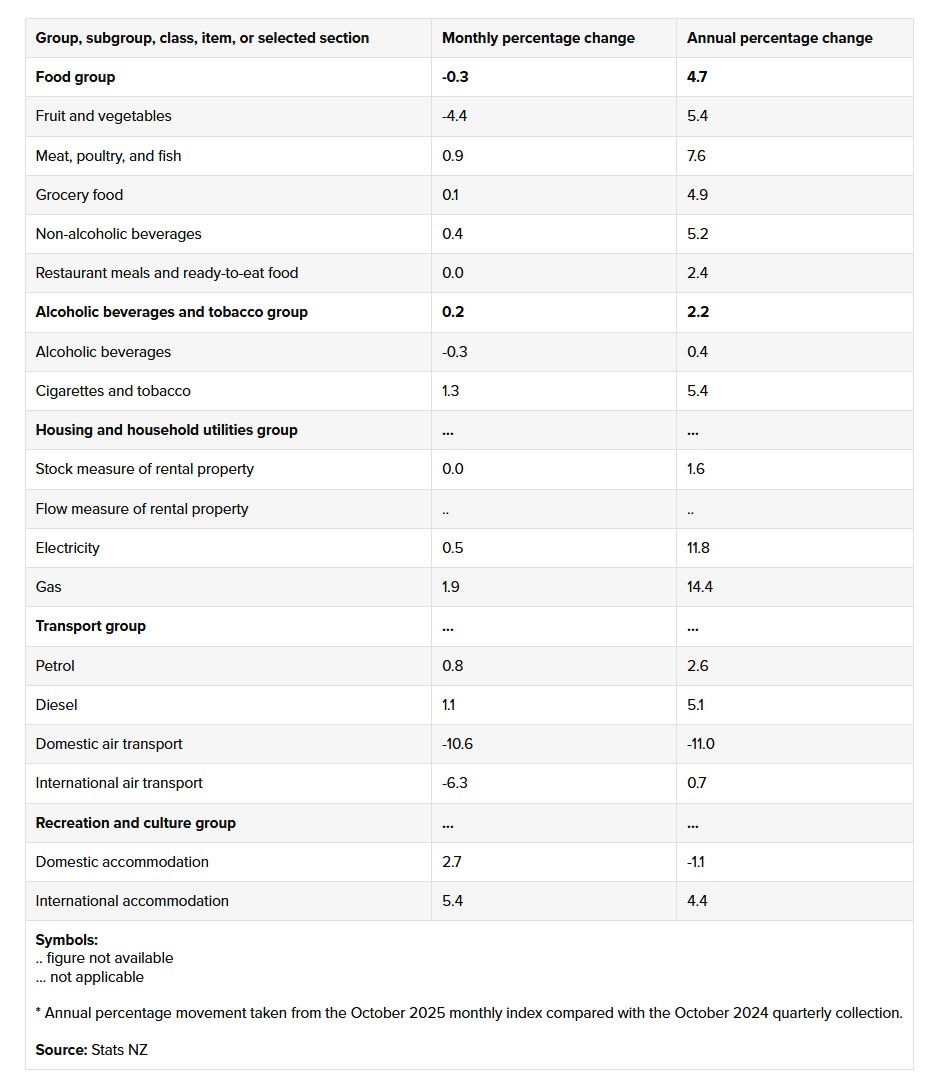
These predictions come as Statistics New Zealand’s Selected Price Indexes (SPI) show annual food prices jumped 4.7% in the year to October driven by a 4.9% annual rise for the grocery group. This was followed by meat, poultry and fish which rose 7.69% annually.
In September, annual food prices rose 4.1%.
Statistics NZ’s SPI is a monthly series that features about 47% of the contributors to the quarterly Consumers Price Index (CPI) – NZ’s official measure of consumer inflation.
The SPI includes monthly data on things like food, alcoholic beverages and tobacco, rental housing, utilities, transport and accommodation services.
Food prices make up about 18.5% of the CPI and rent now makes up just over 11% of the CPI so the SPI is a good early guide to what inflation is doing.
‘No obstacles’ to OCR cut next week
The Reserve Bank (RBNZ) is charged with maintaining inflation between 1% and 3%, and it specifically targets 2%.
While annual inflation, as measured by the consumers price index (CPI), is currently on the higher side of its target at 3%, the RBNZ’s Monetary Policy Committee expected this.
The fact this inflation figure was initially expected, coupled with an expectation that inflation will slow next year has led economists on Monday, to reaffirm their forecasts of a drop in the Official Cash Rate (OCR) by 25 basis points.
This would take the OCR from 2.5% to 2.25% at the next review on November 26.
ASB senior economist Mark Smith says despite October’s SPI having stronger than expected food prices, the underlying measures point to further easing when it comes to inflation.
“Much of the upward surprise looks to be a consequence of rising costs (energy prices have soared) and/or global catalysts rather than pointing to a lift in domestically-generated inflation,” says Smith.
“We expect annual inflation to end this year at 2.8% and there are good reasons to expect inflation to move towards 2% from next year, with the large margin of spare capacity being the key disinflationary driver.”
While Smith says they expect this 25-basis point drop, “the path of the OCR beyond that is conditional on the economic outlook”.
“With few non-monetary policy tailwinds on the economic horizon, the risk is that the OCR moves lower as the RBNZ moves to actively support the economy. This will depend on inflationary pressures being contained.”
Westpac NZ senior economist Satish Ranchhod says the new SPI data doesn’t presents any obstacles to another RBNZ rate cut.
Ranchhod says: “We’ve revised our forecast for December quarter inflation to +0.3% and +2.8% for the year to December. Those estimates are both down 0.1 percentage points from our earlier forecast.”
The latest SPI figures “showed greater than expected softness in travel costs, which can be volatile on a month-to-month basis and will warrant close attention over the coming months”, Ranchhod says.
“However, we also saw softness in other areas. Most notably, rental inflation has been very weak.”
Prices for eggs and coffee rise
“The price of milk has increased by 91 cents per 2 litres over the last two years. Eggs were up 8.8%, and coffee was up 12.4% over the same period,” Statistics NZ’s prices and deflators spokesperson Nicola Growden says.
“Those who enjoy eggs and coffee in the morning may have noticed them becoming more expensive.”
The average price for milk was up 13.5% annually, at $4.78 per 2 litres and cheese was up 30.1% annually, at $12.71 per 1 kilogram block.
Instant coffee was up 25.5% annually at $7.88 per 100 grams, while fresh eggs were up 18.5% annually – at $9.88 per dozen.
The average prices for milk and cheese represent the cheapest available option for each, according to Statistics NZ.
Monthly food prices fall by 0.3%
Compared with September, October saw a monthly food price decrease of 0.3%, with the fruits and vegetables subgroup was the only group to record a fall, which contributed to the overall decrease.
“Vegetable prices fell 10.7% this month, with salad items such as lettuce, tomato, and cucumber becoming cheaper. This is the largest monthly price decrease for vegetables since November 2021,” Growden says.
“Although fruit and vegetable prices have fallen overall, the price for fruits such as kiwifruit and apples have increased by 48.4 percent and 7.1 percent respectively.”
Growden says this is the first time this year that food prices have fallen in consecutive months.
The average price for lettuce was down 31.9% monthly at $4.60 per 1 kilogram while capsicums were down 26.2% monthly at $13.79 per 1 kilogram while cucumbers dropped 21.9% monthly to $8.57 per 1 kilogram.
Select chart tabs
Food price index pa %
Food price index monthly %
Fruit and vegetables pa %
Meat/poultry/fish pa %
Grocery food pa %
Non alcoholic beverages pa %
Restaurant meals and ready to eat food pa %
Electricity and gas prices increase
Growden says there have been 11 consecutive months of price increases for both electricity and gas. In the year to October, electricity went up 11.8% and gas rose 14.4%.
Monthly prices also increased – electricity was up 0.5% and gas was up 1.9% in October.
Rent prices
The stock measure of rental property went up 1.6% in the 12 months to October.
Transport
Petrol increased by 2.6% annually and diesel also saw a 5.1% jump.
When it came to domestic air transport, there was an annual 11% decrease while international air transport was up 0.7% annually.
Alongside this, domestic accommodation dropped 1.1% while international accommodation increased 4.4%.
Here is the detailed SPI information as supplied by Statistics New Zealand: