
Unlock the White House Watch newsletter for free
Your guide to what Trump’s second term means for Washington, business and the world
Donald Trump on Sunday said he could hold talks with Nicolás Maduro, opening a potential diplomatic path after the US designated the Venezuelan leader a terrorist and stepped up its military presence in the Caribbean.
“We may be having some discussions with Maduro, and we’ll see how that turns out,” Trump said before boarding Air Force One in Palm Beach, Florida, on Sunday.
Trump added that Maduro’s government “would like to talk”.
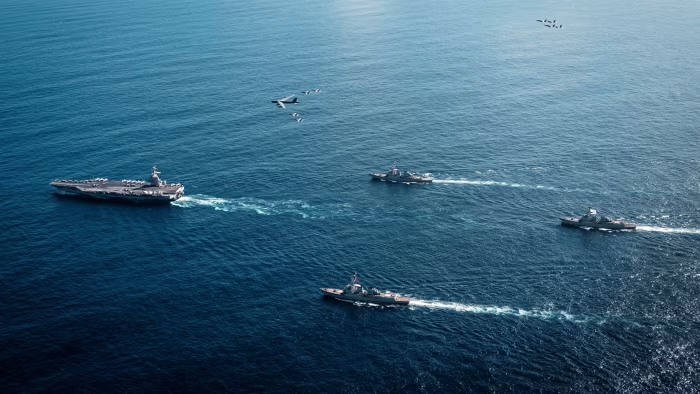
His comments came on the day the US’s newest and most advanced aircraft carrier arrived in the Caribbean Sea to bolster an already significant naval build-up in the region.
The military presence — which includes more than 14,000 troops, a dozen warships, a nuclear-powered fast-attack submarine, a special operations vessel and F-35 fighter jets — is widely seen as an effort to force Maduro from power.
The USS Gerald R Ford aircraft carrier, accompanied by three destroyers, was carrying dozens of aircraft and more than 4,000 troops, according to the US Navy.
The US president has said he has “sort of made up my mind” on whether to order a military operation on Venezuelan soil.
“I can’t tell you what it is, but we made a lot of progress with Venezuela in terms of stopping drugs from pouring in,” Trump said on Friday.
The Trump administration says its military campaign is aimed at stemming the flow of narcotics into the US from Venezuela.
The US on Sunday continued its strikes against alleged drug-trafficking boats in the region, launching its 21st attack and killing four people, according to US Southern Command, which oversees military operations in the region. The boat strikes have killed at least 83 people since early September.
US army secretary Daniel Driscoll told CBS on Sunday that the administration was “reactivating our jungle school in Panama” to train troops in the country for the first time in more than 20 years.
Trinidadian Prime Minister Kamla Persad-Bissessar said US marines had begun joint exercises in Trinidad and Tobago, a dual-island nation a few miles off Venezuela’s coast.
Maduro said in a speech that the US’s exercises in Trinidad and Tobago are “intended to be threatening to a republic like Venezuela, which does not allow itself to be threatened by anyone”.
The US on Sunday said it would designate the Cartel de Los Soles, a drug cartel it claims is headed by Maduro and high-level officials in his regime, as a foreign terrorist organisation. The US Treasury department sanctioned the group in July.
The designation could widen the Trump administration’s legal justification for escalating its military actions in the region.
The administration has maintained that it has the legal authority to conduct the boat strikes campaign, despite concerns from both Republican and Democratic lawmakers, human rights experts and critics that the military actions are illegal under domestic and international law.
The Cartel de los Soles is “responsible for terrorist violence throughout our hemisphere as well as for trafficking drugs into the United States and Europe” and the US “will continue using all available tools to protect our national security interests and deny funding and resources to narco-terrorists”, secretary of state Marco Rubio said on Sunday.
Trump said that the designation “allows” the US to target Maduro’s assets and infrastructure “but we haven’t said we’re going to do that”.
As the Ford’s strike group arrived in the Caribbean, Admiral Alvin Holsey, the commander of US Southern Command who will leave his post next month, said: “We stand ready to combat the transnational threats that seek to destabilise our region.”
Maduro has claimed that the US flotilla and the strikes are a precursor to his attempted ousting.
Last week, his defence minister announced the mobilisation of 200,000 troops for military exercises.