
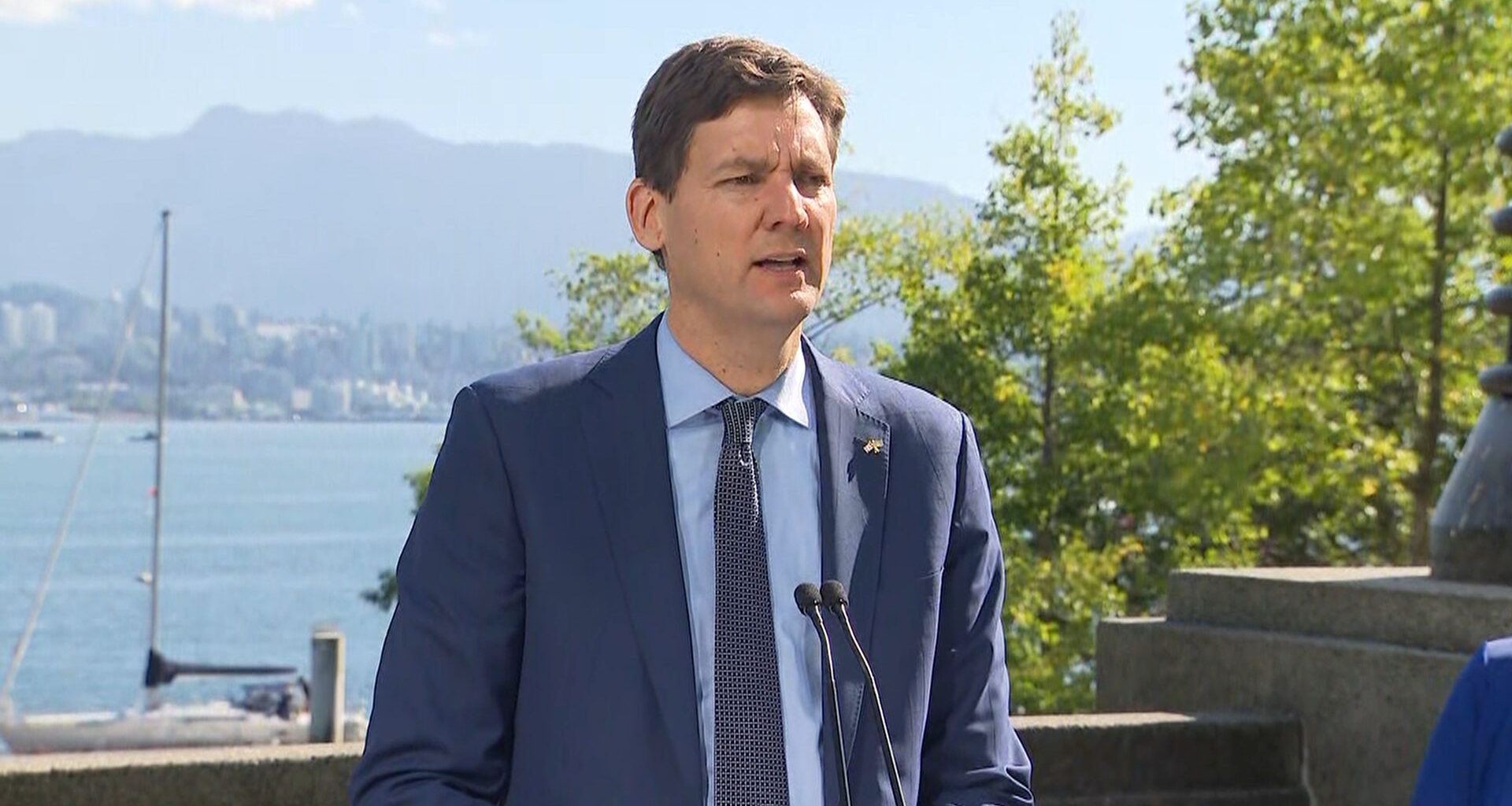
Premier David Eby is once again calling out what he says is a long-standing funding imbalance between British Columbia and eastern Canada, this time in response to a major federal subsidy that will sharply reduce ferry fares in Atlantic provinces.
Speaking at a news conference Monday morning, Eby questioned a federal decision to cut tolls and fares in half on multiple ferry routes in Atlantic Canada, saying ferry users in B.C. receive far less federal support despite facing similar transportation challenges.
“It’s an issue that I have raised directly with the federal government and also with Canadians,” said Eby.
“The structural unfairness of the fact that not only are British Columbians paying equalization to eastern provinces in the amount of billions of dollars…but also we have to watch the federal government show up on the East Coast and subsidize ferry users that already get a $300 subsidy per each $1 that a B.C. ferry user gets.”
On Monday, Prime Minister Mark Carney announced the fare cut for multiple federally supported ferry services including Marine Atlantic, which links Nova Scotia and Newfoundland, as well as a drop in the toll for the Confederation Bridge that connects Prince Edward Island to New Brunswick from $50.25 to $20 starting Aug. 1.
Currently on the ferry line’s Argentia, Nfld., to North Sydney, N.S. route, passenger fares are set at $120.79 one-way for adults, while a standard-size vehicle costs $243.57 one-way.
Ottawa says the cost-cutting measures will boost interprovincial mobility and reduce cost-of-living for residents, generating an estimated $100 million for the region’s economy.
But Eby said the announcement reinforces what he called an outdated funding model that leaves B.C. shortchanged.
“I do understand the federal government made an election commitment to follow through on those things, but at the same time, we’re going to need the federal government to have a serious look at their policy in relation to ferry users of British Columbia and ensure fair treatment for ferry users here,” Eby said.
“It’s time for them to up the federal subsidy that has not changed for almost 20 years in British Columbia, while East Coast ferry users continue to see benefits from the federal government.”
He stressed that any national transportation dollars must offer “equal per capita funding” to all provinces, not just those closest to Ottawa.
“Our ask is not a complicated ask. There is an equalization formula that we disagree with,” he said. “It doesn’t matter if it’s an economic program, a subsidy for ferries, subsidies for road building, subsidies for immigration, health-care funding, child-care funding, you name it. Equal funding is the answer.”
When asked about Eby’s call for equal per capita investment in ferries, a spokesperson for federal Transport Minister Chrystia Freeland said in a statement: “The Government of Canada supports ferry services across the country by investing in ferry-related infrastructure. When it comes to the operating costs, funding is focused on constitutionally mandated and interprovincial ferry services.”
Eby’s comments follow similar concerns he voiced earlier this month, when he urged a House of Commons transport committee to examine the disparity in ferry funding between coasts.
According to the BC Ferry & Marine Workers’ Union, the federal government has earmarked roughly $37.8 million in grant money for ferry services in B.C. in 2025-26, a figure Eby has previously said represents “a fraction of a fraction of the operating costs of BC Ferries.”
In a statement Monday, BC Ferries said it recognized Atlantic Canada’s ferry system is critical to the communities it serves, but as B.C. operates “one of the largest and most complex ferry systems in the world,” the company is unique in that the majority of costs are paid directly by users, unlike many other jurisdictions.
“Without additional support, fares would need to increase by more than 30% in 2028 alone just to keep up with operating and capital pressures,” BC Ferries said. “Navigating aging infrastructure, inflationary pressures, and growing demand will require continued collaboration across all levels of government to keep ferry travel reliable, affordable, and sustainable for coastal British Columbians”
BC Ferries CEO Nicolas Jimenez has previously said more federal support could help offset costs as the company works to replace aging vessels.
He also noted that the company’s recent to award a construction contract for four new electric-diesel ships to a Chinese shipbuilder were based in part on a lack of Canadian shipyard bids, something Eby has said he hopes to change by growing building capacity here with federal backing.
Eby said he was scheduled to meet with federal Liberal MPs from B.C. Monday to discuss how the province can stay on Ottawa’s radar, adding that with even a fraction of the support Eastern Canada gets, B.C. could unlock tens of billions in economic growth.