
Europe’s construction industry faces a significant challenge: build more but build green. Or as Building Green 2025 puts it: ‘How can we meet society’s needs without exceeding the planet’s capacity?’
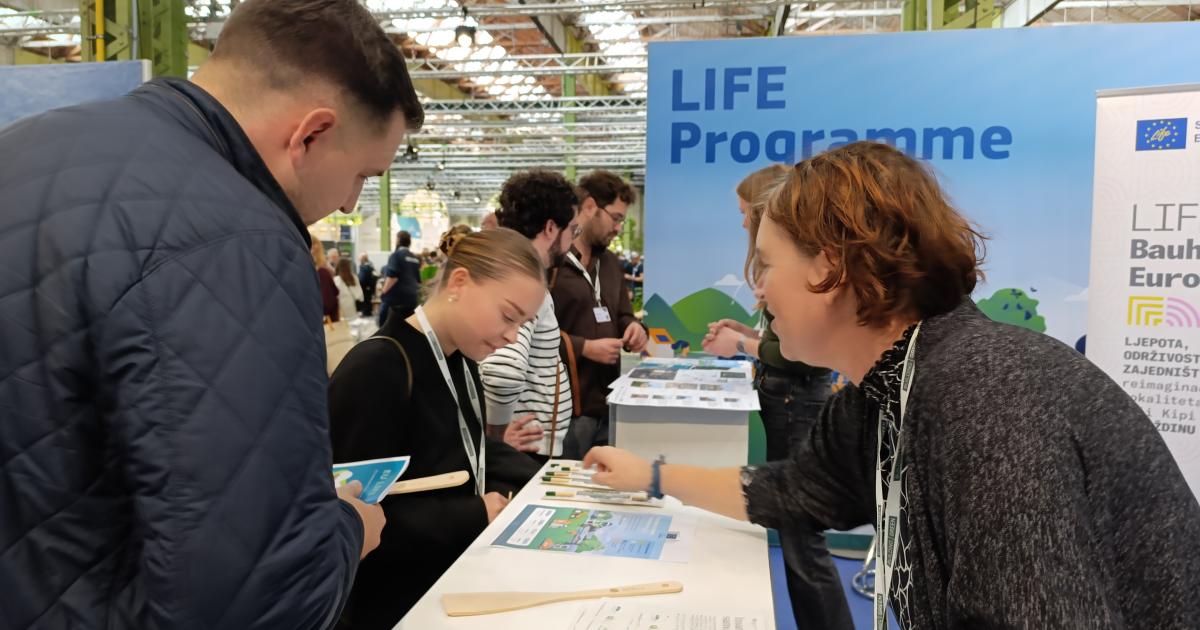
Experts from the LIFE Programme and 10 LIFE projects from 6 EU Member States joined 10 000 architecture, engineering and construction (AEC) professionals in Copenhagen, Denmark for one of Europe’s biggest events for green construction and a sustainable built environment. This year’s focus on ‘scaling and sufficiency’ asked the question: how do we construct enough new houses, offices and other buildings to meet future needs while at the same time keeping in line with our climate, energy and environmental targets?
From cooling roof tiles and water-saving bathrooms to upcycling and energy retrofits, LIFE projects were on hand to provide some practical answers. LIFE COSME Reno, for example, works with small and medium enterprises (SMEs) across Europe to transform existing homes into energy-efficient, affordable and liveable spaces. ‘By equipping SMEs in the construction sector with innovative tools and collaborative models, the project is turning housing renovation into a collective movement toward a more sustainable and people-centred built environment,’ explains project coordinator Amy Egerter from DEPACT Consulting.
‘Sustainable living starts with smart choices, from greener public buildings to homes designed with care for people and the planet,’ adds Nataša Kebe, Undersecretary at Slovenia’s Ministry of the Environment, Climate and Energy which coordinates LIFE Care4Climate. ‘We are delivering solutions for future buildings to meet today’s needs without compromising the needs of tomorrow.’
Building Green 2025 was also a chance to explain EU funding opportunities and partnerships: since 2021, some 75 LIFE sustainable construction and renovation projects have been awarded around €300 million of EU investment. Several LIFE projects took part in a talk on the Green Stage entitled Unlocking the Future: Navigating EU LIFE Funding – Essentials and Strategies, while the EU BUILD UP initiative — established in 2009 to support the Energy Performance of Buildings Directive (EPBD) — was also on hand to give advice.
LIFE projects with practical, scalable solutions attracted most attention. LIFE ReUseWater, for example, has developed a shower which cuts water use by 90% and heating by 80%, together with a simple way to flush toilets with recycled water. ‘ That’s real circularity!’ says project manager Johannes Melin. ‘The technology is now market-ready for international expansion. The LIFE Programme gave us direct access to our target market, letting us demonstrate, evaluate and refine the products in operational environments.’
Similarly enthusiastic is More LIFE to LEVELs project coordinator Alfons Ventura, of the Spanish Green Building Council. ‘We’re gathering practical data from 11 real world building projects to show that sustainable buildings of different types — buildings that meet people’s needs, provide comfort and well-being, and save energy, water and materials — are economically and technically feasible across the EU,’ he says.
Other LIFE projects participating in Building Green 2025 included LIFE SUPERHERO, LIFE ITS4ZEB, LIFEBauhausingEurope, LIFE CAPT-TILE, LIFE Street HP Reno and LIFE AREC. All LIFE projects in this area support the Energy Performance of Buildings Directive, Construction Products Regulation, Circular Economy Action Plan, European Green Deal, Fit for 55 package and the Energy Efficiency and Renewable Energy Directives.