

Ever since the devastating October 7, 2023, Hamas invasion and atrocities, the government has resisted establishing an investigative body to thoroughly examine how such a disastrous military calamity could befall the country.
Now, with its back against the wall, the government has announced it will establish what it calls an “independent” inquiry with full investigative powers, but whose yet-to-be-defined mandate will be set by government ministers. Critics say the proffered solution falls short of the truly unfettered state commission sought by much of the country.
In June 2024, petitions were presented to the High Court of Justice demanding the government be compelled to set up a state commission of inquiry into the disaster, the most rigorous and independent form of state investigation available.
In reply, lawyers representing the government argued that such a commission would distract military commanders at a time when their time and focus could not be diverted from the multi-front war Israel was waging against its enemies in Gaza, Lebanon, Yemen, Iran and beyond.
With a ceasefire in Gaza largely holding and nearly all hostages released, the government has shifted its argument against establishing a state commission, now insisting — with scant evidence — that such a panel would lack public trust because its makeup would be determined by Supreme Court President Isaac Amit, who is seen as a liberal.
Get The Times of Israel’s Daily Edition
by email and never miss our top stories
By signing up, you agree to the terms
Instead, the government is proposing a different, although as yet unspecified, body to examine the October 7 catastrophe.

Prime Minister Benjamin Netanyahu speaks at the weekly cabinet meeting in Jerusalem, November 16, 2025. (Screenshot/GPO)
While there are laws determining what the government is and is not required to do to investigate the disaster, there is also uncertainty and a fair amount of wiggle room, including regarding how the High Court might decide to wade into the explosive issue.
The government’s (vague) proposal
The government’s idea for an inquiry was included in a Sunday response to the High Court on the matter, though the filing provided only the vaguest of outlines for what it hopes to establish.
In two short sentences, the government said it had approved a cabinet resolution to “advance the establishment of a commission which will be independent and hold full investigative powers and enjoy the broadest public support possible.”
It added that Prime Minister Benjamin Netanyahu will establish a ministerial team to discuss the mandate of the commission, meaning what issues it will address, which will deliver its recommendations to Netanyahu in 45 days. The government asked the court to give it another 60 days to provide it with an update on its progress.
Due to the lack of details, it is unclear what the government is actually seeking to do. It may be trying to establish a government commission of inquiry, an investigative body mandated by law but less independent than a state commission, or it may even seek to legislate a new form of inquiry entirely.
Some private members’ bills have already been submitted to the Knesset to do just that, such as that of radical Likud MK Ariel Kallner.
According to several Hebrew media reports, the government wants to appoint retired Supreme Court justice Yosef Elron to head the committee.

Outgoing Supreme Court Justice Yosef Elron attends a ceremony in his honor at the Supreme Court in Jerusalem, September 18, 2025. (Yonatan Sindel/Flash90)
Elron was a highly conservative jurist who favored judicial restraint while on the bench, meaning that he frequently ruled in favor of the government during his time on the top court. He retired on September 25, meaning he would not be able to take up a new post until December 25.
Some critics have speculated that the government is playing for time in its responses to the High Court petitions, in order to be able to appoint Elron to head whatever investigative body it sets up.
If given the ability to define the mandate of the commission, the current government is likely to shape its avenues of inquiry to include items that it sees as root causes behind the assault, which a state commission may not have included. These could include tracing the roots of the attack to the 2005 Gaza disengagement and alleged judicial interference in security matters.
A history of inquiry
Calls for a state commission of inquiry are anchored in the 1969 Law for Commissions of Inquiry, which enables the government to establish a State Commission of Inquiry if it deems that there is “a matter of vital public importance at that time that requires investigation.” Critically, however, the law says that the government is “permitted” to establish such a commission, not obligated.
State commissions are the most rigorous form of investigative body available under the law since they are the most independent and have the broadest powers.
They are established by a cabinet resolution, which also lays out the mandate of the commission, but are then entirely independent of the government. They can also be created by a vote in the Knesset State Control Committee. The Supreme Court president then chooses its members, of whom three, including the chairman, must usually be a serving or retired judge, and is typically a retired Supreme Court judge.
The commission can subpoena documents and witnesses, and compel them to testify.
Since the law was passed, Israel has established some 20 such commissions, investigating a wide range of topics, from the failures in the lead-up to the Yom Kippur War to the assassination of prime minister Yitzhak Rabin to construction standards in the wake of the collapse of a Jerusalem wedding hall.

Israelis light memorial candles as they mourn Sunday November 5, 1995 at the spot where Prime Minister Yitzhak Rabin was assassinated the night before. (AP PHOTO/Nati Harnik)
In 2024, a state commission released its findings regarding the deadly 2021 crush at Mount Meron, the last such panel to fulfill its mandate. A separate commission examining allegations of graft surrounding defense acquisitions is ongoing.
The alternative would be a government commission of inquiry, in which a cabinet minister or the cabinet approves the establishment of a commission and also appoints its members.
Although a government commission of inquiry is considered less independent because its members are chosen by the government, it can be granted subpoena power if its chairman is a serving or retired judge, as happened in the Winograd Commission that investigated the failures in the Second Lebanon War.
Reasonability rears its head
According to Dana Blander, a research fellow at the Israel Democracy Institute, the government is under no obligation to establish a state commission of inquiry due to the wording of the law.
But if the government decides to establish an alternative to a state commission of inquiry, there will inevitably be petitions against it to the High Court, which has already indicated that it believes some form of investigative body is needed.

Former Supreme Court justice Eliyahu Winograd in 2007 at a press conference (photo credit: Nati Shohat/Flash90)
On October 15, the court told the government sharply that “there is no real argument about the need to establish a state commission with broad investigative powers and the authority to determine findings and formulate recommendations in all matters related to the events of October 7, 2023.”
But the court panel, which included two conservative justices, did not use the explicit language of a “State Commission of Inquiry,” apparently giving the government leeway as to what kind of investigative body it could establish.
Despite the comments, judges have concluded in the past that the High Court lacks the authority to force the government to establish a state commission.
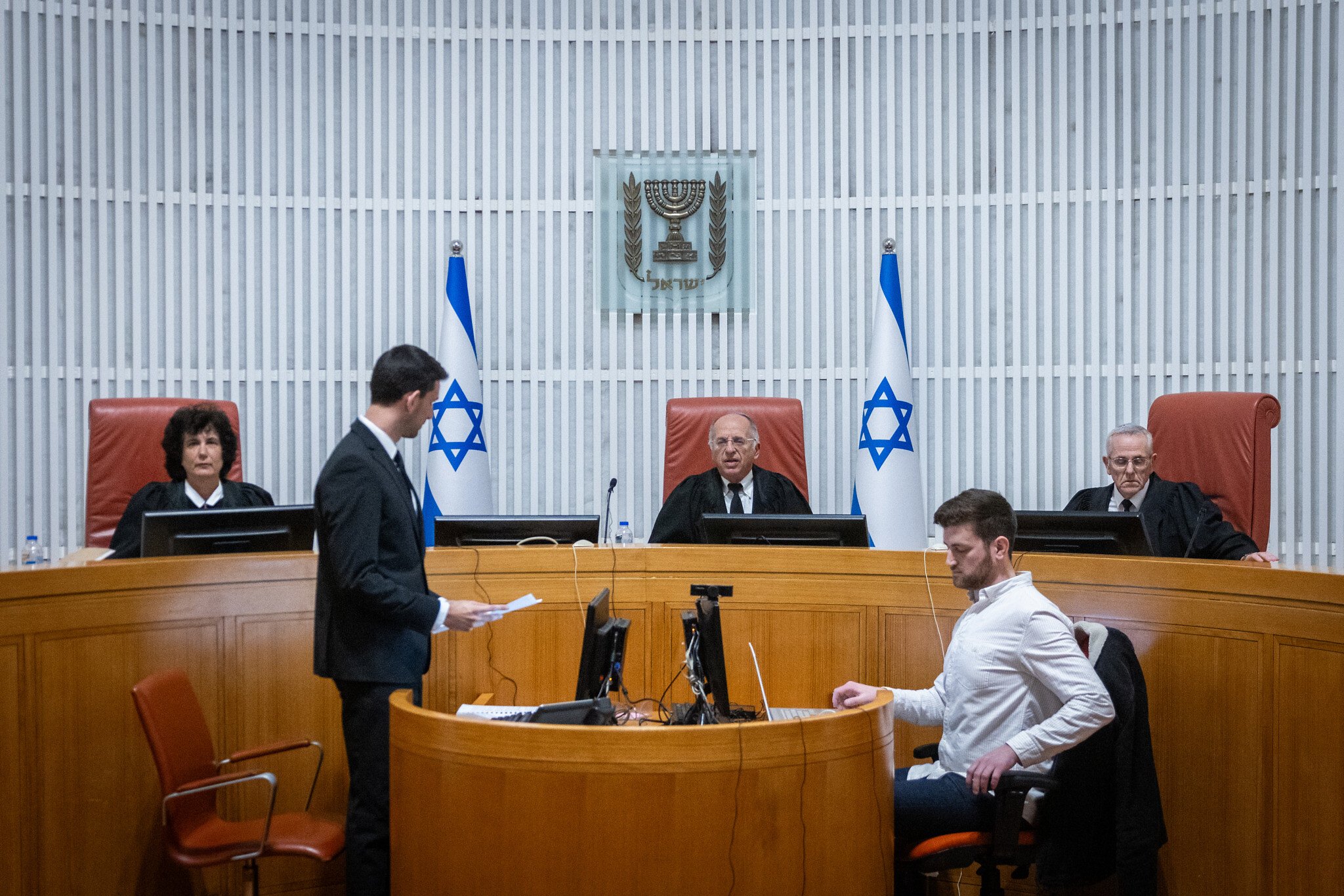
Supreme Court Justice Noam Sohlberg and supreme court justices arrive for a court hearing on a petition at the Supreme Court in Jerusalem on January 13, 2025. (Chaim Goldberg/Flash90)
On at least three occasions, the High Court has ruled that the decision is left to the discretion of the government and that the bench’s scope for intervention is extremely limited.
In 2006, petitions were filed against the government of prime minister Ehud Olmert and its decision to establish a governmental committee of inquiry into the failures of the Second Lebanon War, and not a state commission.
The court ultimately ruled four to three that the government was not required to establish a state commission of inquiry, saying that there was no reason for it to intervene in that specific case.
Blander pointed out, however, that the minority of judges found that the government’s decision had failed the judicial standard of reasonableness, which would pave the way in some circumstances to judicial intervention if the court believed the decision not to establish a state commission was fundamentally flawed.
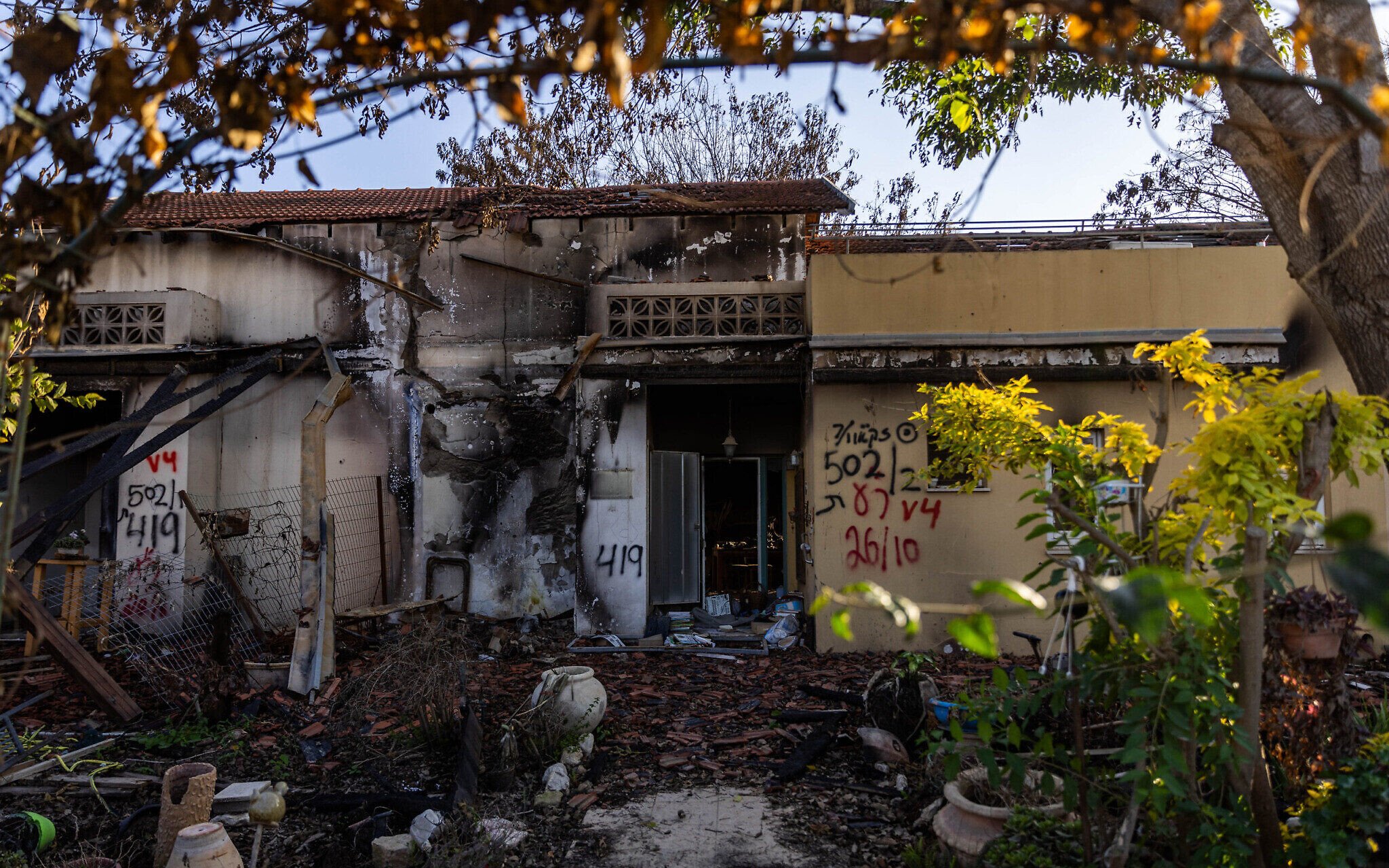
The remains of the destruction Hamas terrorists caused at Kibbutz Be’eri near the Israeli-Gaza border, as seen on January 4, 2024. (Chaim Goldberg/Flash90)
Further muddying the waters, the court in the 2006 ruling noted a previous decision from 1997 where the court ruled the government was not obligated to create a state commission of inquiry into backroom dealings surrounding the appointment of Roni Bar-On as attorney general.
The court said at the time that its power of intervention over such matters was “extremely limited,” and that it was unlikely to intervene “except in extremely irregular and rare cases the likes of which have not come, and likely will not come, before the court.”
Hamas’s shocking assault against southern Israel was the single worst invasion the country has ever experienced and the massacres against its citizens the largest loss of life experienced by the Jewish people since the Holocaust.
It would certainly seem possible that the October 7 invasion and the refusal of the government to appoint a state commission qualify as the “extremely irregular and rare case” in which the court could intervene.
The question is whether enough justices currently on the court will see it that way and be willing to override the government’s discretion on a highly combustible issue, at such a febrile time in the country’s history.