
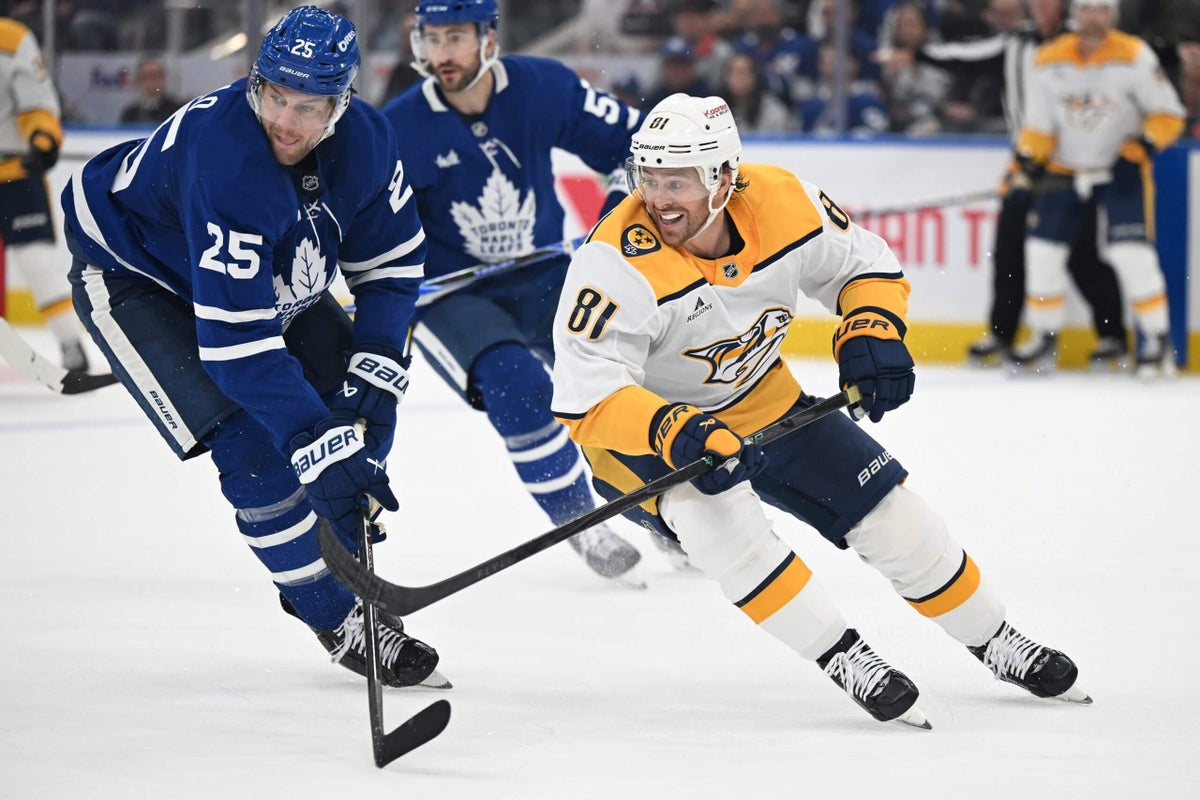
Maple Leafs general manager Brad Treliving has three options right now, it would seem, to shake up a team that’s now lost five games in a row.
One: do nothing. Wait for the storm that’s swept his team up right now to pass and get some injured players back too.
Two: replace head coach Craig Berube. The Leafs were in a similar spot when Mike Babcock was replaced on Nov. 20, 2019: in the midst of a similar losing streak (0-5-1) and owned the same kind of disappointing record (9-10-4). In fact, that team had a slightly better points percentage (.478) than this one (.474).
This isn’t a route that Treliving presumably wants to take with the only coach he’s hired as Leafs GM and it might not be one MLSE president Keith Pelley would endorse — not yet, anyway.
Which brings us to the third path: a trade.
Now, maybe the Leafs aren’t ready to deal prized futures just yet, if ever. So what about an old fashioned shake-things-up kind of trade? The kind that would have the Leafs deal someone they would be OK with moving on from in exchange for someone occupying a similar space elsewhere.
A trade like this is tricky to pull off for a variety of reasons. First, how many players do the Leafs have that a) they would be willing/eager to move but also b) represent some value to rival teams?
We can safely assume Auston Matthews, William Nylander, Matthew Knies and John Tavares aren’t in this discussion. Neither, presumably, are Chris Tanev and Jake McCabe. As the most prized of those futures, Easton Cowan is off the board too for now. Nick Robertson has also unexpectedly played his way into useful status. Even if the Leafs are willing to consider trading Morgan Rielly, he has four more years left on his contract and a full no-movement clause.
The Leafs could trade either of Anthony Stolarz or Joseph Woll, though it’s hard to see how trading a goalie helps anything. Same with moving Steven Lorentz, Oliver Ekman-Larsson or Nic Roy. All of Calle Järnkrok, Sammy Blais, Dakota Mermis and Philippe Myers are too minor to be worth anything.
That leaves a pool of Max Domi, Dakota Joshua, Matias Maccelli, Bobby McMann, Simon Benoit, Scott Laughton and Brandon Carlo where all bets are off. And even then, there are caveats.
Joshua has two more years left on his contract ($3.2 million cap hit) after this one. He has two goals in 19 games and Berube played him on the fourth line on Saturday. The Canucks surrendered him for a lonely fourth-round pick this past summer. Maccelli came to the Leafs in similar fashion, and his value hasn’t ticked up either. Would either one genuinely attract a suitor?
The Leafs could also move either McMann or Benoit, both of whom earn $1.35 million. Though he’s a free agent at the end of the year, McMann brings the kind of speed the team needs more of. And while Benoit has struggled of late, he’s hardly a problem on that kind of contract. Meanwhile, Laughton is on IR with an apparent concussion, cost a ton at last year’s trade deadline and is adored by the head coach (for what that’s worth).
Which brings us to the two most logical players to move: Domi and Carlo. Both are prominent enough players to deliver the splash quality that management would be looking for.
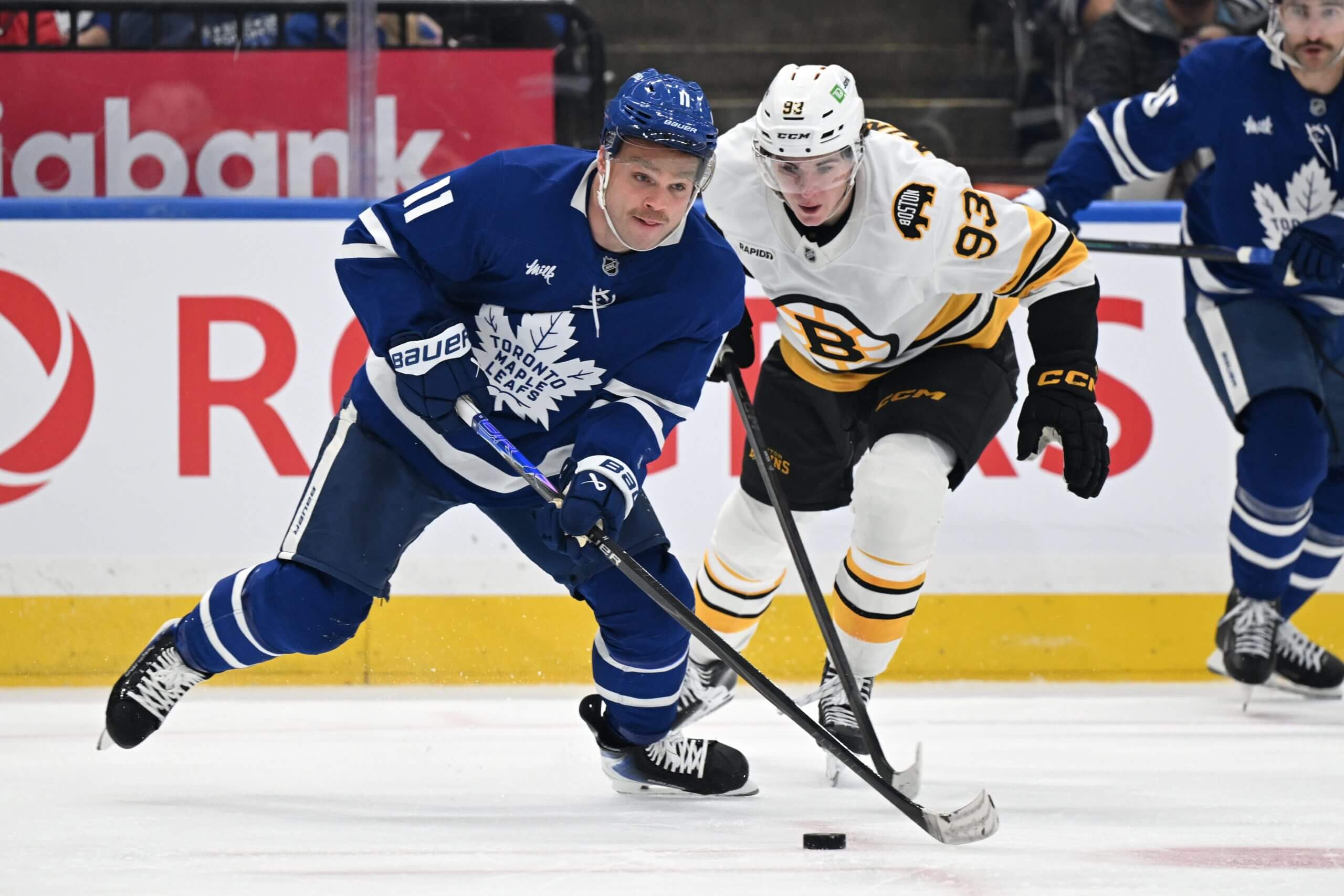
Max Domi has two more seasons left on his contract after this one. (Dan Hamilton / Imagn Images)
Domi is on pace for just 26 points and the Leafs have been outscored 18-8 in his five-on-five minutes. He has another two seasons after this one left on his contract, with a cap hit of $3.75 million. He’ll be 31 in March. All of those factors could make him a difficult player to trade.
It’s not hard to imagine, on the other hand, that Treliving could find a suitor for Carlo.
Though he’s struggled this season (and is hurt at the moment), he is also one of those coveted right-shooting defenders who also happens to be signed for another season at reasonable money, with a $3.48 million cap hit.
The problems with such a move are twofold:
Trade Carlo, and suddenly the Leafs have a gaping hole on the right side of their top four — assuming, of course, that a right-shot defender isn’t coming back in return. Tanev could be out a while longer. There is nobody internally capable of moving into Carlo’s spot, as the team was reminded again over the weekend in Myers’ rough minutes.
The Leafs traded so much — a first-round pick and Fraser Minten — to acquire Carlo that dealing him away for player(s) of questionable value would look awful.
That’s the other thorn in the trade path; what’s coming back might just be another problematic player/contract. If it’s one problem out for one problem in, is that really a good thing in the bigger picture for the Leafs?
The Nashville Predators, for instance, might be willing to play ball with Steven Stamkos, who has two more seasons left with a cap hit of $8 million. But even assuming Stamkos would be willing to accept a move to Toronto, he’s 35, would be a tricky fit in Berube’s lineup and doesn’t exactly offer the kind of skill set the Leafs need.
Stamkos’ teammate Jonathan Marchessault might be a slightly better fit, but he’s also due to turn 35 in December, has struggled himself this season and has three more years left on his contract at $5.5 million.
That said, Marchessault did have 21 goals and 56 points last season, and 42 goals the season before that. He could bring some juice to the Leafs’ top nine. If the Preds were willing to take Domi back in exchange, should the Leafs risk one additional season of an older player at a slightly higher cost? And would Nashville insist on getting back an additional asset, knowing or thinking the Leafs might be able to move Marchessault for something of value down the line? If so, the Leafs probably say no.
They might say no regardless, though it’s the kind of swap that’s at least worth thinking about.
Nine things I like, don’t like or find interesting right now
1. Cowan returned from the Marlies to play almost 17 minutes in Chicago, sixth most among Leaf forwards. He was slotted on a line with Roy and Knies and leapt immediately into a gig on the top power-play unit.
With how dangerous he looked, I think there was a case to even play him a little more, like in the final moments of regulation when the Leafs needed a goal and had the net empty. Instead, with 33 seconds left and a faceoff in the Chicago zone, Berube chose Domi.
2. The Leafs coach has tended toward this kind of thing throughout his tenure, leaning on Domi more than he should. In the immediate aftermath of Matthews’ injury, Berube chose to vault Domi from the fourth line to the second. In short, he opted to have Domi leapfrog Roy.
That plan was ditched against the Chicago Blackhawks Saturday.
It was Roy who lined up as the No. 2 centre of a line with Cowan and Knies, and they crushed it. Shot attempts were 13-3 in the Leafs’ favour over their nearly 11 minutes. (Domi, Maccelli and McMann logged the fewest minutes of any Leaf line. The Leafs were outscored 1-0 in their minutes and got outchanced 11-6.)
Roy, in particular, looked more dynamic with the upgrade in talent around him. He had a season-high five shots on a season-high seven attempts and also won 11 of his 19 faceoffs. It was probably his best performance of the season.
3. Another Roy-related development: He’s moved into a full-time role on the top penalty-kill unit.
Matthews held that role next to Mitch Marner last season. More and more, however, the Leafs were turning to Roy for first-unit duty even before Matthews was injured in Boston last week. The results might explain why: Though he’s logged the third-most shorthanded minutes of any Leaf (about 42), Roy has been on the ice for only three power-play goals against.
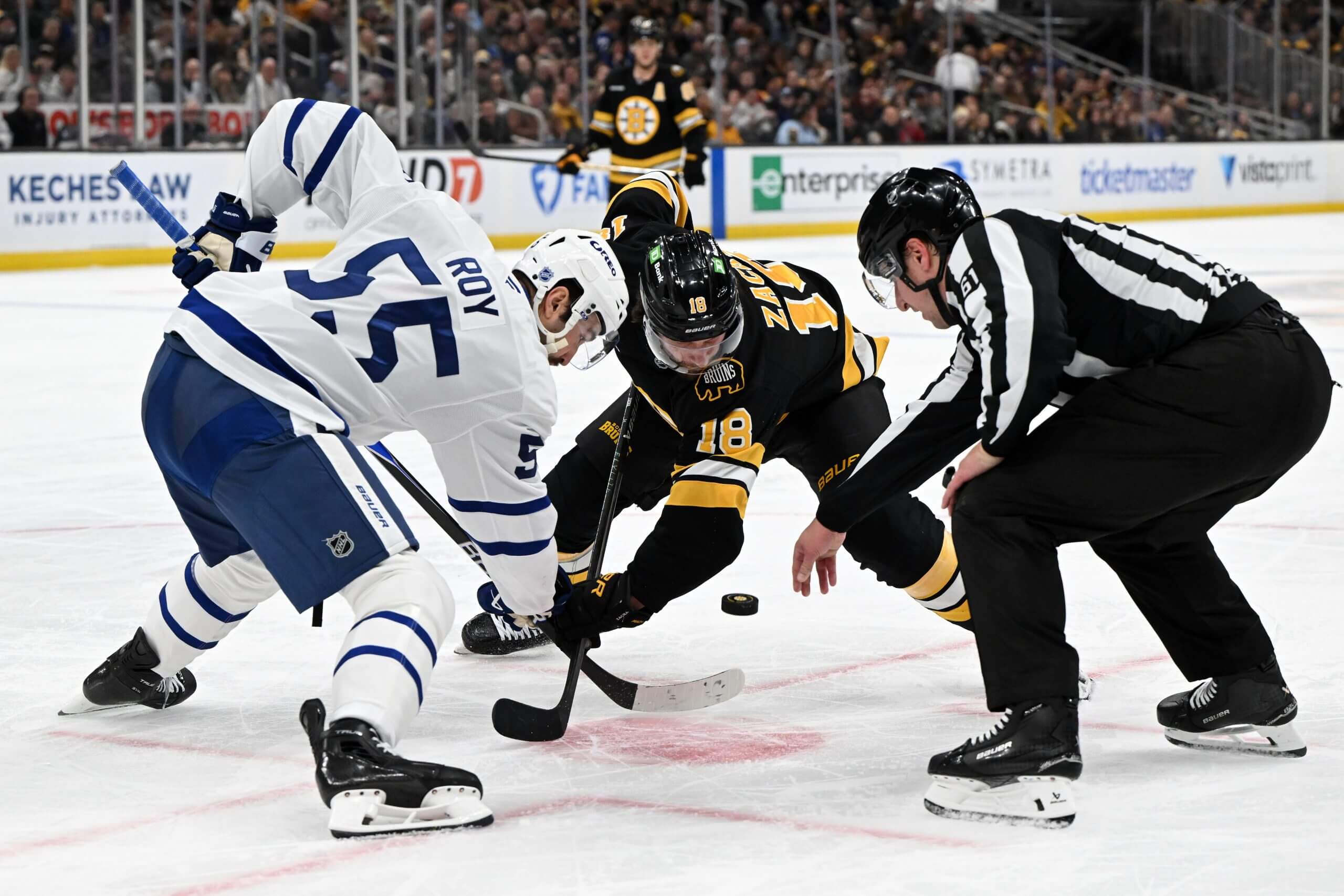
Offseason acquisition Nicolas Roy has watched his role continue to grow. (Brian Fluharty / Imagn Images)
4. How much will the Leafs lean on Woll in the coming weeks?
Stolarz’ status was “not serious and potential option to play” two nights after his injury in Boston, but he’s now on injured reserve, meaning he’ll miss a week’s worth of action at minimum.
Woll performed well in his season debut, stopping 29 of 32 shots. While the team has tried to replicate a training camp-like environment for him ahead of that start, it also has to be careful as Woll has struggled with injuries over the years. Too much too soon has obvious risks that way.
The good news is that Dennis Hildeby, Woll’s backup at the moment, has looked pretty good in difficult circumstances (.904 save percentage). The Leafs might just be OK with mixing him in here and there in the event Stolarz’ absence lingers.
5. The Leafs have given up the first goal in 11 of 19 games. That’s almost 60 percent of the time and one of the higher marks in the league.
6. Their time spent leading this season: 312 minutes and 48 seconds. Time spent trailing, on the other hand: 396 minutes and 28 seconds.
Last season, the Leafs led more (1854:05) than they trailed (1565:33). Frequently playing from behind has been a low-key sore spot all season.
7. The Leafs needed another right-shooting defenceman and they needed another defenceman who could move the puck, period.
Enter Troy Stecher.
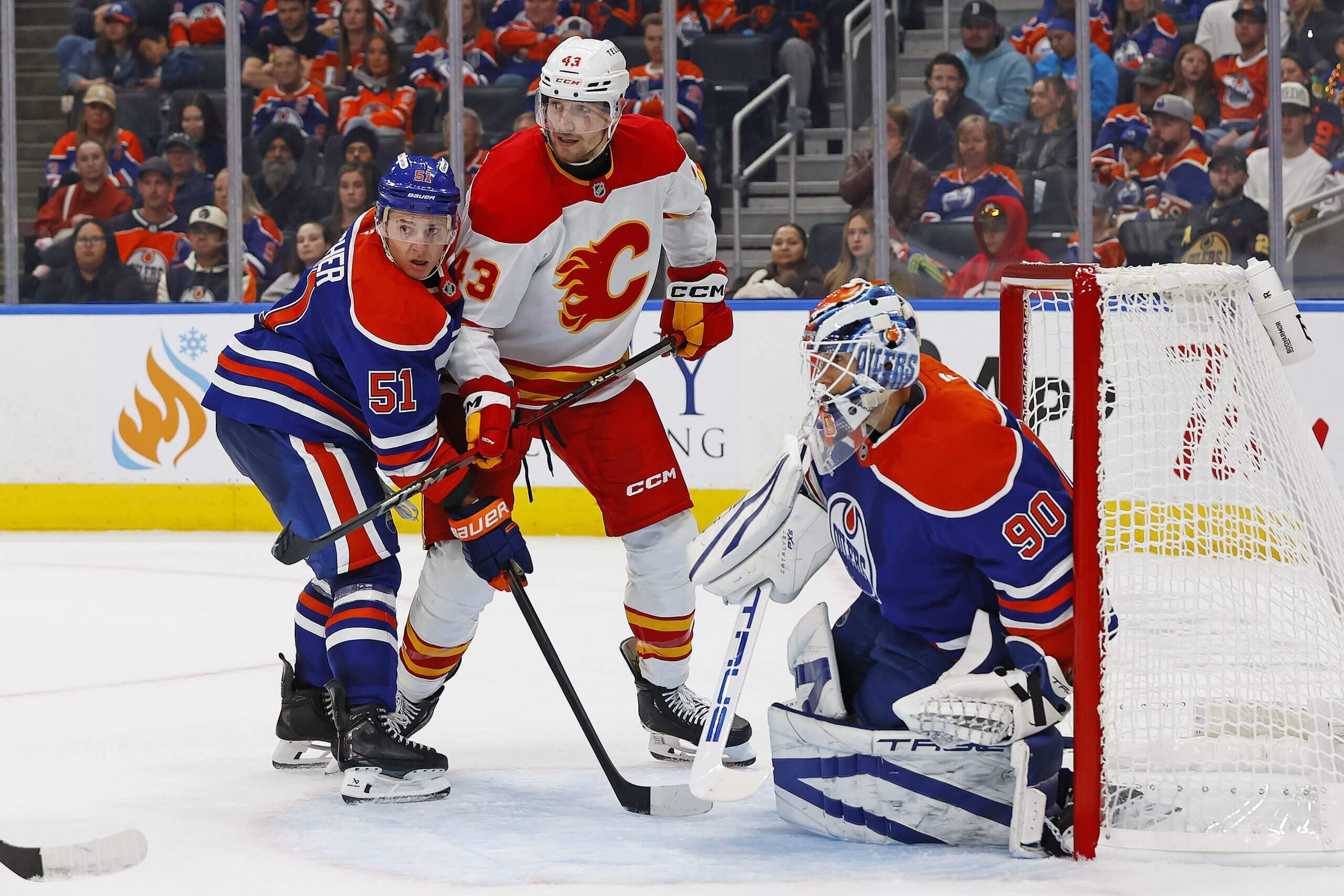
Troy Stecher isn’t a typical Leafs defenceman. (Perry Nelson / Imagn Images)
Stecher falls in the depth category. He struggled in sparse minutes with the Oilers this season (33 percent expected goals) and is not a prototypical Treliving defenceman, standing at 5-foot-10 and 184 pounds.
Yet he should be an upgrade on at least one of Dakota Mermis or Myers. At worst, he’s one more righty option for Berube, who dressed five lefties in Chicago.
8. John Tavares’ three busiest nights of the season have been his last three games, which saw him slide into Matthews’ usual No. 1 centre spot. Tavares logged 20:41 on the night Matthews was hurt, 22 minutes two nights later against the Kings, and another 20 minutes in Chicago.
Before that, Tavares hadn’t logged 20 minutes in a single game all season.
9. One thing the Leafs very much lack in the wake of David Kämpf’s contract termination: centre depth. With Matthews’ and Laughton’s injuries, the Leafs are playing Domi and Lorentz out of position.
The Marlies lack an obvious option were another injury to pop up. There’s Logan Shaw (who hasn’t played in the NHL since 2021-22) Luke Haymes (who hasn’t played in the NHL ever) and Jacob Quillan (who got into one game last season).
In the end, getting out from under Kämpf’s contract was positive for the Leafs. And yet, for a team that wasn’t exactly overflowing with legitimate NHL centres, they still might have been better off simply hanging onto him to start the season instead of banishing him in favour of Blais.