
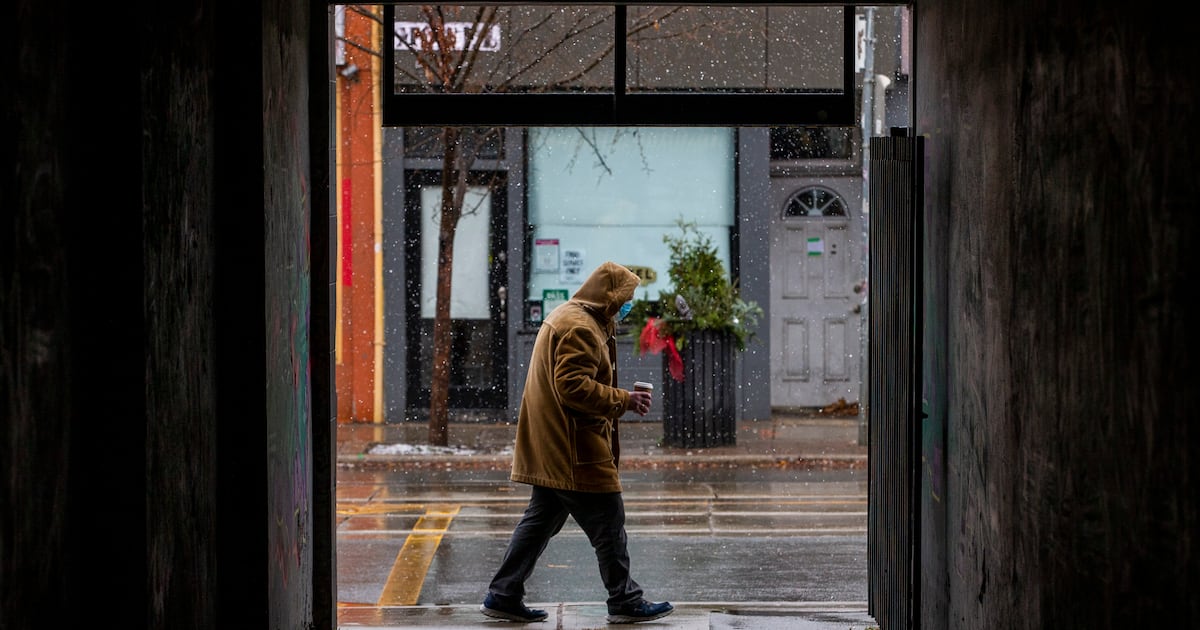
More than 35,000 households left the Greater Toronto Area for other parts of Canada last year with Simcoe County, Hamilton and Calgary topping the list of destinations, new data obtained by CTV News Toronto shows.
The data compiled by Environics Analytics, a marketing and analytical services company owned by Bell Canada, found that nearly 250,000 GTA households moved between the first quarters of 2024 and 2025, however the vast majority of those relocations were within the same census area – for example a Toronto resident moving to another neighbourhood within the city.
Of the 68,173 households that moved to another region, about 51.5 per cent (35,140) left the GTA altogether. Meanwhile, 48.5 per cent (33,033) relocated to other regions within the GTA.
The top destination for former GTA residents was Simcoe County, accounting for 10.4 per cent of movers (3,651 households), followed by Hamilton, Ont. (3.2 per cent), Calgary, AB (3.1 per cent), Waterloo, Ont. (2.9 per cent), Greater Vancouver (2 per cent) and Niagara Region (1.9 per cent).
There was also a notable number of households relocating to more rural communities a few hours from the GTA, with 1,174 households leaving the GTA for Middlesex, Ont. and 1,101 households moving to Wellington, Ont.
Researchers used government demographic data, Statistics Canada sources, and anonymized mobile device movement data to estimate migration patterns. They say the approach provides a snapshot of where Canadians are moving — and how frequently.
‘Driving till you qualify,’ one expert explains
Real estate experts say this outflow isn’t a sudden exodus but rather a continuation of long-term migration patterns largely driven by affordability.
“It’s not new at all. It’s something that we’ve seen for years. It’s called driving till you qualify,” said James Milonas, managing director at The Agency brokerage.
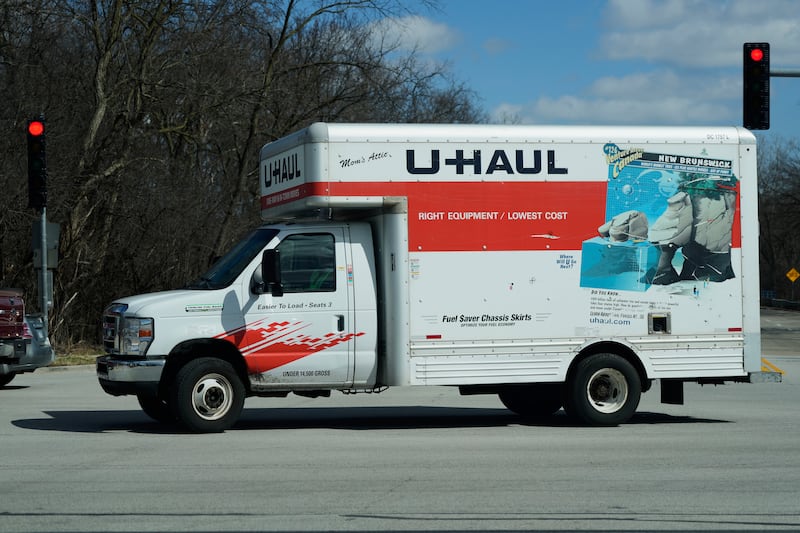 U-Haul A U-Haul truck is seen on the street in Mount Prospect, Ill., Monday, March 24, 2025. (AP Photo/Nam Y. Huh) (AP)
“If your budget is $500,000 and that gets you a one-bedroom apartment downtown, but you need a three-bedroom freehold, you’re going to drive to Belleville, Hamilton, Niagara, or Sudbury.”
Milonas said the trend has accelerated over the past decade, often tied to housing costs and shifting work patterns.
“Whenever the market gets too expensive in Toronto, people flock to Hamilton,” he said, adding that younger families are increasingly seeking space and affordability beyond the city limits.
What are the top destinations outside the GTA?
Toronto real estate agent Michael Devanathan said the numbers align with what he’s seeing from clients in the Toronto area.
“In the last one or two years, I’m seeing a growing minority of sellers explicitly tell me they’re moving to Barrie, Waterloo, Hamilton, or even Calgary and Halifax,” he said.
“Family sellers are cashing out on their GTA semi or townhouse and buying a detached with a bigger lot in those smaller markets.”
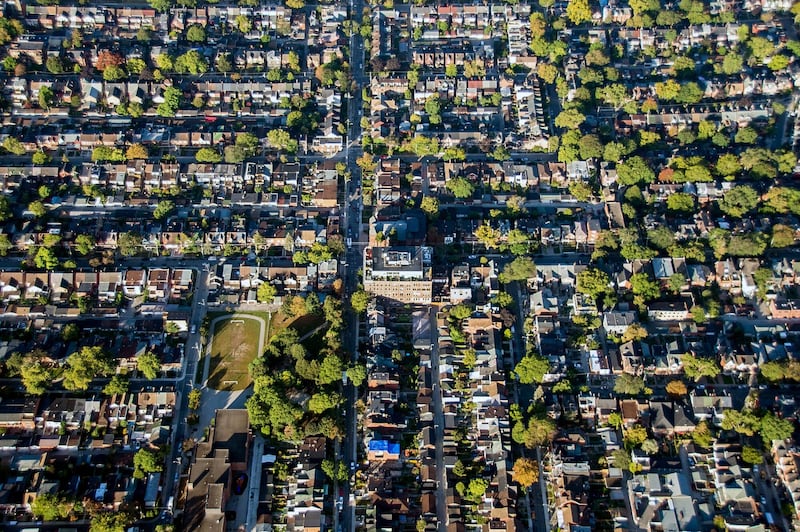 Homes in Toronto Homes in Toronto. Photographer: James MacDonald/Bloomberg (James MacDonald/Bloomberg)
Giles Gherson, president and CEO of the Toronto Region Board of Trade, said the number of people leaving is also not surprising, pointing to a recent board survey that revealed 65 per cent of respondents considered leaving the GTA due to traffic congestion.
“If you look at Calgary or Edmonton, there’s a sense that the economies are very strong there, and people go where they think there’s opportunity,” he said. “If we can’t get a handle on congestion and housing, then it’s going to be harder for people who come here, to remain here.”
Immigration levels offsetting the loss
Despite the outflow, the population across the GTA continues to grow — mainly due to immigration.
Toronto’s population surpassed seven million this year, with nearly 300,000 newcomers arriving in the last year alone. The Toronto Regional Real Estate Board’s (TRREB) Jason Mercer said out-migration is a long-standing pattern.
“The share of transactions being reported by our members outside of the GTA proper has been growing,” Mercer said. “That’s something we’ve (also) noted over the last decade.”
 Jason Mercer Toronto Real Estate Board’s market analysis director Jason Mercer speaks at a presentation by the Toronto Real Estate Board of their mid-year forecast update to the media in Toronto on Thursday July 6, 2017. THE CANADIAN PRESS/Chris Young (THE CANADIAN PRESS)
Mercer said the pandemic and hybrid work arrangements gave more households flexibility to move farther from the urban core.
“We want policymakers to remain focused on bringing on more supply, especially that type that bridges the gap,” he added.
That reality is reflected in what realtors explain as being “priced out,” where most families struggle to decent sized homes near the big city.
“My clients are pretty much like we eat, sleep, breathe, and live Toronto… but no one wants to live in a 400-square-foot one bedroom condo,” Milonas said.
Earlier this year, a CivicAction report described the working middle class — including nurses, teachers, and essential workers — as “the invisible poor,” warning that rising housing and living costs could soon push them out of the region.
Have you recently left the GTA? Are you on the fence? Tell us your story
Are you currently considering leaving? Have you recently left the GTA for another city or region? We’d like to hear your story. What influenced your move — affordability, lifestyle, or something else?
Share your experience by emailing torontonews@bellmedia.ca with your name, general location, and phone number in case we want to follow up.
Your comments may be used in a future CTVNews.ca story.