
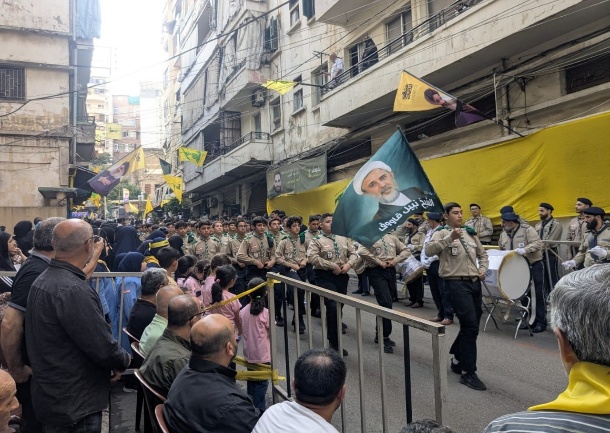
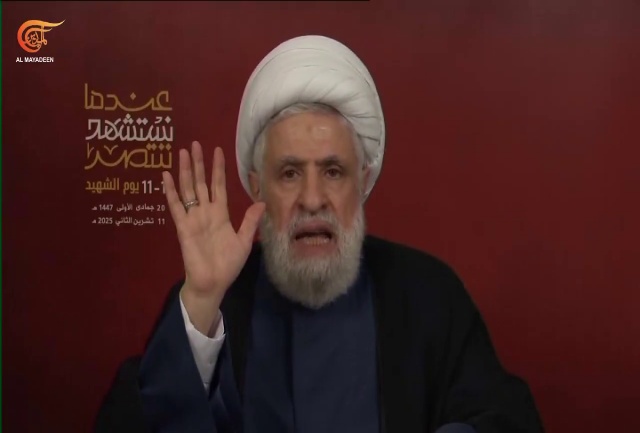
 Qassem delivers his Shaheed Day speech (al-Mayadeen, November 11, 2025).
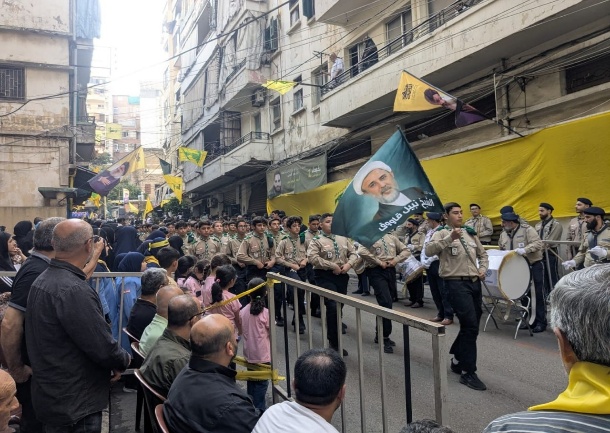 Shaheed Day procession in Beirut (al-Madan, November 9, 2025)
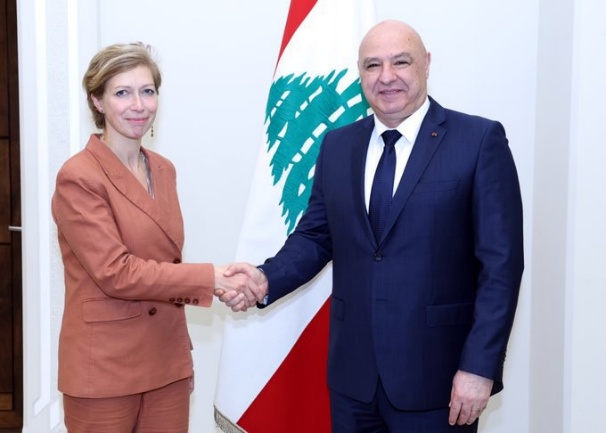 Aoun meets with Anne-Claire Legendre (Lebanese presidency office X account, November 13, 2025)
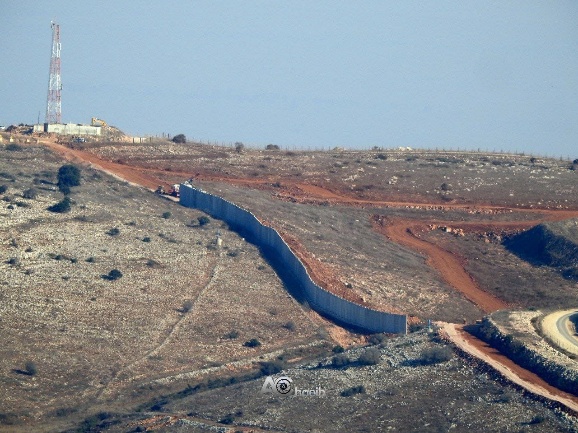 The new security wall built near the village of Yaroun (al-Jazeera, November 14, 2025)
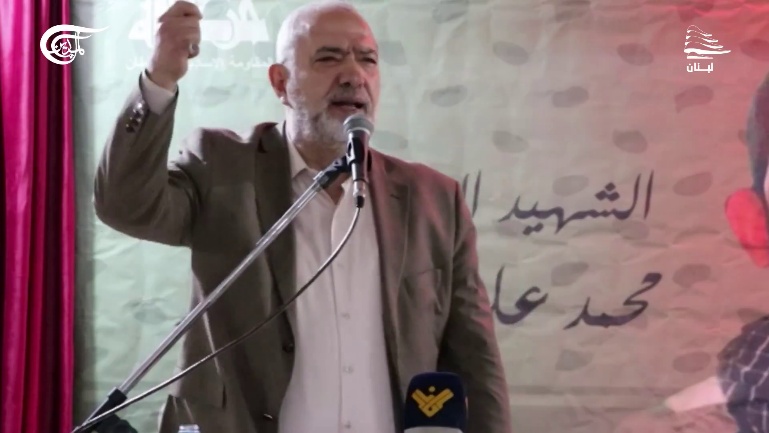 Mahmoud Qamati (Lebanese News Agency, November 10, 2025)
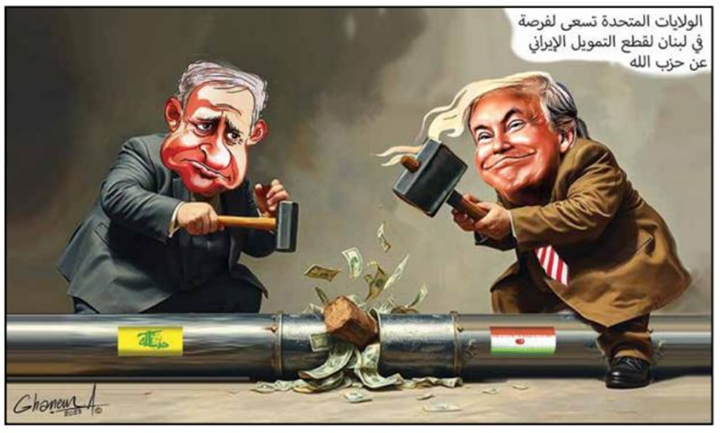 “The United States is exploiting the opportunity in Lebanon to cut off Iranian funding to Hezbollah” (al-Jumhuriya, November 10, 2025)Overview
IDF forces attacked Hezbollah facilities in south Lebanon and in the Beqa’a Valley and eliminated operatives of the organization as part of ongoing activity against Hezbollah’s presence in south Lebanon, in violation of the ceasefire understandings and because of the organization’s renewed attempts to regain its strength and rebuild its arsenal. A rocket launching site and facilities for the production and storage of strategic weapons were attacked, and a Hezbollah operative who also served as a school principal was eliminated.
Hezbollah secretary general Na’im Qassem threatened a possible response to the continued Israeli attacks. Another senior Hezbollah figure warned that Israel would achieve nothing with a new war in Lebanon or an escalation and “any aggression will be met with confrontation.”
Senior Lebanese government officials reiterated their support for opening negotiations with Israel which would lead to the implementation of the ceasefire agreement and the regulation of the border, and accused Israel of continuing “aggression.” It was reported that American officials who visited Lebanon concluded that there was no chance of progress and the American administration would allow Israel to carry out a powerful and brief attack on Hezbollah without sliding into a broad war. The aide to the speaker of the Lebanese parliament visited Iran and said he hoped it would stand by Lebanon “in the face of the challenges before us.”
UNIFIL protested to Israel over the construction of a new security wall, claiming it penetrated Lebanese sovereign territory. The IDF denied UNIFIL’s claims of deliberate gunfire at a UN force in south Lebanon.
The Lebanese army reportedly refused Israel’s demand to conduct searches for Hezbollah weapons in private homes in south Lebanon for fear of confrontation with operatives of the organization and its supporters. A senior Hezbollah figure claimed the organization had the right to refuse external pressures to disarm.
Given the growing pressure from the American administration to block Hezbollah’s funding, Lebanon’s central bank announced there would be tighter supervision on unauthorized institutions and illegal money transfers. Hezbollah warned that it would respond to an attempt to disrupt the activities of the al-Qard al-Hasan Association, the organization’s economic arm.
The Instability of the Ceasefire[1]
IDF activity to prevent Hezbollah from renewing its arsenal
During the past week, the IDF attacked Hezbollah targets in south Lebanon which violated the ceasefire agreement of November 27, 2024 prohibiting the organization’s presence south of the Litani River. The forces also attacked Hezbollah’s military capabilities and efforts to rebuild its arsenal and regain strength in south Lebanon and the Beqa’a Valley. An aerial attack targeted a rocket launching site, facilities for the production and storage of strategic weapons, and an underground terrorist facility, and ground forces operating in south Lebanon destroyed weapons and structures used by Hezbollah for terrorist activity. In addition, a Hezbollah operative who also served as a school principal in the town of al-Mansouri in south Lebanon was eliminated (IDF spokesperson, November 10–17, 2025). The Lebanese ministry of health reported one killed and four wounded in IDF attacks (al-Nashra, November 10–17, 2025).
According to reports, on November 13, 2025, a UAV targeted a vehicle in the town of Toul in the Nabatieh area and grenades and other weapons were found near the car (Lebanese News Agency, November 13, 2025). The IDF spokesperson stated that there had been no Israeli attack in the town and that the explosion was caused by a failed attempt by Hezbollah to transport weapons (IDF spokesperson, November 14, 2025).
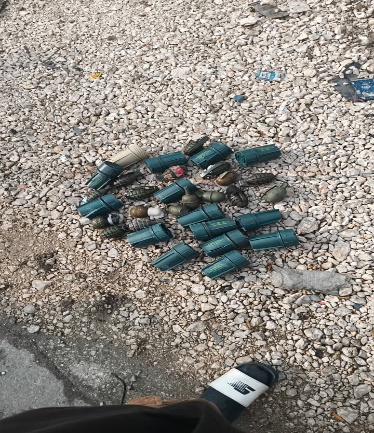
The grenades found near the vehicle (L’Orient Today, November 13, 2025)
“Lebanese security sources” claimed that Israel conducted an electronic warfare operation which targeted Hezbollah sites in south Lebanon and in other areas in the Dahiyeh al-Janoubia in Beirut, including the organization’s communications networks, UAV guidance systems and air-defense radars. According to the report, it was the largest electronic interference operation since the Second Lebanon War and was perceived as a final warning before a possible war (Aram News, November 12, 2025).
Hezbollah
Senior Hezbollah figures rejected any possibility of negotiations with Israel and demanded that state institutions take action against Israel’s “violations and aggression.” They also reiterated the importance of the “resistance,”[2] with threats to respond to “Israeli aggression:”
Hezbollah secretary general Na’im Qassem delivered a speech for Shaheed Day in which he claimed that Israel was trying to draw Hezbollah into direct confrontation by violating the ceasefire agreement, but the attempts had failed. He claimed that the agreement dealt only with the area south of the Litani River,[3] and therefore demanded that Israel withdraw from Lebanese lands, cease fire and release the “prisoners” it held. He said the existing agreement was acceptable to Hezbollah, since it included the deployment of the Lebanese army south of the Litani, and therefore was a victory for the “resistance,” as the state undertook to fulfill its security role. Qassem accused the United States and Israel of interfering in Lebanon’s affairs, its army, its economy and its status. He claimed United States wanted, through Israel, to end the role of the “resistance” in Lebanon and to expose it to “aggression.” He also alleged that Israel sought to control Lebanon and turn it into its backyard as part of the Greater Israel plan. He said he would not hold discussions with those he called “servants of Israel,” and called on the Lebanese government to defend its citizens and not bow to American dictates. Qassem asked why the government’s agenda did not include a plan for restoring sovereignty and setting a timetable for it. He warned that “the aggression cannot continue forever, everything has a limit,” and reiterated that Hezbollah would not give up the weapons which allowed it to defend itself, especially in view of the [alleged] “existential threat” Israel posed to the organization (al-Nur Radio, November 11, 2025).
Right: Qassem delivers his Shaheed Day speech (al-Mayadeen, November 11, 2025).
Left: Shaheed Day procession in Beirut (al-Madan, November 9, 2025)
Hezbollah’s bloc in the Lebanese Parliament said in a statement said that the current national priority was for the state to fulfill its responsibility to protect its citizens against “the enemy that ignores its obligations under the ceasefire and daily attacks civilians” (Hezbollah combat information Telegram channel, November 13, 2025).
Hussein al-Hajj Hassan, a member of the Hezbollah faction in the Lebanese Parliament, claimed that the United States was not a neutral mediator but acted in Israel’s favor and for the sake of the “Zionist project.” He asked why a new agreement was necessary when the existing agreement for Israel’s withdrawal and the cessation of its “aggression” could be implemented (al-‘Ahed, November 15, 2025). His parliamentary colleague Hussein Jashi accused the United States of pressuring Lebanon’s power centers to sign an agreement under conditions dictated by Israel and of threatening sanctions if they did not comply. Hassan noted that figures in the Lebanese government were not reacting and appeared to accept the “American mandate” (al-Nashra, November 15, 2025).
Mahmoud Qamati, deputy head of Hezbollah’s political council, claimed Israel had deluded itself into thinking it had succeeded in imposing its conditions on Lebanon through international pressure and continued attacks. According to him, the reality was that “concern was evident within the entity,” which he said was reflected in increased diplomacy aimed at “saving face after its failure to achieve its goals.” He also warned Israel not to think of a new war in Lebanon or any similar escalation, because it would achieve nothing and “any aggression will be met with confrontation.” Qamati also called on the Arab states to support the continuation of the “resistance” and said they would not be able to disarm the organization (al-Manar, November 16, 2025).
The Lebanese Government
Senior Lebanese officials said they wanted to negotiate with Israel to implement the ceasefire agreement and regulate the borders, but accused Israel of not responding to proposals and continuing the “aggression.” They urged the international community to pressure Israel to implement the ceasefire:
Lebanese President Joseph Aoun said Lebanon was waiting for Israel’s response, to be conveyed through the United States, about the possibility of negotiating. He said the use of force was no longer effective and the time had come to turn to the power of reason. Aoun claimed that Hezbollah was not operating in the area south of the Litani and praised the Lebanese army for its efforts in the matter (Lebanese presidency X account, November 12, 2025). In response, Ali al-Maqdad, a member of the Hezbollah faction in the Lebanese Parliament, said President Aoun had noted that the organization coordinated and cooperated with Lebanon Lebanese army in every way possible, and had done everything UN Security Council Resolution 1701 required, contrary to Israel and other countries. Al-Maqdad accused Israel of wanting to take control of the entire area, and said that Lebanon’s defense was complete only because of the combined forces of the “resistance” and the army (Al Jazeera, November 13, 2025).
Meeting French President Emmanuel Macron’s adviser for Middle East and Africa affairs, Anne-Claire Legendre, Aoun noted the difficulties facing the Lebanese army in completing its deployment up to the southern border. He claimed the main obstacle was the continued “Israeli aggression” and the non-implementation of the ceasefire agreement signed in November 2024. He added that Lebanon welcomed any European cooperation to maintain stability in the south, especially in view of UNIFIL’s withdrawal, while emphasizing the importance of coordination with the Lebanese army (Lebanese presidency office X account, November 13, 2025).
Aoun meets with Anne-Claire Legendre
(Lebanese presidency office X account, November 13, 2025)
Lebanese Deputy Prime Minister Tarek Mitri also said his country had not yet received an Israeli response regarding the proposal to hold direct or indirect negotiations. He said any negotiation had to begin with respect for the ceasefire agreement and implementation of the understandings reached under it before discussion of other issues, but so far Israel had not responded. He stated that Lebanon met its obligations under the ceasefire agreement every day, unlike Israel, which he said “threatens major escalation” while no one deterred it. He added that Lebanon had no choice but to mobilize political and diplomatic support to confront the Israeli “escalation” (al-Arabi Network, November 11, 2025).
Lebanese Defense Minister Michel Mansa met with the UN coordinator for Lebanon, Jeanine Hennis-Plasschaert, to discuss strengthening the ceasefire monitoring mechanism. He noted the ongoing cooperation between the Lebanese army and UNIFIL regarding the implementation of Resolution 1701 in relation to the “continued Israeli violations.” He also called for international pressure to be exerted on the “Israeli occupation” (al-Nashra, November 11, 2025).
Nabih Berri, speaker of the Lebanese Parliament, claimed that for the 11 months of the ceasefire, the “resistance” had not fired a single bullet, the state had met all its obligations under the ceasefire agreement and Lebanese army forces had been deployed in the area, while Israel “had not implemented even one clause of the agreement.” Meeting with a delegation from the Lebanese Press Editors’ Syndicate, Berri said that Hezbollah had the right to rebuild itself and the claims about arms smuggling into the country were false (al-Nashra, November 15, 2025). He also said he opposed direct negotiations with Israel and supported only technical negotiations through the ceasefire monitoring mechanism (al-‘Ahed, November 15, 2025).
Ali Hassan Khalil, aide to the speaker of the Lebanese Parliament, visited Iran and met with the secretary of the Supreme National Security Council, Ali Larijani, with Foreign Minister Abbas Araghchi, and with the speaker of the Majlis, Muhammad Qalibaf. He and his hosts discussed bilateral relations and regional developments, including “the continuation of the aggression of the Zionist entity” against Lebanon. According to reports, Khalil said Lebanon appreciated Iran’s supported, adding that he there would be “a greater Iranian presence in facing the challenges before us” (Press TV and al-Alam TV, November 15–16, 2025).
According to reports, American officials who completed a visit to Lebanon concluded there was no chance of political progress because the Lebanese government had no intention of disarming Hezbollah, implementing reforms which would harm the organization’s funding, or advancing negotiations with Israel. Therefore, Washington would implement a new policy, which in its view would be more effective: the first and preferred stage would include the application of economic pressure, sanctions and a political blockade intended to choke Hezbollah and weaken its power in the Lebanese arena; the second stage, to be activated if the pressure did not yield results, would be a powerful but short and precise Israeli attack under close American supervision, to damage Hezbollah’s main military capabilities while avoiding a broad war or a collapse of the state which could allow the organization to expand its control (al-Jumhuriya, November 15, 2025).
Hezbollah’s Opponents
Fouad Makhzoumi, a National Dialogue Party member of the Lebanese Parliament, noted that the state had a short window of opportunity of only 60 days to carry out significant economic reforms and attract global investments. He called it “a one-time historic opportunity,” adding that the government could not afford to fail this time. He said that the Gulf states, Europe and the United States were prepared to extend a helping hand to Lebanon, and therefore action had to be taken quickly and decisively. He warned that if the government did not act swiftly, a historic turning point that could change Lebanon’s future would be missed. Regarding the situation in the south of the country, Makhzoumi emphasized that Lebanon’s sovereignty was the sole responsibility of the government and the army. He warned that chaos and the presence of militias in the south provided Israel with a pretext to remain in Lebanese territory. He said that genuine confrontation with the militias was the key to restoring sovereignty, attracting investments and building a better future for Lebanon (MTV, November 14, 2025).
Sami al-Jamil, leader of the Christian Phalange Party, said he was in favor of direct negotiations between Lebanon and Israel. He criticized the current approach of conducting talks through mediating parties, mainly the Americans, and questioned its effectiveness. He said that other aspects, such as whether they would be direct or indirect, were marginal compared to the importance of advancing the process itself. In his view, direct negotiations were expected to produce more effective results, since only Lebanon’s representatives could best defend the rights and interests of their country, not any external mediator (LBCI, November 10, 2025).
UNIFIL
UNIFIL forces in Lebanon reported that their teams had recently uncovered illegal weapons caches, tunnels, and facilities near several Lebanese villages close to the border with Israel, documented their findings and handed the ammunition over to the Lebanese army. According to UNIFIL, since the ceasefire agreement was signed between Israel and Lebanon at the end of November 2024, UN forces had uncovered 360 bunkers and 300 types of unexploded ordnance in south Lebanon. UNIFIL said they were trying to prevent escalation and ensure the safety of the residents of south Lebanon (Lebanese News Agency, November 12, 2025).
UNIFIL submitted an official protest to Israel following the construction of a new security wall near the village of Yaroun. According to UNIFIL, the IDF built the wall beyond the Blue Line, thereby infringing on an area of 4,000 square meters defined as Lebanese sovereign territory. It was further noted that additional measurements carried out by UNIFIL confirmed that a section of the wall in southeastern Yaroun crossed the Blue Line, and another wall built between Aita al-Shaab and Maroun al-Ras was also located south of the Blue Line within Lebanese territory. UNIFIL said that “Israeli presence and construction on Lebanese soil violate UN Security Council Resolution 1701 and Lebanon’s sovereignty and territorial integrity,” and called on the IDF to withdraw from all areas north of the Blue Line (UNIFIL Telegram channel, November 14, 2025). Lebanese President Joseph Aoun instructed Foreign Minister Youssef Rajji to file a complaint with the UN Security Council against Israel for building the concrete wall on the territory of the south of the country. Aoun requested that the complaint be accompanied by UN reports proving the existence of the wall and noting UNIFIL’s request for its removal (Lebanese presidency X account, November 15, 2025).
The new security wall built near the village of Yaroun (al-Jazeera, November 14, 2025)
UNIFIL accused the IDF of shooting at a UNIFIL force from an IDF position established inside Lebanese territory. According to the UN force, bullets hit about five meters from the UNIFIL soldiers, who were forced to take cover. UNIFIL claimed it was a violation of Resolution 1701, and called on the IDF to cease “any aggressive activity against or near the force’s soldiers” (UNIFIL Telegram channel, November 16, 2025). In response, the IDF spokesperson said IDF forces had identified two suspects in the Tel Hamamis area in south Lebanon. The forces fired warning shots and the suspects retreated unharmed. He noted that an investigation revealed that the suspects had been UN soldiers conducting a patrol in the area and had been identified as suspects because of poor weather conditions. The IDF spokesperson also emphasized that no deliberate fire had been directed at UNIFIL soldiers, and that the issue was being handled through official military coordination channels (IDF spokesperson, November 16, 2025).
Challenges to Hezbollah
Disarming Hezbollah
Hezbollah’s open letter related to disarmament and called the government’s decision regarding the exclusivity of weapons a “mistake,” exploited by Israel to impose the demand for the disarmament of the “resistance” throughout all of Lebanon as a condition for stopping its attacks, not only south of the Litani River. Hezbollah clings to the position that the discussion about the state’s monopoly on weapons can take place only within a national framework with the aim of reaching agreement on a comprehensive strategy for security, defense and sovereignty, and not as a response to a “foreign request or Israeli demand.”[4]
The deputy head of Hezbollah’s political council, Mahmoud Qamati, said the organization saw itself as “protecting Lebanon from external threats.” He claimed maintaining Hezbollah’s military strength was a guarantee for Lebanon’s “survival” and the preservation of its power, and shielded not only the state but all the regional countries. He claimed that in view of the “existential threats” facing the state, no political faction in Lebanon had the authority to align itself with “the enemy,” and in particular, American dictates should not be obeyed. He claimed Hezbollah had the right to refuse to bow to external pressures, and added that Syrian compliance with all American demands, without resistance, had not prevented “Israeli aggression” against it (Lebanese News Agency, November 10, 2025).
Mahmoud Qamati (Lebanese News Agency, November 10, 2025)
“Security sources in Lebanon” reported that Israel had conveyed a direct demand to the Lebanese army to increase its efforts to disarm Hezbollah, in particular to act more aggressively to locate and seize weapons, including conducting searches in private homes in south Lebanon. However, the army leadership rejected the demand, fearing that its implementation could ignite internal civil confrontations and harm regional stability. The Lebanese army emphasized that erecting roadblocks throughout south Lebanon prevented the transfer of weapons and reduced Hezbollah’s ability to operate in the area (Reuters, November 10, 2025).
Lebanese Deputy Prime Minister Tarek Mitri said the demand that Lebanon complete Hezbollah’s disarmament within 60 days could not be carried out, adding that “everyone knows it is impossible.” He said the pressure placed on Lebanon to hurry in carrying out the task did not correspond with the situation on the ground. He added that if there was a genuine desire to accelerate Hezbollah’s disarmament, the Lebanese army had to be provided with appropriate support (al-Arabiya, November 11, 2025).
Samir Geagea, leader of the Christian Lebanese Forces party, accused the Lebanese government of lacking political will to disarm Hezbollah. He said that among the government officials responsible for the issue he saw no determination to succeed. Geagea added that Lebanon was being left behind, and in his opinion, the Lebanese authorities were wasting time, dealing with trivialities instead of essentials (The National, November 13, 2025).
Combatting Hezbollah’s Funding[5]
“Lebanese security sources” reported that Hezbollah had recently been transferring money into Lebanon by importing packages of clothing and beauty products in which the money was hidden, using its economic branches outside Lebanon. According to the “sources,” the packages containing money were addressed to temporary import companies, some of them shell companies, while customs officers in Lebanon who were still linked to Hezbollah facilitated the passage of the packages at Beirut International Airport and the Beirut seaport. The “sources” noted that smuggling money in packages was faster than relying on currency exchange offices, which had become targets for surveillance and legal action. They added that Hezbollah periodically focused on changing its methods of money smuggling from abroad in order to complicate monitoring (Aram News, November 13, 2025).
“Sources” reported that as part of the emerging Egyptian initiative, assisted by the United States and France, to calm tensions between Israel and Lebanon, the president of Lebanon would play an important role in conducting financial audits of money officially entering the country. The “sources” said the United States and France were focusing on stopping Hezbollah’s funding, increasing economic pressure on the organization, and increasing the Lebanese army’s control over the border to prevent weapons smuggling from Syria or by air, which would militarily weaken the organization (al-Akhbar, November 10, 2025).
Following the visit of the senior delegation from the American Treasury Department to Lebanon, and reports that the Americans demanded their hosts toughen measures against Hezbollah’s funding sources and take practical steps within 60 days, Lebanon’s central bank announced the implementation of steps within the financial sector to remove Lebanon from the Financial Action Task Force’s gray list. Enhanced monitoring measures were applied to all unlicensed financial institutions, including money transfer companies, exchange firms, and other entities conducting cash transactions in foreign currencies and transferring them into and out of Lebanon. The central bank said it planned to take additional steps to tighten control over compliance with procedures by all entities operating in the financial sector (Lebanese News Agency, November 14, 2025).
“Sources in Lebanon” claimed Hezbollah had been informed of the state’s intention to implement financial measures against it, focusing on the al-Qard al-Hasan Association, the organization’s financial arm. According to the “sources,” measures included restrictions on the association’s operations, such the suspension of all banking activities and the use of ATMs (al-Hadath, November 15, 2025). However, Hezbollah did not conceal its dissatisfaction with attempts to reduce or completely block the organization’s economic activity:
“Hezbollah officials” said that the issue of al-Qard al-Hasan was like the issue of its weapons, and warned against any measures by Lebanon’s central bank (al-Diyar, November 15, 2025).
“Sources close to developments within Hezbollah” reported that the recent economic measures launched by Lebanon’s central bank, as well as those planned for the future, threatened the stability of the state and Hezbollah could not remain indifferent to the pressure being exerted on Lebanon whose objective was to cause internal conflicts (al-Diyar, November 17, 2025).
Hassan Azz al-Din, a member of the Hezbollah faction in the Lebanese Parliament, said the economic pressure being exerted on Lebanon was no less dangerous than pressures in other fields and could affect all the country’s residents. He claimed that the al-Qard al-Hasan Association was a central component of the organization’s economic activity and the measures against it were being presented as steps to dry up Hezbollah’s and the “resistance’s” sources of funding. He said that as the pressures increased, the “resistance community” strengthened its commitment to its struggle and its ability to continue operating. Azz al-Din also noted that there was a clear division of roles in the campaign being waged against Lebanon: Israel was responsible for applying military and security pressure, while the United States was leading the economic and political pressure, both on the state and on the society surrounding Hezbollah. In this way, he said, the external parties were trying to undermine the foundations of the resistance from within and without (al-‘Ahed, November 16, 2025).
“The United States is exploiting the opportunity in Lebanon to cut off Iranian funding to Hezbollah” (al-Jumhuriya, November 10, 2025)
Infiltrating Hezbollah
“Lebanese security sources” reported that the investigation of a spy network headed by a Ukrainian of Syrian origin revealed espionage activity of unusual scale, which included attempts to infiltrate sensitive facilities, including Beirut International Airport. According to a “security source,” the findings indicated an Israeli capability to operate within the airport, also relying on indirect assistance from Western entities. Internal Hezbollah investigations following the pager attack in September 2024 found that Israel had precise information on the organization’s communications systems deployment, commanders’ locations, meeting times, and routes of movement, a combination of human intelligence from agent networks and technological data from drones and advanced surveillance systems. Accordingly, Hezbollah reorganized its security mechanisms: conducting in-depth background checks on personnel in logistical and sensitive units, updating movement routes and communication channels, reducing senior officials’ exposure, using unconventional routes and means of transportation, and creating a more visible separation between civilian and military systems. In addition, after its call to disconnect home security cameras from the network, the organization reduced reliance on civilian facilities that could be used for intelligence gathering, and redeployed small units with constant movement to thwart patterns of aerial tracking. Meanwhile, Lebanese security forces intensified their activity against spy networks and arrested more than 30 suspects, including state employees, port workers, former officers, and foreigners. According to “sources,” one of the networks collected information on the movements of Radwan Force commanders and on weapons smuggling routes between Beirut, south Lebanon, and the Beqa’a Valley, and the information collected was allegedly used to improve the accuracy of some of the Israeli aerial attacks in Lebanon (Aram News, November 14, 2025).
The IDF Arabic spokesperson reported that Hezbollah’s Unit 121, which is responsible for assassinating the organization’s opponents, had killed Elias al-Hasrouni, secretary general of the Lebanese Forces Party in Bint Jbeil, in August 2023, disguising it as a car accident. The IDF spokesperson noted that even after the campaign against Israel, Hezbollah continued to operate Unit 121, which had previously carried out assassinations of journalists, Lebanese army officers, politicians, and other figures within the country who opposed the organization (IDF Arabic spokesperson’s X account, November 14, 2025).
The Reconstruction of Lebanon
According to a report, Hezbollah is carrying out a plan to promote its reconstruction and development in various areas throughout Lebanon. Its activity is measured and deliberate and maintains a planned course, even though the organization did not issue an official timetable for the implementing the plan. Hezbollah has reportedly been operating in a pragmatic way adapted to the changing security and political situation in Lebanon. The report further stated that the measures carried out on the ground showed the organization was prepared for a variety of scenarios, including the possibility of a sudden escalation, without clearly indicating the intention to slide into a comprehensive confrontation. According to prevailing assessments in the Lebanese arena, at this stage a large-scale war is unlikely, and the main emphasis is on maintaining internal stability and preventing deterioration into a confrontation that could exact a heavy price from all sides (Lebanon 24, November 15, 2025).
[1] For further information, see the October 2025 ITIC report, Hezbollah’s Reconstruction Efforts Amid the IDF’s Enforcement of the Ceasefire in Lebanon and the November 2025 report, Hezbollah’s defiance, the instability of the ceasefire andattempts to promote an Israeli-Lebanese dialogue
[2] Hezbollah and the Palestinian terrorist organizations operating in Lebanon.
[3] While the ceasefire agreement focuses on the area south of the Litani, it explicitly states that Resolution 1701 calls for the disarmament of “all armed groups in Lebanon” and that only the official forces of the state may bear arms. For further information, see the December 2024 ITIC report The Israel-Lebanon Ceasefire Agreement The Lebanese Point of View
[4] For further information, see the October 2025 ITIC report, Implementation of the Lebanese Army’s Plan to Disarm Hezbollah: Status Report and the November 2025 report, Hezbollah’s defiance, the instability of the ceasefire andattempts to promote an Israeli-Lebanese dialogue
[5] For further information, see the November 2025 ITIC report, Iran Assists Hezbollah’s Post-Ceasefire Reconstruction
[6] Hezbollah, its supporters, the Palestinian terrorist organizations operating in Lebanon and their supporters
Related Articles