
It’s not because we didn’t build enough motorway lanes. It’s because we didn’t build in the places that make the most sense.
Every morning around 7am, a queue forms from Papakura to the city centre. The northern motorway jams up at Albany. The entire suburb of Massey turns into a carpark. The snarl-ups are treated as an immutable fact of life, regular as the sunrise and reliable as a Top 10 holiday park. Politicians occasionally talk half-heartedly about unclogging the streets. They while away the years commissioning studies on budget-destroying motorway projects and talking up the queue-killing benefits of new schemes. Congestion charging, which has just been enabled by the government, looks like the best chance in a while to at least take the edge off the gridlock.
Even so, it’s unlikely to fully rid residents of the daily smorgasbord of delay that’s estimated to be costing them $2.6bn a year. Auckland’s traffic problems are, in large part, structural and inevitable, baked into the shape of the city and the planning documents that govern its growth.
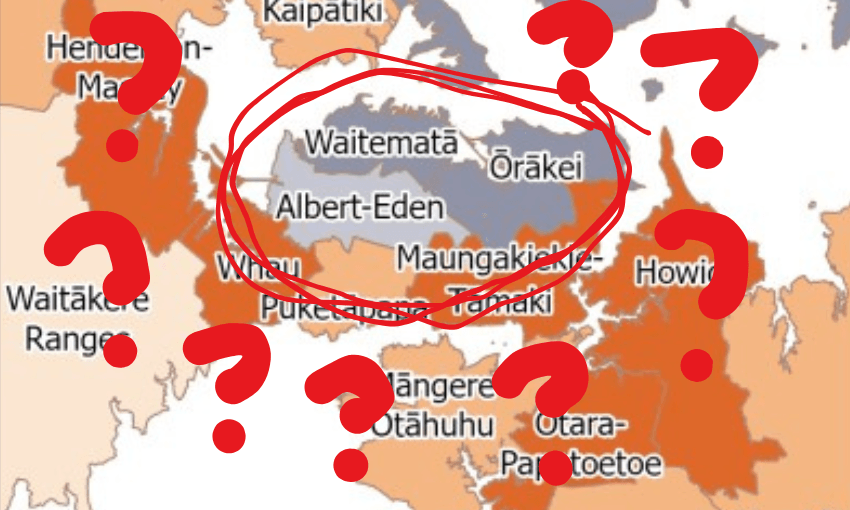
The root of the dilemma is starkly illustrated in a recent Statistics NZ release with the snappy title “Subnational population estimates: At 30 June 2025”. It contains a map showing New Zealand’s annual population change broken down by district. Selwyn is expanding. Ruapehu is shrinking. But inset is a breakdown of Auckland’s population data organised by local board area, and it reveals the city has got things, to use the official planning terminology, arse backwards.
 The central suburbs of Auckland are dying while the rest grow. (Image: Statistics NZ)
Not only are the central suburbs of our biggest city failing to grow; they’re shrinking at a rate similar to the Tararua district, which is home to a place RNZ described as “the town you’ve never heard of”. Though that may have been harsh to Herbertville, its growth still shouldn’t be on par with areas that sit next to the country’s most productive economic centre and a new $5.5bn rail line.
Wtf RNZ.
Instead of concentrating the city’s population in places with the best access to public transport, jobs and other amenities, Auckland has built the majority of its housing in Papakura, Howick, Hobsonville, the two Mills, and *gestures at every suburb west of the Te Atatū causeway*.
This isn’t a 2025 blip either. Back in 2019 and 2020, development data showed the exact same trends in motion. Auckland will do literally anything to avoid building houses in its central suburbs. Though its councillors like to talk about a “compact city”, subtly inferring they’re trying to encourage building around town centres and public transport, what they really mean is they’re compacting the entire city into the Te Atatū peninsula. Together with their planners, they’ve placed 42% of all residential land within 5km of the city centre under restrictive character protections, while allowing developers to go hog wild in the outer south, north, and west.
The big circles show growth. The littlest circles are around the city centre.
The effects are visible in the traffic compacting nose to bumper at rush hour on the motorways every morning. Auckland’s public transport is improving, and in some areas is even good, but it’s difficult to efficiently serve such a spread out city. For most trips, the residents making their home in Kumeu and Papakura are still going to have to drive. Some will travel to the city centre, some will stay local, and some will go to jobs across town, but unfortunately all of them will require a car, and one little-known fact is that traffic is made of cars. Greater Auckland’s Matt Lowrie sums it up. “As a city we have focused on spreading people out and that has resulted in people being more likely to have to drive, and therefore we have more congestion,” he says.
By contrast, Auckland’s inner suburbs have everything you need to minimise car journeys. They’re right next to the job market that generates 8% of our nation’s GDP and connected to both bike lanes and rapid transit. They’ve got parks and playgrounds. Regional amenities like the zoo are close by. If you got a chance to design the city from scratch, the central suburbs are where you’d put the housing.
Why haven’t we? Last week, a story came out in the Herald about a new nine-storey apartment development proposed for Freemans Bay. The Kubrick would be a landmark, with its striking purple brick facade and ground level circular windows. Neighboured on two sides by a park and another by a community centre, it could hardly make less of an impact on nearby residents. Despite that, 750 of those residents have banded together to protest. They’ve found an ally in the Herald, which warns that nine storeys “might not be the worst of it”, and a new plan pushed onto the council by the government could soon enable buildings of up to 15 storeys in the area.
There could be more housing like this right next to the city centre. The horror. (Photo: Auckland Council)
Councillors have always tended to listen to these wealthy inner suburb residents, who vote in large numbers and reliably show up to grumble at weeknight meetings in community centres. The rest of Auckland has been paying for their inhospitality in the form of hour-long commutes.
Where housing would go under a new plan change proposed by Auckland Council. (Image: Auckland Council)
But the Herald is right. Plan change 120 could soon allow more growth close to jobs, council facilities and the City Rail Link. For the first time in decades, Auckland is looking like it might approve housing in places where you don’t need a car to get everywhere. The plan is currently out for consultation, and the denizens of Freemans Bay will be definitely sending in their feedback. It’s unclear how many others will find the time. They might all be stuck in traffic.
An online submission form for plan change 120 is available on the Auckland Council website.