
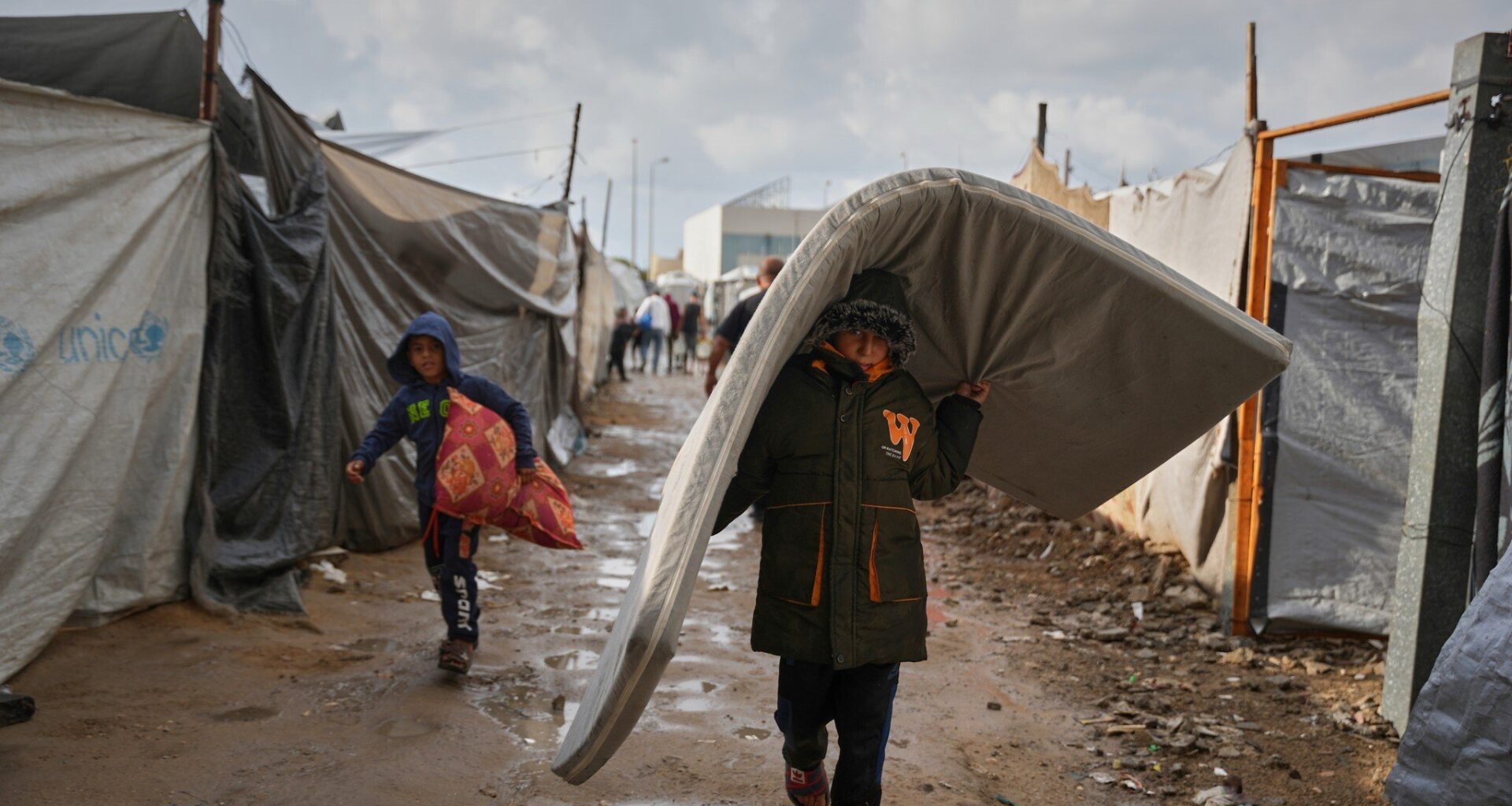
For months Gazans would come to Nasser Hospital in Khan Younis not for medical care but to seek shelter from Israeli missiles and shells falling throughout the Palestinian enclave.
Over the weekend, the crowds returned, this time seeking cover from an altogether less sinister, albeit still potentially calamitous, threat from the sky: rain.
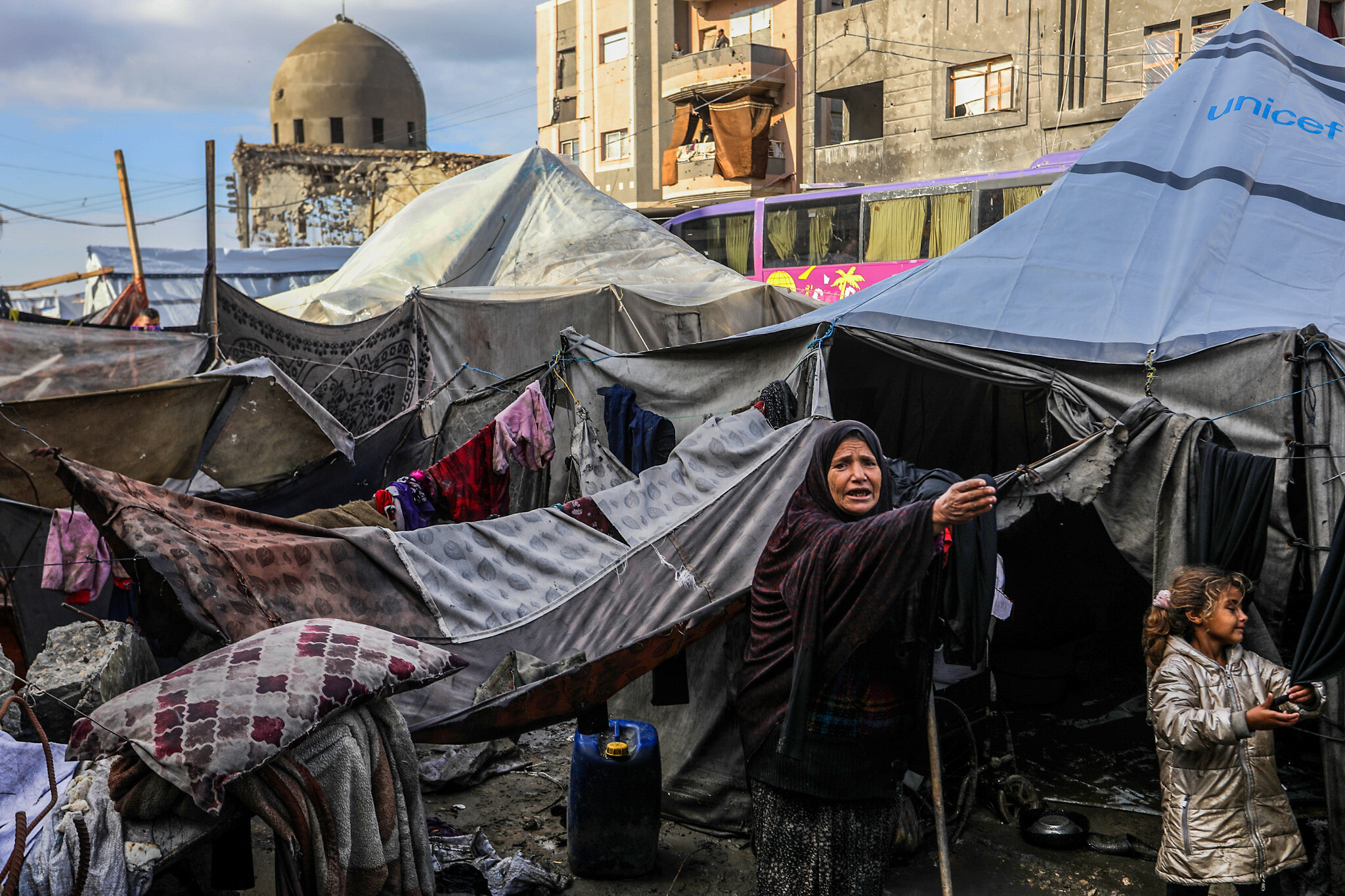
With postwar reconstruction barely underway, the sheets of cold rain and gusting winds that blew into the region over the weekend proved a ruinous start to winter for many in the Strip, where hundreds of thousands were forced to weather the storms in makeshift tents or exposed spaces, often on swiftly inundated ground.
“When the rain is very strong at night, the tents blow away in the wind. People come with their children and wives because they have nowhere else to go,” a doctor at Nasser told The Times of Israel by phone from the southern Gaza City.
Trauma cases, which overwhelmed the hospital during the war, have now all but stopped. Instead, the hospital is now dealing with an influx of people coming in for winter-related illnesses.
Get The Times of Israel’s Daily Edition
by email and never miss our top stories
By signing up, you agree to the terms
“There’s a big rise in patients with colds and flu. Many people are not living in sheltered places anymore — they’re in tents, exposed to rain and wind,” said the doctor, who requested anonymity for security reasons.
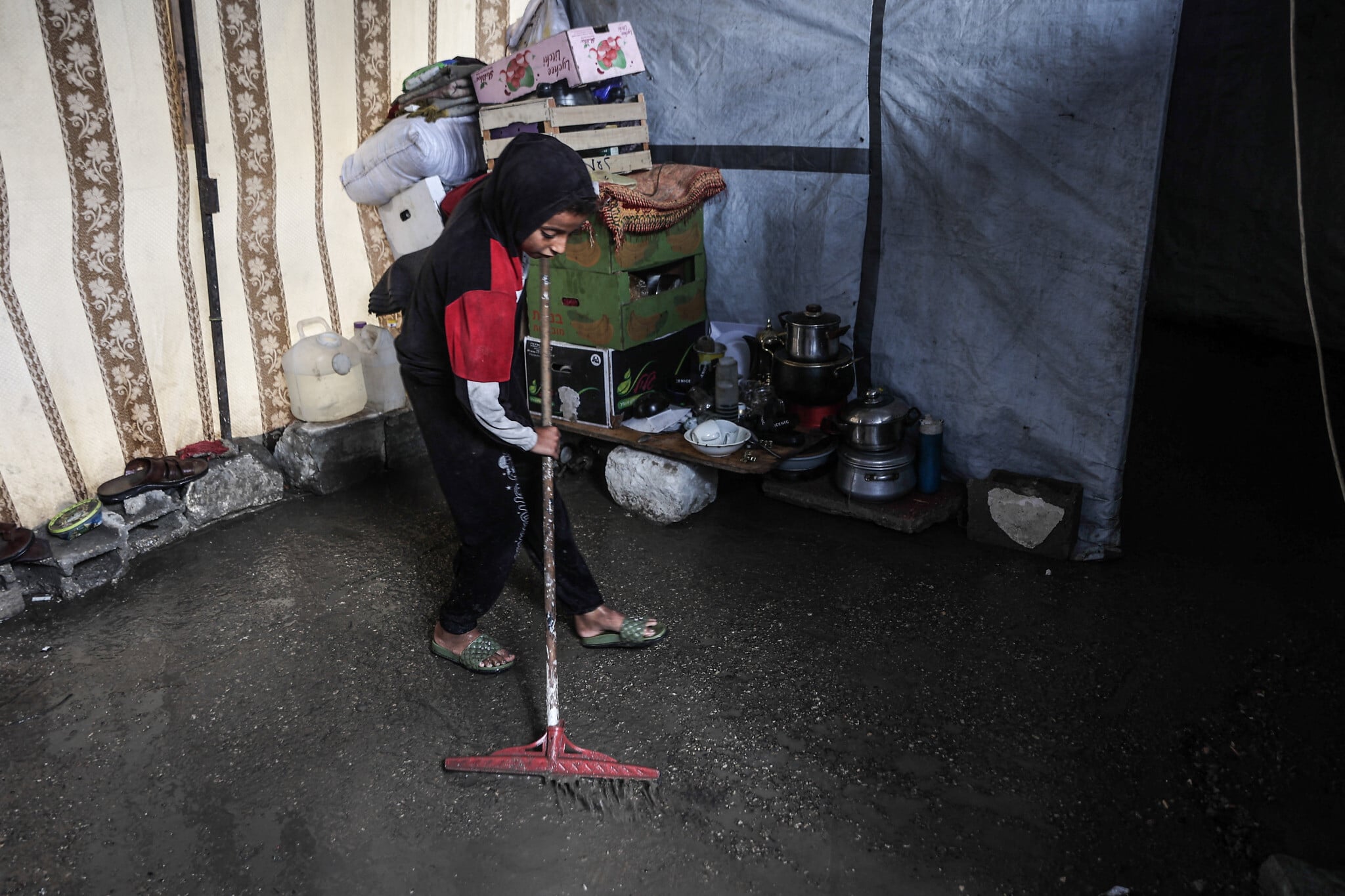
A Palestinian boy clears water from his shelter after the first winter rainfall in a displacement camp in Gaza City on November 14, 2025. (Omar al-Qattaa/AFP)
The region saw its first big rainstorm from Thursday to Sunday, with weather stations in Israel near the Gaza border measuring between 12 and 23 millimeters of the wet stuff falling, though Ashkelon on the coast, a little to the north, reported 92 millimeters, indicating an even larger deluge. (There are no internationally reporting weather stations working inside Gaza.)
In the camps’ low-lying areas, water pooled and accumulated before it could stream away toward the sea, leaving some children wading ankle-deep in water.
Images out of the enclave showed flooded tents and heavy damage to the meager possessions of displaced families living in temporary shelters.
Heavy rains are a yearly issue in the enclave, which lacks the infrastructure for proper drainage. At a camp housing the displaced in Gaza City, residents struggled to stay dry.
Nura Abu el-Kass, another displaced woman from the camp, said she found her mattress, blankets and clothes all soaked.
“My son sent me this tent, but it doesn’t protect us [from rainwater]. What am I supposed to do,” she asked.
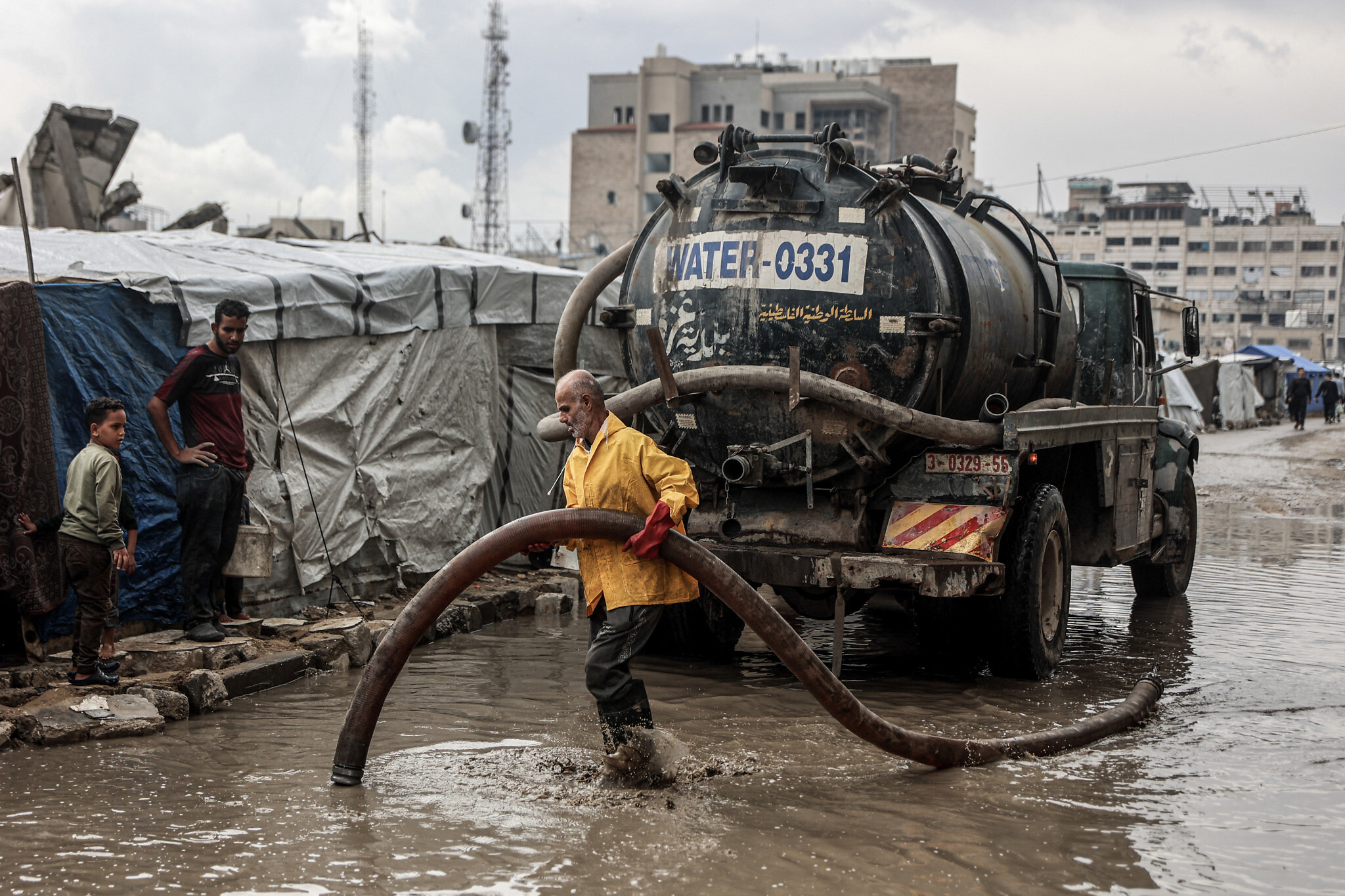
A Palestinian man clears stagnant water from the road near a displacement camp after the first winter rainfall in Gaza City on November 14, 2025. (Omar AL-QATTAA / AFP)
Some 13,000 households were damaged by the rainfall, the UN Office for the Coordination of Humanitarian Affairs said on November 15.
“Hundreds of tents and makeshift shelters across the Strip were reportedly flooded, leaving households exposed to harsh weather, loss of belongings, and heightened protection and health risks, particularly for people with disabilities, older persons, and other vulnerable groups,” read an OCHA statement.
The cold is also increasingly becoming an issue, with tents unable to keep out frigid drafts.
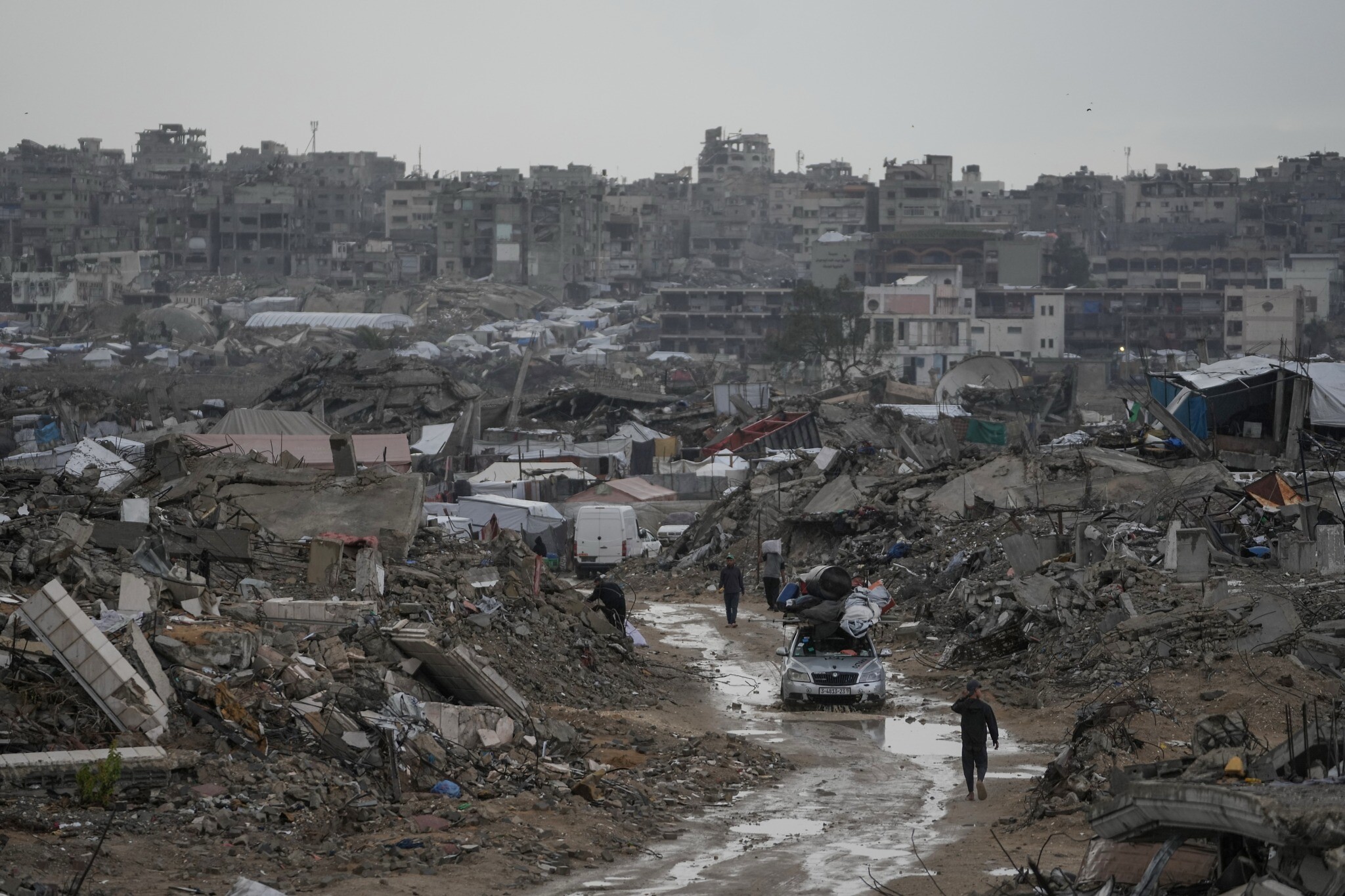
A car drives along a muddy road amid destroyed buildings in the Sheikh Radwan neighborhood of Gaza City, Friday, Nov. 14, 2025. (AP/Jehad Alshrafi)
In the south Gaza city of Khan Younis, Mohammed Shabat and his family were also struggling because of the weather, as cold drafts have been seeping through their tent’s openings.
“We live in a cemetery, and I have a baby. This tent does not protect us from the cold or the rain,” said Shabat, who lives with his wife and five children in a tent wedged between graves. “Soon winter will come, and it will be very difficult.”
Sitting by a stove built out of stacked concrete blocks, Shabat’s wife Alaa was preoccupied with the coming cold.
“A tent is not a safe place to live with young children. The cold wind penetrates the tent in the evening and the temperature is very low,” she said.
Tent hunting
Humanitarian groups operating under the UN estimate that roughly 1.5 million of Gaza’s approximately 2 million people are currently living in makeshift structures such as tents, due to widespread destruction caused by Israeli airstrikes and ground fighting during the war.
Finding new tents for those who lost theirs to the rain can be difficult. Anas Arafat, a Gaza City resident who lives in an apartment, said he had been searching for something for his brothers, who were flooded out, leaving them on the street.
“I’m trying to find new tents for them, but a tent costs $500,” Arafat told The Times of Israel.
Humanitarian organizations have been distributing free tents in recent days, while private traders are also importing and selling them. Arafat said he knows of families selling their tents in order to get cash for food and basic necessities.
In a November 12 presentation, the Palestine Shelter Cluster, which coordinates the import and distribution of humanitarian goods among UN-affiliated groups, reported that over 50,000 tents had entered Gaza since September, though only around 14,000 had been distributed. Another 7,600 were stolen, it said.
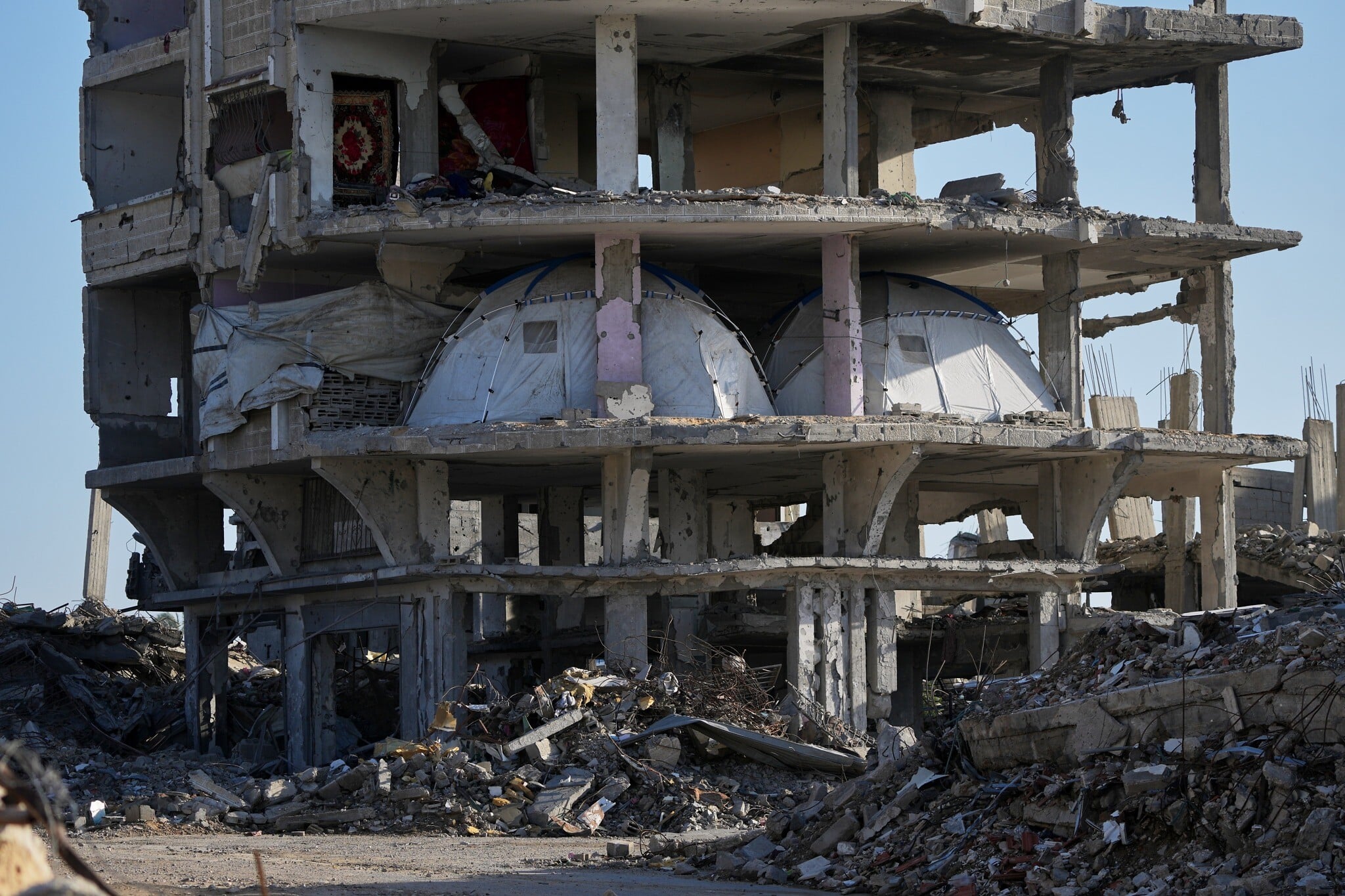
Tents are set up inside a gutted apartment building in Khan Younis, in the southern Gaza Strip, Saturday, Nov. 15, 2025. (AP/Abdel Kareem Hana)
Officials say that various factors can prolong the process of distributing goods from warehouses to families, since there is a need to assess and identify those most in need.
A humanitarian source who spoke to The Times of Israel on condition of anonymity said humanitarian goods were getting into the Strip, but more were needed.
“In recent months, humanitarian groups have distributed 8,000 free tents in Gaza, along with 80,000 tarps and 50,000 blankets — and more are coming in. But we are talking about more than 2 million people, most of whom need shelter support,” they said.
Aid organizations are operating on both sides of the so-called Yellow Line separating parts of Gaza under Israel Defense Forces control from areas where the army has pulled out of and where most Palestinians live, the source said. Coordination on the IDF side is more restrictive due to the army’s presence, they added.
Palestinians remove water from their tents after a rainstorm at the Austrian Quarter in Khan Younis, in the southern Gaza Strip, November 16, 2025 (Abed Rahim Khatib/Flash90)
“There is need everywhere, because people live on both sides of the line. But there are far more people in the western part of the Strip, which is not under Israeli control, so the need is much greater there,” the source said.
While the flow of aid has ramped up since the start of a ceasefire last month, aid officials say Israel is continuing to restrict goods. The humanitarian source said multiple requests to import aid were being rejected daily.
“For example, on November 16, organizations tried to bring in biscuits and it was rejected on the grounds that such products ‘are not in policy’ — meaning not on the list of items Israel allows in,” he said. “Mangoes, educational supplies, and toys are also not being allowed in at the moment.”
A humanitarian source told AFP that restrictions also remained on many materials required for building shelters, such as certain types of tent poles.
COGAT, the Israeli Defense Ministry body that coordinates the entry of goods into the Strip, did not respond to a Times of Israel request for comment on the matter.
‘800 trucks daily’
The volume of aid entering the Strip has been a point of contention between Israel, Hamas, and the international community since the war began.
Under the ceasefire agreement, Israel committed to allowing 600 trucks of goods into Gaza daily, or 4,200 per week. The number is meant to include both humanitarian aid meant for free distribution and goods imported by private traders for sale commercially.
COGAT has stopped publishing data on the number of trucks entering the Strip since the ceasefire began, and did not respond to a Times of Israel request for the figures.
However, on November 14, the US military’s Central Command, which is monitoring the implementation of the ceasefire from a command center in Kiryat Gat inside Israel, announced that 800 trucks had entered the Strip daily from November 9 to November 14, up from 600 trucks per day in previous weeks.
“More than 40 nations and international organizations at the CMCC are coordinating to deliver and distribute commercial goods and aid to Gazan civilians,” CENTCOM added, using the acronym for the ceasefire monitoring mechanism.
Hamas, however, claims the volume is far lower than agreed.
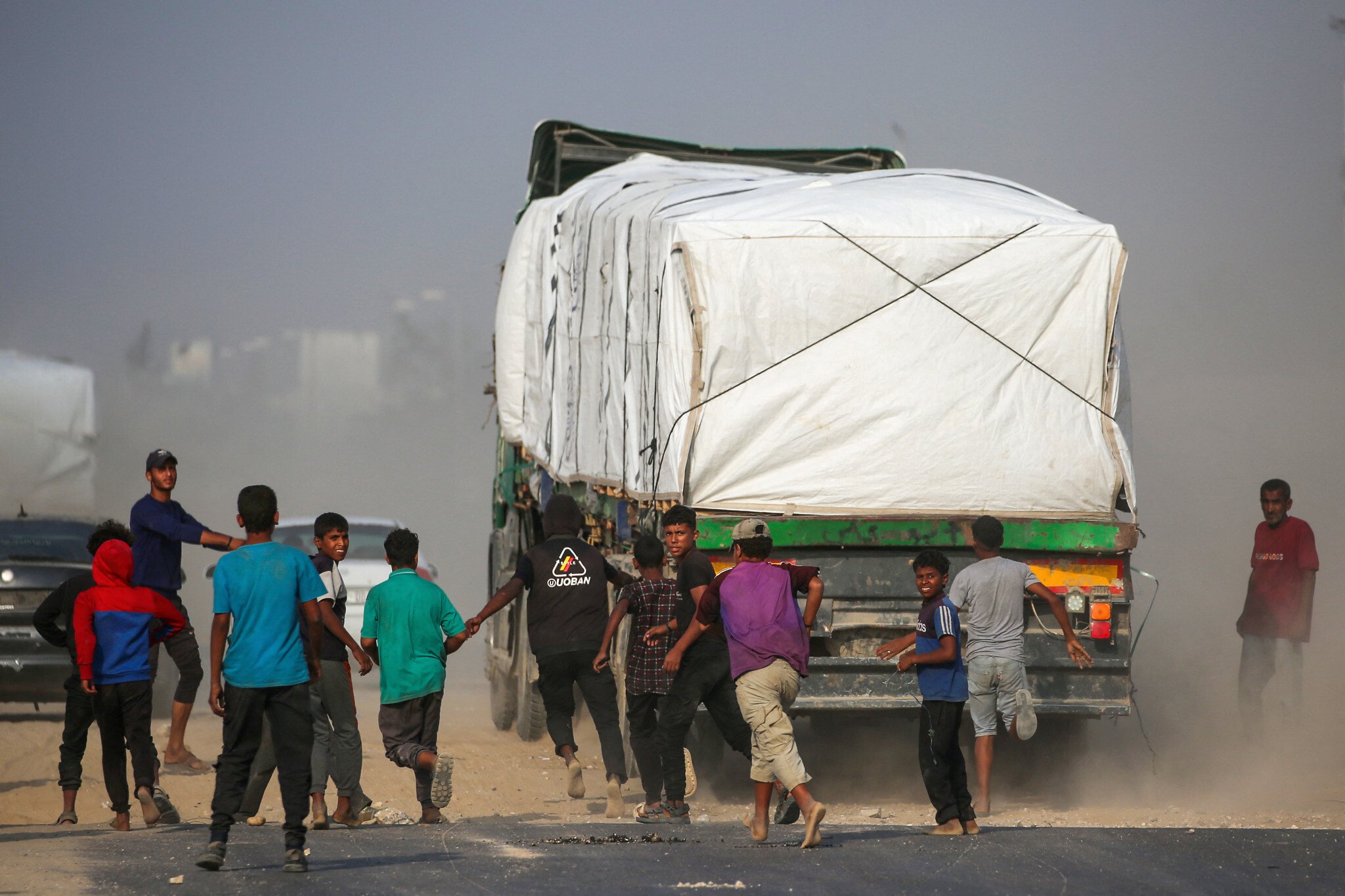
Displaced Palestinians chase after trucks travelling along Salah al-Din road in the central Gaza Strip, near Deir al-Balah, as they attempt to obtain humanitarian aid on November 9, 2025. (Eyad Baba/AFP)
On November 12, the Hamas-run Government Media Office in Gaza stated that the number of aid trucks entering the Strip amounted to just 28% of what should have entered since the ceasefire began. On November 10, the same office said that an average of 145 trucks per day had entered Gaza since the truce took effect.
According to the UNOPS, the UN agency overseeing logistics, between November 9 and November 15, 754 trucks of aid shipped via UN-affiliated organizations were unloaded at Gaza’s crossings. The figure did not include commercial goods.
UNOPS added that 972 trucks reached their destinations inside Gaza during the same period — some of which had likely entered the Strip in the week before.
During the war, official reports indicated that much of the aid entering Gaza was diverted — either by armed groups or crowds of hungry looters — before reaching distribution centers where it was meant to be handed out to Gazans for free.
It is unclear whether this phenomenon has continued on a large scale during the ceasefire.
Beyond tarps
According to the humanitarian source, Israeli officials approving requests to bring goods in often reject shipments from organizations that refused to register with the government, keeping vital assistance from those who need it most.
“There have been nine rejections of tent shipments since the ceasefire began, on the grounds that the organizations requesting them are not authorized to bring in aid or operate in Gaza,” the source said.
Several groups have come out in opposition to the registration requirement, imposed in March, arguing that the system is “politically motivated, unlawful, and dangerous.”
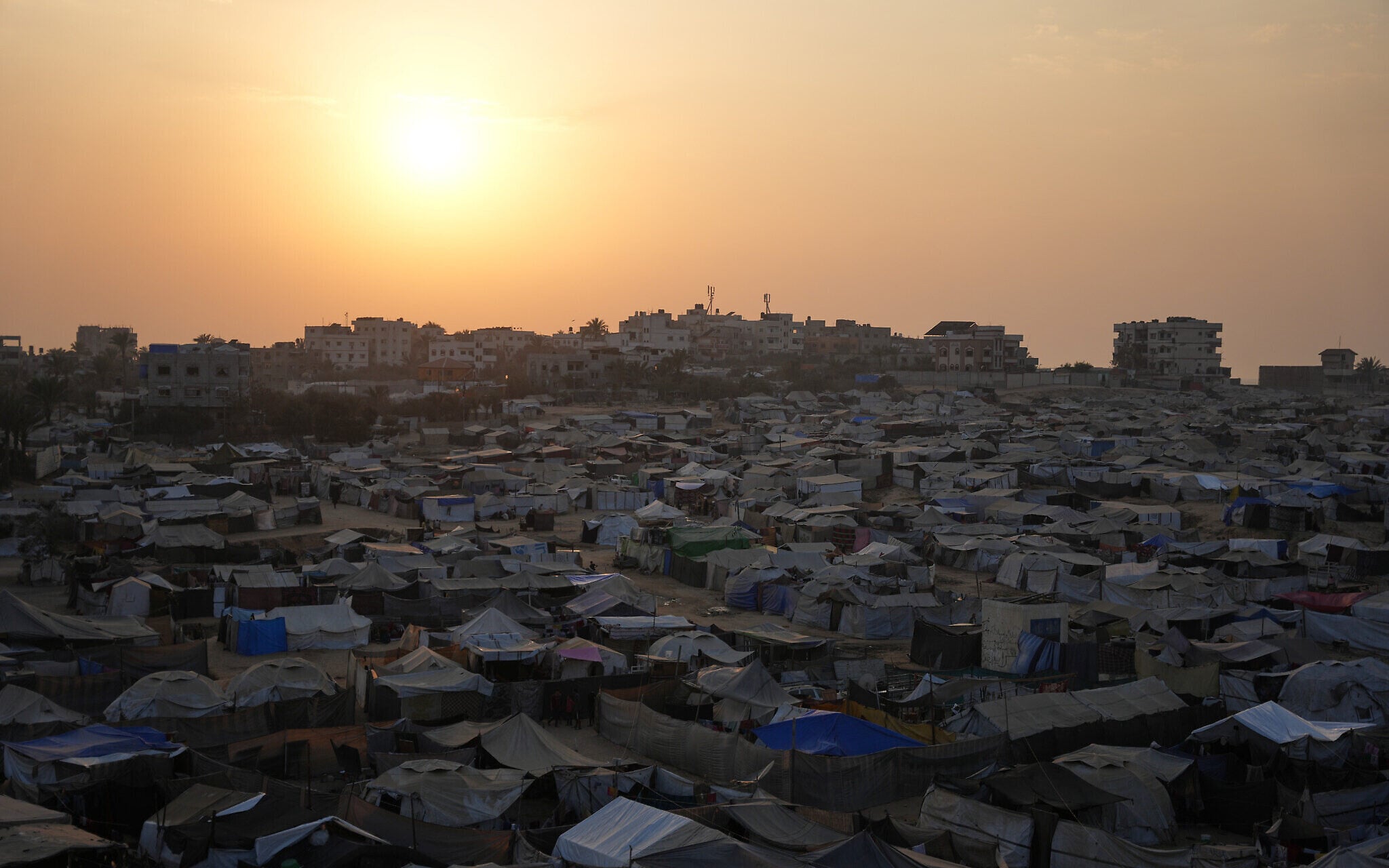
A tent camp for displaced Palestinians stretches along Zawaida in the central Gaza Strip on November 4, 2025. (AP Photo/Abdel Kareem Hana)
“Under these new rules, registration can be denied based on vague and politicized criteria, such as alleged ‘delegitimization’ of the State of Israel,” a coalition of aid groups wrote in an August statement.
COGAT responded at the time that the registration system was designed to “safeguard the integrity of the humanitarian system and prevent the infiltration of terrorist elements,” and said 20 organizations had complied and were delivering aid daily.
According to the humanitarian source, though, the aid issues are not the main problem. With about 92 percent of residential buildings damaged or destroyed during the war according to the UN, the coming winter in Gaza requires something entirely more fundamental than tents: reconstruction.
“To deal with the root causes of this crisis, we need massive repairs — heavy machinery, spare parts for infrastructure. Shelter alone isn’t enough,” they said. “No matter how many shelter units we bring in — even if a million tents arrived — we don’t have the right equipment and materials to address the underlying impact of these storms. We need heavy equipment and spare parts to drain rainwater. We are very limited in how far we can respond.”