
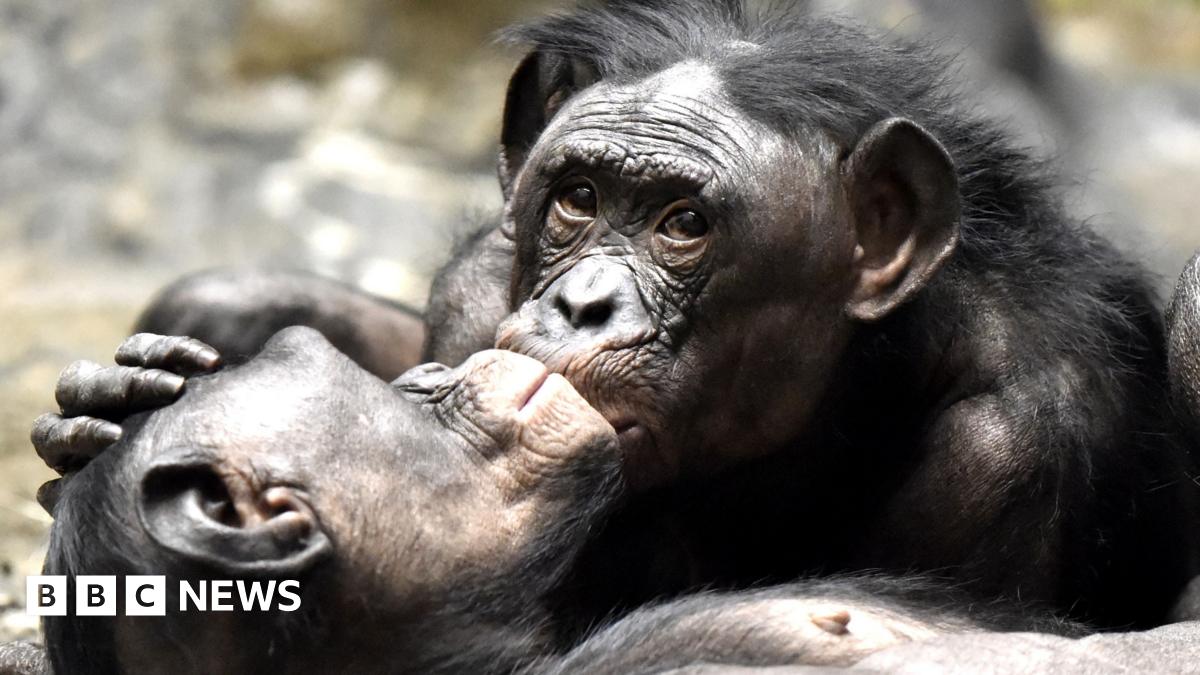
By finding evidence of other animals engaging in kissing, scientists were able to construct an “evolutionary family tree” to work out when it was most likely to have evolved.
To ensure that they were comparing the same behaviour across different species, the researchers had to give a very precise – rather unromantic – definition to a “kiss”.
In their study, published in the journal Evolution and Human Behaviour, external, they defined kissing as non aggressive, directed oral-oral contact “with some movement of lips or mouthparts and no food transfer”.
“Humans, chimps, and bonobos all kiss,” explained lead researcher Dr Matilda Brindle, an evolutionary biologist from the University of Oxford. From that, she concluded, “it’s likely that their most recent common ancestor kissed.”
“We think kissing probably evolved around 21.5 million years ago in the large apes.”