
Unlock the Editor’s Digest for free
Roula Khalaf, Editor of the FT, selects her favourite stories in this weekly newsletter.
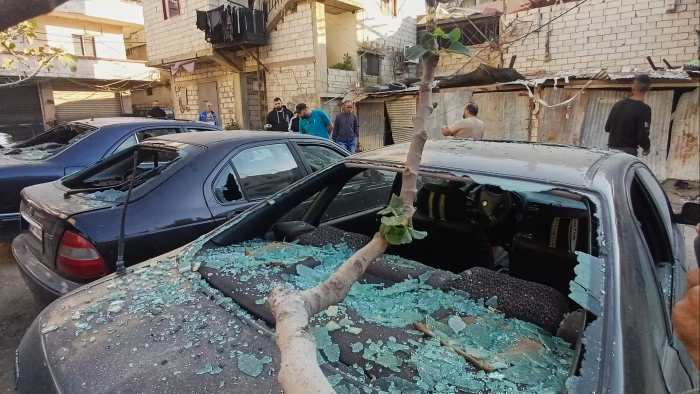
An Israeli air strike on a Palestinian refugee camp in southern Lebanon killed 13 people, the Lebanese health ministry said, an escalation that has heightened fears of a renewed Israeli offensive.
The drone strike on Lebanon’s largest refugee camp, Ein el Hilweh, on Tuesday was one of the deadliest since Israel and Hizbollah agreed to a ceasefire last year.
Israel has intensified military operations in Lebanon in recent weeks, saying it is trying to prevent Hizbollah from rebuilding itself. Two other people were killed in separate Israeli attacks on Tuesday, according to Lebanese health authorities.
The Israeli military said it was targeting a Hamas training site, adding that it would continue to strike the group in Lebanon. Hamas denied that the target was a training compound, saying Israel had struck a public sports field and that Israel’s claims were “incitement against the camps”.
Israel and Hizbollah agreed to a US-brokered ceasefire in November 2024, ending a year of conflict that escalated from cross-border exchanges to two months of full-blown war. The hostilities began when Hizbollah began firing at Israel in the wake of Hamas’s October 7 attack.
But Israel has continued to attack Lebanon on a near-daily basis despite the truce, and Prime Minister Benjamin Netanyahu warned this month that his government was prepared to expand its attacks if the Lebanese army did not do more to disarm Hizbollah.
In a sign of a further increase in tensions, Lebanon’s army chief Rodolphe Haykal on Tuesday called off a planned visit to Washington, a crucial backer of the army, after scheduled meetings in the US were cancelled, according to a Lebanese army official.
US Senator Lindsey Graham earlier this week on X described Lebanon’s army head as “a giant setback for efforts to move Lebanon forward”, criticising comments referring to Israel as the enemy, and what Graham called his ‘‘weak almost non-existent effort to disarm Hezbollah’’.
As part of its push to disarm Hizbollah and other militant groups, a condition of the 2024 ceasefire deal, the Lebanese government has pledged to defang the Palestinian factions which maintain a presence in the camps, though implementation has faltered.
Israel has also targeted Hamas members in Lebanon, adding to pressure on the Lebanese government to disarm the group.
Still, direct attacks on Lebanon’s refugee camps, densely populated residential neighbourhoods which were established after Palestinians fled or were displaced in the violence surrounding Israel’s creation in 1948, have been less common.
Israel in recent days has kept up its strikes across Lebanon, including a drone attack Wednesday morning on a car that killed one person and injured 11, according to the Lebanese ministry of health. The UN said on Sunday that an Israeli tank in southern Lebanon had fired on peacekeepers during a foot patrol.
As part of its intensifying military activity, Israel has also in recent weeks issued evacuation orders for southern Lebanese villages and carried out cross-border raids into the country.
It has continued to occupy military outposts inside southern Lebanon, and last week UN peacekeepers said Israel had built a concrete wall inside Lebanese territory.