
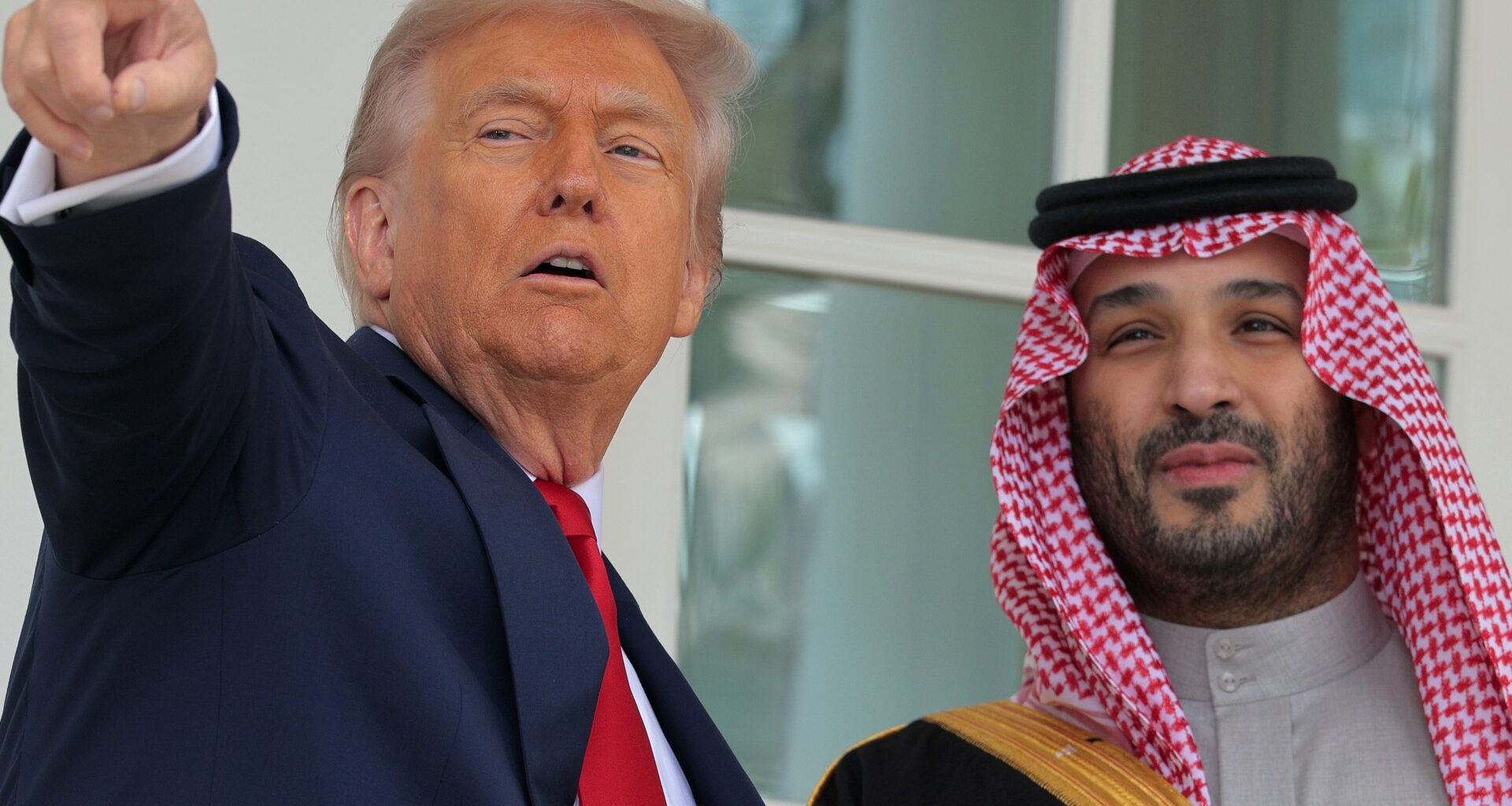
Dems may have an advantage in the 2026 midterms. And, Trump defends Saudi crown prince
Good morning. You’re reading the Up First newsletter. Subscribe here to get it delivered to your inbox, and listen to the Up First podcast for all the news you need to start your day.
President Trump yesterday defended Saudi Crown Prince Mohammed bin Salman when a reporter questioned him during a meeting with the two leaders in the Oval Office about the 2018 killing of Washington Post journalist Jamal Khashoggi. The CIA concluded that the crown prince approved the operation that led to Khashoggi’s killing and dismemberment.
Both the House and the Senate have moved to compel the Justice Department to publicly release files related to convicted sex offender Jeffrey Epstein. The measure will now head to Trump’s desk after a unanimous Senate vote yesterday. The president promised to sign the legislation, but told reporters that the intense focus on the files is a Democratic hoax.
A new NPR/PBS News/Marist poll finds that Trump’s approval rating has hit a new low, 10 months into his second term. He and the Republican Party are getting most of the blame when it comes to the government shutdown, and people are overwhelmingly saying he needs to focus on lowering prices. There are signs that Democrats could reap the benefits of these critiques heading into the 2026 midterm elections. Here’s a look at the poll results by the numbers.
Trump floated the idea of a 50-year fixed mortgage, a concept that many observers, including some Trump supporters, hate. Critics complained that a 50-year fixed mortgage would leave Americans in debt for their entire adult lives. The idea might not solve the U.S. housing affordability problem, but is the idea as unconventional as it sounds? Here’s what we know:
Latina grandmothers in their 70s and 80s in San Antonio, Texas, have come together to form a folklórico dance troupe known as Las Abuelitas De Oro, a name inspired by The Golden Girls. Folklórico is a traditional Mexican dance that combines regional dance with ballet techniques. It features intricate footwork and elaborate skirt movements. The troupe has gained popularity in the city because, despite their age, the members can perform the impressive movements for extended periods with great enthusiasm. They now offer free performances year-round throughout San Antonio and are dedicated to passing down their culture to new generations by teaching the traditional art form. Take a look at these photos, which showcase their culture. (via Texas Public Radio)
Audio transcript
(SOUNDBITE OF MUSIC)
LEILA FADEL, HOST:
President Trump defended the crown prince of Saudi Arabia when asked about the murder of journalist Jamal Khashoggi
(SOUNDBITE OF ARCHIVED RECORDING)
PRESIDENT DONALD TRUMP: Whether you like him or didn’t like him, things happen, but he knew nothing about it.
A MARTÍNEZ, HOST:
That moment overshadowed a day of billion-dollar agreements.
FADEL: I’m Leila Fadel with A Martínez, and this is UP FIRST from NPR News.
(SOUNDBITE OF MUSIC)
FADEL: Congress passed a bill to force the release of the Epstein files. Trump says he will sign it, but one survivor criticized his earlier efforts to bury the documents.
(SOUNDBITE OF ARCHIVED RECORDING)
JENA-LISA JONES: It is not about you, President Trump. I voted for you, but your behavior on this issue has been a national embarrassment.
FADEL: So what comes next, and how much will the Justice Department redact?
MARTÍNEZ: And a new NPR/Marist poll shows major political warning signs for the president. We’ll hear about what the public wants him to focus on. Stay with us. We’ve got all the news you need to start your day.
(SOUNDBITE OF MUSIC)
MARTÍNEZ: Sitting beside Saudi Crown Prince Mohammed bin Salman in the Oval Office yesterday, President Trump dismissed a question about the 2018 killing of Washington Post journalist Jamal Khashoggi.
(SOUNDBITE OF ARCHIVED RECORDING)
TRUMP: You don’t have to embarrass our guest by asking a question like that.
MOHAMMED BIN SALMAN AL SAUD: It’s OK. Since she asked, Mr. President (ph)…
FADEL: U.S. intelligence found that the Saudi crown prince approved the operation that led to Khashoggi’s dismemberment and killing. He denies any personal involvement. The exchange highlights a tension with Saudi Arabia, an important ally in the Middle East that stretches beyond the current administration.
MARTÍNEZ: Here to discuss the visit is NPR White House correspondent Danielle Kurtzleben. Danielle, that was quite the exchange.
DANIELLE KURTZLEBEN, BYLINE: It really was. And to explain it, it started during an Oval Office meeting when a journalist asked the crown prince about Khashoggi and also about 9/11. The journalist noted that there are families of 9/11 victims who were angry that the prince was visiting, as some believe the Saudi government was involved in the 9/11 attacks. So the journalist asked why Americans should trust the crown prince. Trump jumped in and responded, saying, Salman has done a, quote, “phenomenal job.” Then he turned to the topic of Khashoggi, who was a Saudi journalist who was critical of the Saudi government.
(SOUNDBITE OF ARCHIVED RECORDING)
TRUMP: You’re mentioning somebody that was extremely controversial. A lot of people didn’t like that gentleman that you’re talking about. Whether you like him or didn’t like him, things happen, but he knew nothing about it, and we can leave it at that.
KURTZLEBEN: But then the crown prince said that, no, he would respond as well, and he had this to say.
(SOUNDBITE OF ARCHIVED RECORDING)
AL SAUD: We did all the right steps of investigation, etc., in Saudi Arabia, and we’ve improved our system to be sure that nothing happen like that. And it’s painful and it’s a huge mistake, and we are doing our best that this doesn’t happen again.
KURTZLEBEN: It’s really notable the two different tones there, the crown prince acting regretful about the killing, while Trump not only didn’t condemn the death, but got defensive. One more thing we should add is Khashoggi’s widow has criticized Trump’s comments, saying, quote, “there is no justification to murder my husband.”
MARTÍNEZ: Now, other than that tense moment, it sounded like this visit was really about cooperation between the two countries.
KURTZLEBEN: Very much. And we learned last night that Saudi Arabia and the U.S. signed a whole string of agreements. Just to tick through a few – they agreed to cooperate on creating nuclear energy, to work together on AI. There was a defense agreement, which the White House said would make it easier for U.S. defense firms to operate in Saudi Arabia. The U.S. agreed to sell the Saudis F-35 fighter jets, and the White House announced Saudi Arabia is pledging to invest a trillion dollars in the U.S.
Now, that’s a lot of stuff that they say they signed, but also there just haven’t been a lot of details on those things yet. We’re still waiting on the text of some of those agreements, for example. But there was one more big development. Last night at a black-tie dinner, Trump announced that Saudi Arabia is now a major non-NATO ally. The U.S. confers that particular designation on select countries. It gives those countries special defense and financial relationships with the U.S. For example, their firms can bid on some defense contracts, and they can cooperate on research.
MARTÍNEZ: I know the president also has hopes of getting Saudi Arabia to sign on to the Abraham Accords. Any progress on that?
KURTZLEBEN: Well, it did come up in that Oval Office meeting. The crown prince said that he wants to sign on, but he also wants a two-state solution to the conflict in Gaza. Well, the leader of Israel, Benjamin Netanyahu, has said there will never be a Palestinian state. So that’s a fundamental roadblock.
MARTÍNEZ: All right. One more day of the visit. What’s on the schedule?
KURTZLEBEN: Well, today, there’s a Saudi-U.S. investment forum at the Kennedy Center, and it’s set to feature executives from some major companies like Chevron, Pfizer and Nvidia. And it’s possible that we’ll learn more about some of these potential investments then.
MARTÍNEZ: That’s White House correspondent Danielle Kurtzleben. Thanks a lot.
KURTZLEBEN: Thank you.
(SOUNDBITE OF MUSIC)
MARTÍNEZ: Both chambers of Congress have now moved to force the Justice Department to release its files on convicted sex offender Jeffrey Epstein.
FADEL: The legislation went unopposed in the Senate on Tuesday and passed with a near-unanimous vote in the House. President Trump has promised to sign the measure but told reporters that the intense focus on the files is a Democratic hoax.
(SOUNDBITE OF ARCHIVED RECORDING)
TRUMP: I have nothing to do with Jeffrey Epstein. I threw him out of my club many years ago ’cause I thought he was a sick pervert. But – and I guess I would turn out to be right.
MARTÍNEZ: NPR congressional reporter Sam Gringlas is following this story from Capitol Hill. So when we talk about releasing the Epstein files, Sam, I mean, which ones are we talking about?
SAM GRINGLAS, BYLINE: So this legislation applies to unclassified documents, communications or investigation materials held by the Justice Department, the FBI, and U.S. attorney’s offices, related to federal investigations into Epstein in New York and Florida. Now, it’s worth noting that the House Oversight Committee has already released other Epstein files, including thousands of pages of emails obtained from the Epstein estate. That batch of documents included Epstein telling a journalist that Trump, quote, “knew about the girl,” seemingly referring to people Epstein was trafficking. As we just heard, the president has said he broke ties with Epstein years ago and has denied any wrongdoing.
MARTÍNEZ: Now, releasing the files has been a very divisive thing within the Republican Party. But yeah, yesterday, legislation sailed through both chambers. So take us through what changed.
GRINGLAS: For months, President Trump and Republican leaders in Congress tried to thwart a vote on these files. But Democrats and some Republicans, like Marjorie Taylor Greene of Georgia, pressed ahead. Greene said Trump’s refusal to release the files was a betrayal of his most ardent supporters.
(SOUNDBITE OF ARCHIVED RECORDING)
MARJORIE TAYLOR GREENE: For people that slept in their cars to go to rallies, have fought for truth and transparency, watching this actually turn into a fight has ripped MAGA apart.
GRINGLAS: But once a bipartisan petition to force the issue got enough signatures, Trump reversed course. And that paved the way for Tuesday’s vote in the House, which several survivors of Epstein’s abuse actually watched from the gallery. Here’s one of them, Jena-Lisa Jones, who spoke outside the Capitol before the votes.
(SOUNDBITE OF ARCHIVED RECORDING)
JONES: It is not about you, President Trump. I voted for you, but your behavior on this issue has been a national embarrassment.
GRINGLAS: The House passed the legislation 427-1. And within a few hours, the Senate agreed to automatically advance the measure without a vote as soon as it arrives from the House, and that is expected sometime today.
MARTÍNEZ: Four hundred twenty-seven to one sounds like unity, right?
GRINGLAS: I mean, on paper, sure. But it’s clear that many Democrats and Republicans are looking at this fight through different lenses. Just listen to House Oversight Committee Chair James Comer of Kentucky.
(SOUNDBITE OF ARCHIVED RECORDING)
JAMES COMER: Democrats have chosen to manufacture yet another anti-Trump hoax instead of pursuing justice.
GRINGLAS: And compare that to his Democratic counterpart on that committee, Robert Garcia of California.
(SOUNDBITE OF ARCHIVED RECORDING)
ROBERT GARCIA: Trump has the power to release the files today. He does not even need a vote. What is Donald Trump hiding?
MARTÍNEZ: So, Sam, the debate over the files, I think that – still a couple of steps to go before we get any resolution.
GRINGLAS: The materials have to be made public within 30 days of Trump signing the bill. Depending on what comes out, that could fuel new conflicts. Trump, for example, has pledged to focus on Democrats whose names might come up. And depending on what the Justice Department redacts, that could spark even more questions.
MARTÍNEZ: All right. NPR congressional reporter Sam Gringlas. Thanks a lot.
GRINGLAS: Thank you.
(SOUNDBITE OF MUSIC)
MARTÍNEZ: Ten months into a second term, Donald Trump appears to be in a critical moment in his presidency.
FADEL: Yeah, a new NPR/PBS News/Marist poll finds the president at a new low in approval. He and his party also get most of the blame for the shutdown. And overwhelmingly, people say he needs to focus on lowering prices, and Democrats are benefiting.
MARTÍNEZ: NPR senior political editor and correspondent Domenico Montanaro joins us now. Domenico, a lot in this poll. What stuck out to you?
DOMENICO MONTANARO, BYLINE: Well, the most eye-opening thing is on the question of who would you vote for if the 2026 midterm elections took place today – a Democrat or a Republican? Democrats have a 14-point advantage, and I can’t underscore enough how massive a number that is. I mean, the last time the gap was this wide was eight years ago during Trump’s first term. A year later, Democrats won 40 seats, and their lead on this question back then ranged from six to 12 points, not 14. So this is really big. No one expects that big of a wave next year, and there’s the potential that this is coming too soon for Democrats. Frankly, you know, people in the poll also say they don’t really like Democrats very much. So we’ll see what the political landscape is like in a year, but for right now, it’s Democrats’ advantage.
MARTÍNEZ: Yeah, that makes sense right now because of what happened with those elections earlier this month for Democrats. If you take a step back, though, Domenico, I mean, is there anything in the survey that shows what’s leading to this?
MONTANARO: Well, I mean, first of all, Trump’s unpopular. You know, he’s had just 39% job approval right now. It’s only 24% among independents. All of that is the lowest of his second term in Marist’s polling, and it’s the lowest since right after the January 6 attack on the Capitol. Trump’s unpopular because of his handling of the most critical issues. You know, the elections earlier this month were all about affordability, and what jumps out in this survey is that 57% say that lowering prices should be Trump’s top priority. Nothing else even came close. Controlling immigration was second at 16%. But even among Republicans, more of them say that lowering prices is most important.
MARTÍNEZ: Do these kind of numbers make Republicans possibly more brave to disagree publicly with Trump?
MONTANARO: Maybe. You know, we’ve talked about a lot of different things that could be the case. But certainly, a president with a low approval rating, seemingly on the wrong side of many of the issues, makes it more likely that you see people cross him. There have been some major cracks between Trump and his base on the release of the Epstein files about the convicted sex offender. I’m not sure if this is a dam-break moment, though. Republican voters in our survey showed no signs of abandoning this president. Eighty-nine percent of them approve of the job he’s doing. I think a lot of elected Republicans are going to be watching this feud between the president and Marjorie Taylor Greene, the congresswoman from Georgia. Does she suffer any consequences politically, as he’s threatened, or does she survive unscathed? You know, that could really tell you whether the door is open for others to show a bit more independence.
MARTÍNEZ: Now, the poll also asked how people view institutions and each other in the United States. I shudder to hear the response, Domenico.
MONTANARO: (Laughter) Yeah. People are really down on everything. I mean, overwhelming majority say that they have no confidence – little to no confidence in Congress, the media, the political parties, the Supreme Court and the presidency itself. It extends also, though, to how people feel about each other, really doubting where the other is coming from. You know, big majorities of people who say they’re Democrats or Republicans think the opposite party is closed-minded and dishonest when talking about politics. And I have to say, maybe at Thanksgiving, stick to cooking.
MARTÍNEZ: (Laughter) Or sports. No, that’s a bad one.
MONTANARO: (Laughter).
MARTÍNEZ: NPR political correspondent Domenico Montanaro. Thanks a lot.
MONTANARO: You got it.
(SOUNDBITE OF MUSIC)
MARTÍNEZ: And that’s UP FIRST for Wednesday, November 19. I’m A Martínez.
FADEL: And I’m Leila Fadel. The news you hear on UP FIRST is possible because of support from listeners like you. When you give to your local NPR station, you help keep journalists reporting here at home and around the world. You can make a donation at donate.npr.org/upfirst. And for more news and conversations, listen to our radio show Morning Edition. You can find it on your local NPR station or at npr.org.
MARTÍNEZ: Today’s episode of UP FIRST was edited by Dana Farrington, Kelsey Snell, Megan Pratz, Mohamad ElBardicy and Alice Woelfle. It was produced by Ziad Buchh, Nia Dumas and Christopher Thomas. We get engineering support from Stacey Abbott, and our technical director is Carleigh Strange. Join us again tomorrow.