
Poland identifies suspects behind rail sabotage incidents — what we know Jakub Krupa
Two Ukrainian men have been identified as main suspects behind the rail sabotage incidents in Poland over the weekend, Poland’s prime minister Donald Tusk said (13:34).
The perpetrators are believed to be working for Russian intelligence services, who had crossed into Poland from Belarus this autumn and fled to Belarus following the attacks.
One of the suspects was previously convicted of sabotage in Ukraine.
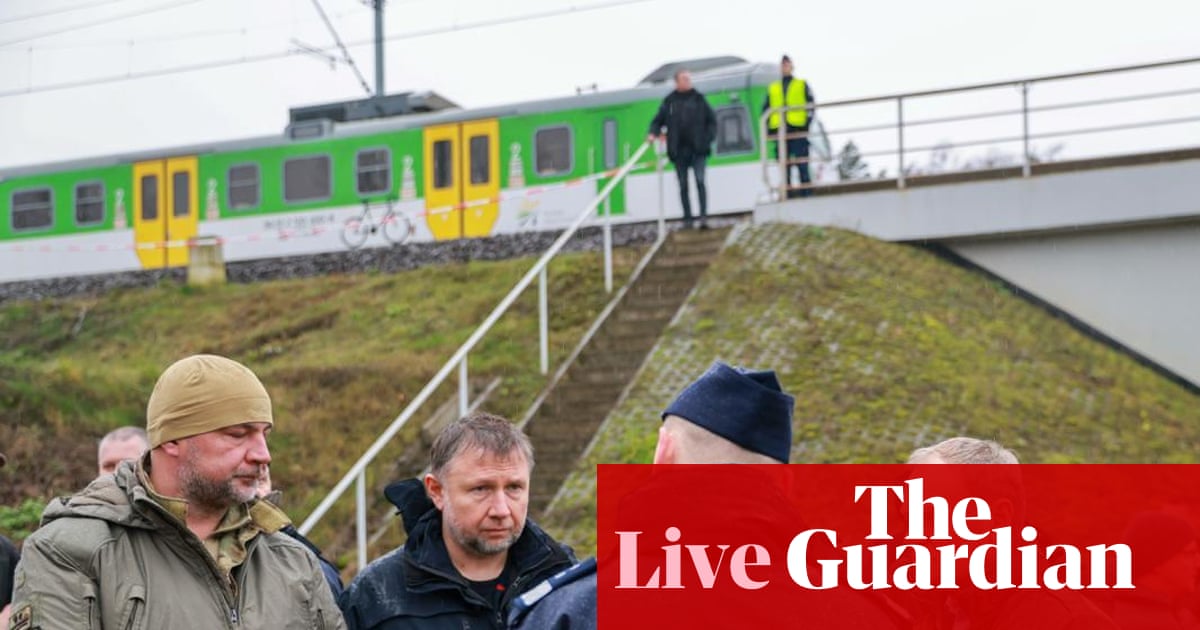
The main incident in the village of Mika involved the use of a military-type C-4 explosive intended to blow up a train, it is believed (13:40).
Speaking in the Polish parliament, Tusk said the two incidents were “unprecedented” and “perhaps the most serious, when it comes to the security of the Polish state, incidents since the beginning of the full-scale invasion on Ukraine” (13:46).
He further warned that “these acts of sabotage and actions of Russian services across … Europe, not only in Poland, are unfortunately gaining momentum,” calling it “an escalation” and an attempt to sow chaos and anti-Ukrainian sentiment (13:58).
In response, Poland will raise the threat level to protect selected rail routes, but it will stay unchanged in the rest of the country, Tusk said (13:56).
Key events
1d ago
Closing summary
1d ago
New Slovenian law treats entire Romany minority ‘as a security threat’
1d ago
Sweden offers Poland help ‘if there’s anything we can do’ after rail sabotage attacks
1d ago
Macron and Merz call for European response to US, Chinese dominance in tech
1d ago
Thousands join protest in Greece to mark anniversary of the 1973 student revolt
1d ago
Donohoe’s departure will trigger race for new Eurogroup head with Spain’s Cuerpo seen as contender
1d ago
Ireland’s new foreign minister will be ‘calm voice for diplomacy and dialogue,’ deputy PM says
1d ago
Harris named Ireland’s new finance minister, with McEntee taking foreign affairs
1d ago
Poland rail sabotage attacks are ‘extremely alarming,’ Czech PM says, warning against Russia’s ‘openly hostile’ behaviour
1d ago
Poland’s ‘Russophobia’ behind allegations over Moscow’s role in rail sabotage attacks, Kremlin says
1d ago
Poland identifies suspects behind rail sabotage incidents — what we know
1d ago
Tusk warns of ‘escalation’ by Russian intelligence services as he warns about intention to sow chaos
1d ago
Poland raises alarm level on rail in response to rail incidents
1d ago
‘Perhaps most serious … incident since beginning of full-scale invasion on Ukraine,’ Tusk says
1d ago
C-4 explosives used in rail attack in Poland, PM Tusk says
1d ago
Two Ukrainian men identified as suspects in Polish rail sabotage attacks
1d ago
Tusk addresses parliament on rail sabotage incidents
1d ago
Spain to offer ‘substantial’ aid package for Ukraine during Zelenskyy’s visit
1d ago
Polish PM to address parliament on rail sabotage incidents
1d ago
Ireland’s longstanding finance minister Donohoe steps down to join World Bank
1d ago
Zelenskyy visits Spain before flying to Turkey to ‘reinvigorate’ peace talks
1d ago
‘Everything indicates’ Russian intelligence commissioned rail sabotage incidents in Poland, government spokesperson says
1d ago
Czechs join protests against incoming Babiš government as they mark anniversary of Velvet Revolution
1d ago
Tens of thousands of Slovaks protest against Fico as they mark Velvet Revolution anniversary
1d ago
Morning opening: ‘All traces lead to Russia,’ Poland says
Show key events only
Please turn on JavaScript to use this feature
Closing summaryJakub Krupa
As we are closing the blog now, here is a summary of what we know so far:
Two Ukrainian men have been identified as main suspects behind the rail sabotage incidents in Poland over the weekend, Poland’s prime minister Donald Tusk said (13:34).
The perpetrators are believed to be working for Russian intelligence services, who had crossed into Poland from Belarus this autumn and fled to Belarus following the attacks.
The main incident in the village of Mika involved the use of a military-type C-4 explosive intended to blow up a train, Tusk said (13:40).
Speaking in the Polish parliament, Tusk said the two incidents were “unprecedented” and “perhaps the most serious, when it comes to the security of the Polish state, incidents since the beginning of the full-scale invasion on Ukraine” (13:46).
He further warned that “these acts of sabotage and actions of Russian services across … Europe, not only in Poland, are unfortunately gaining momentum,” calling it “an escalation” and an attempt to sow chaos and anti-Ukrainian sentiment (13:58, 15:05).
But Russia dismissed the Polish accusations, saying it was another example of Warsaw’s “Russophobia” (15:09).
Elsewhere,
Ireland’s longstanding finance minister Paschal Donohoe has stepped step down to join the World Bank (11:52), triggering a government reshuffle with deputy PM Simon Harris taking Donohoe’s old job, and Helen McEntee taking over as the foreign minister (16:01, 16:10, 16:53).
French president Emmanuel Macron said that Europe does not want to be a “vassal” that is dependent on US and Chinese tech companies, calling for a “European preference” in the sector (17:51).
Czechs (10:45) and Slovaks (10:34) took to streets last night to protest against populist leaders Andrej Babiš and Robert Fico as they marked the 36th anniversary of the Velvet Revolution of 1989.
Over in Greece, mass rallies have been held to mark the 52nd anniversary of the student uprising at the Athens polytechnic (17:21).
And that’s all from me, Jakub Krupa, for today.
If you have any tips, comments or suggestions, email me at jakub.krupa@theguardian.com.
I am also on Bluesky at @jakubkrupa.bsky.social and on X at @jakubkrupa.
ShareNew Slovenian law treats entire Romany minority ‘as a security threat’ Daniel Boffey
Slovenia’s government has been accused of turning Roma neighbourhoods into “security zones” after the passing of a law giving police powers to raid and surveil homes in so-called “high-risk” areas.
The prime minister, Robert Golob, introduced the law after a man was killed in an altercation with a young Roma man. Photograph: Borut Živulovič/Reuters
At midnight on Monday, the country’s parliament backed the “Šutar law”, named after Aleš Šutar, who was killed in an altercation with a 21-year-old Romany man after rushing to a nightclub after a distress call from his son.
The incident outside the LokalPatriot club in Novo Mesto, in south Slovenia, last month led to huge street protests, police being stationed in Roma neighbourhoods and the resignation of two ministers.
The prime minister, Robert Golob from the centre-left Freedom party, responded by promising new security measures, which he described as being “not against any particular ethnic group but against crime itself”.
But critics said the changes were discriminatory and “treat an entire minority as a security threat”.
The Act on Urgent Measures to Ensure Public Security, which was first introduced two weeks after Šutar’s death, was watered down before the final vote on Monday, but it retained a series of controversial clauses.
The police will, without a court order, be allowed to enter a property or means of transport in a “security-risk area” if “it is unavoidably necessary for the protection of people to immediately seize firearms”.
They will also be able to use to use technical means for photography and recording, such as drones or licence plate recognition, if people’s lives or property are deemed at risk.
Under the legislation, the “security-risk areas” will be geographically demarcated by the director general of the police or the director of the police administration, based on a security assessment.
Mensur Haliti, vice-president of the Roma Foundation for Europe, said the law was discriminatory and called on the European Commission to examine its terms.
ShareSweden offers Poland help ‘if there’s anything we can do’ after rail sabotage attacks
Swedish prime minister Ulf Kristersson said he spoke with Poland’s Donald Tusk about the suspected sabotage on Polish railways.
He added he had “offered Sweden’s help if there is anything we can do.”
Friends stick together.
ShareMacron and Merz call for European response to US, Chinese dominance in tech
French president Emmanuel Macron said that Europe does not want to be a “vassal” that is dependent on US and Chinese tech companies, calling for a “European preference” in the sector, AFP reported.
French president Emmanuel Macron speaks during a Summit on European Digital Sovereignty, a high-level Franco-German meeting focused on discussing Europe’s digital future, security, and independence, in Berlin, Germany. Photograph: Nadja Wohlleben/Reuters
“Europe doesn’t want to be the client of the big entrepreneurs or the big solutions being provided either from the US or from China, we clearly want to design our own solutions,” Macron told a Berlin summit, adding that this stance represented “a refusal of being a vassal”.
AFP noted that Macron was speaking at the European Summit on Digital Sovereignty that has brought together tech leaders and ministers from across the continent, including German chancellor Friedrich Merz.
“I strongly believe that European preference needs to become our guiding principle, starting with public procurement,” Macron said.
“Because guess what? The Chinese have a Chinese exclusivity … and the Americans have a very strong American preference,” he said.
Germany’s Merz also said “the tectonic shifts we are currently witnessing in the world, in the political and economic centres of power, demand swift action in the digital sphere,” Reuters reported.
“The questions of the future will be decided predominantly in the digital realm,” and the US and China, two digital superpowers, are vying for technological leadership, he said. “Europe must not cede this field to them,” he added.
German chancellor Friedrich Merz delivers a speech during the Summit on European Digital Sovereignty in Berlin, Germany. Photograph: Filip Singer/EPAShareThousands join protest in Greece to mark anniversary of the 1973 student revolt Helena Smith
in Athens
It’s not only Czechs (10:45) and Slovaks (10:34) who have used an anniversary to take to the streets in protest.
Over in Greece, mass rallies have been held to mark the 52nd anniversary of the student uprising at the Athens polytechnic, an event that set in motion the collapse of right-wing military rule.
Thousands of people march through the streets of Athens during a commemorative rally marking the 52nd anniversary of the 1973 Polytechnic University uprising against the military junta in Greece. Photograph: Anadolu/Getty Images
In what has become a tradition, as many as 25,000 people participated in the annual march to the heavily guarded embassy of the United States, accused by Greeks of supporting the 1967-74 dictatorship.
Many chanted slogans calling for Greece’s withdrawal from Nato, the closure of US military facilities from the country and “freedom” for Palestine.
Twenty-five students died in the November 1973 revolt, quashed when the then junta ordered tanks to smash through the polytechnic’s gates. The anniversary typically draws the young and old – many leftists – wanting to vent their spleen with government policies.
Ironically, Greek-US relations have never been as good with Athens’ centre-right government on Sunday signing a landmark deal which will see the Mediterranean country become a hub for LNG imports that not only replace Russian gas deliveries but supply the broader region, including Ukraine, in the winter months ahead.
Thousands of people march through the streets of Athens during a commemorative rally marking the 52nd anniversary of the 1973 Polytechnic University uprising against the military junta in Greece. Photograph: Anadolu/Getty Images
Tellingly, Greek police took the unprecedented step of making dozens of arrests before the otherwise peaceful rally while also prohibiting protesters from continuing on to the Israeli embassy in a further display of solidarity for the Palestinians.
ShareDonohoe’s departure will trigger race for new Eurogroup head with Spain’s Cuerpo seen as contender Lisa O’Carroll
Paschal Donohoe’s departure from Irish politics to become managing director of the World Bank will trigger another race for his second job as head of the Eurogroup, an influential alliance of countries that use the euro.
According to the Business Post’s Brussels correspondent Sarah Collins, Spanish economy minister Carlos Cuerpo almost got the numbers the last time around and could lead the field of contenders.
Donohoe, was reappointed for a third term in July.
His other challenger last summer, Lithuania’s Rimantas Šadžius, is no longer a minister.
ShareIreland’s new foreign minister will be ‘calm voice for diplomacy and dialogue,’ deputy PM saysLisa O’Carroll
Helen McEntee, Ireland’s new foreign affairs minister, will be a “calm voice for diplomacy and dialogue”, the deputy prime minister and outgoing foreign minister Simon Harris has said.
McEntee, who is known on the European circuit for her years as minister for European Affairs in Leo Varadkar’s government, got the job as part of the major reshuffle caused by the resignation of finance minister Paschal Donohoe.
“This appointment will come at a time when Ireland’s place in the world, our relationships in Europe, the US, our nearest neighbours in the UK and further afield, have never been more important,” Harris told the Dail.
“It is a moment of great geopolitical upheaval and instability, but one in which Ireland has been a calm voice for diplomacy and dialogue, and I know that minister McEntee will continue to be a strong voice for that approach,” he said.
ShareHarris named Ireland’s new finance minister, with McEntee taking foreign affairsLisa O’Carroll
Simon Harris, Ireland’s ebullient deputy prime minister, will be the country’s new finance minister in a major reshuffle that sees him drop his foreign affairs portfolio.
Helen McEntee, the current education minister, will be the new foreign affairs minister, attending council meetings in Europe and dealing with US foreign and tariff policy.
Tanaiste Simon Harris speaking during a press conference following the British Irish Intergovernmental Conference at Farmleigh House in Dublin. Photograph: Conor O Mearain/PA
She is best known internationally as part of the team who helped negotiate Brexit under former taoiseach Leo Varadkar.
The reshuffle was triggered by the surprise news on Tuesday that the longstanding cabinet minister Paschal Donohoe was quitting to go to the World Bank in Washington as managing director.
Finance is considered one of the top portfolios in any country along with foreign affairs and home affairs.
But it has taken on huge importance this year in Dublin as the country came under relentless attack from Donald Trump which accused Ireland of “stealing” US pharma companies.
ShareJakub Krupa
As we wait for more updates from Poland, let’s get a bit more on Ireland’s government reshuffle taking place after finance minister Paschal Donohoe’s resignation announced earlier today (11:52).
SharePoland rail sabotage attacks are ‘extremely alarming,’ Czech PM says, warning against Russia’s ‘openly hostile’ behaviour
Outgoing Czech prime minister Petr Fiala said the reports of Russian rail sabotage attacks in Poland were “extremely alarming.”
In a post on X, he added:
“Russia is behaving in an openly hostile manner towards us and has long been undermining the security and stability of Europe.
We must not be naive or underestimate the risks we are facing. It is our duty to strengthen our defence, invest in security, cooperate with our allies, and be prepared to confront similar attacks. The incoming government should keep this firmly in mind.”
SharePoland’s ‘Russophobia’ behind allegations over Moscow’s role in rail sabotage attacks, Kremlin says
The Kremlin accused Poland of Russophobia after Warsaw blamed an explosion on a railway route to Ukraine on two Ukrainian citizens whom it said were recruited by Russian intelligence, Reuters reported.
“Russia is accused of all manifestations of the hybrid and direct war that is taking place,” Kremlin spokesperson Dmitry Peskov told a Russian state television reporter.
“In Poland, let’s say, everyone is trying to run ahead of the European locomotive in this regard. And Russophobia, of course, is flourishing there,” he said.
Tusk’s comments about the role of two Ukrainian men will reignite the debate about Moscow’s use of foreign agents recruited, often online, for specific acts of sabotage among Ukrainian, Belarusians and other nationalities.
The choice of Ukrainian mercenaries in particular is deliberate, as can help with stoking anti-Ukrainian sentiments, as Tusk explained (13:58).
As my colleague Shaun Walker explained, on the ground, the acts are often carried out by people who are recruited online and often paid in cryptocurrency.
A map of alleged Russian acts of sabotage and disruption
Some know exactly what they are doing and why, others do not realise they are ultimately working for Moscow. The professional intelligence officers who direct the operations never need to leave Russian territory.
Read more:
Updated at 11.24 EST
Poland identifies suspects behind rail sabotage incidents — what we knowJakub Krupa
Two Ukrainian men have been identified as main suspects behind the rail sabotage incidents in Poland over the weekend, Poland’s prime minister Donald Tusk said (13:34).
The perpetrators are believed to be working for Russian intelligence services, who had crossed into Poland from Belarus this autumn and fled to Belarus following the attacks.
One of the suspects was previously convicted of sabotage in Ukraine.
The main incident in the village of Mika involved the use of a military-type C-4 explosive intended to blow up a train, it is believed (13:40).
Speaking in the Polish parliament, Tusk said the two incidents were “unprecedented” and “perhaps the most serious, when it comes to the security of the Polish state, incidents since the beginning of the full-scale invasion on Ukraine” (13:46).
He further warned that “these acts of sabotage and actions of Russian services across … Europe, not only in Poland, are unfortunately gaining momentum,” calling it “an escalation” and an attempt to sow chaos and anti-Ukrainian sentiment (13:58).
In response, Poland will raise the threat level to protect selected rail routes, but it will stay unchanged in the rest of the country, Tusk said (13:56).
ShareTusk warns of ‘escalation’ by Russian intelligence services as he warns about intention to sow chaos
Discussing the wider effects of the alleged Russian activites, Tusk says that Russia is interested “not only about in the direct effect of this type of actions, but also the social and political consequences,” such as “disorganisation, chaos, panic, speculation, uncertainty,” and “the stirring up of possibly radically anti-Ukrainian sentiments.”
“This is particularly dangerous in countries like Poland, where we have enough burdens that we bear due to over a million Ukrainian refugees in Poland,” he says.
Tusk says that authorities get dozens of alerts – both genuine and false – every day, putting increasing burden on services investigating these reports.
“These acts of sabotage and the actions of Russian services across the whole of Europe, not only in Poland, are unfortunately gaining momentum. We are dealing with an escalation,” he says.
He also asks for vigilance so people report any suspicious incidents to authorities, and for cross-party support for the services investigating these issues.
And that ends his statement.
Updated at 08.09 EST
Poland raises alarm level on rail in response to rail incidents
Tusk says that in response to the incident, Poland will raise the threat level to its third level out of four with regards to some parts of the rail infrastructure across the country.
The overall threat level will remain unchanged at the second level, he says.
Relevant regulations will be issued later today.
Share‘Perhaps most serious … incident since beginning of full-scale invasion on Ukraine,’ Tusk says
Tusk says the rail sabotage incidents were “unprecedented” and “perhaps the most serious, when it comes to the security of the Polish state, incidents since the beginning of the full-scale invasion on Ukraine.”
Polish prime minister Donald Tusk speaks with authorities near an unspecified stretch of railway damaged overnight between Warsaw and Lublin. Photograph: Getty Images
He says that “a certain line has been crossed” as the incident could have been much more serious if it wasn’t for an errorenous execution of the attack by the perpetrators.
He then recalls that Poland has faced serious sabotage incidents over the last few years, with 55 people detained in total.
But he also talks about a broader pattern of attacks, as he references other acts of Russian sabotage in Europe, including in Moldova, Romania, the United Kingdom, and Germany.
Updated at 08.27 EST
C-4 explosives used in rail attack in Poland, PM Tusk says
Revealing more details about the first explosion in the Mika village, Tusk says that it has now been confirmed that the perpetrators used a military-type C-4 explosive with a 300m cable attached to it.
Map of sabotage incidents in Poland
The explosive went off under a freight train, which suffered minor damage to its undercarriage, but seriously damaged the tracks, posing further risks for next trains going on this route, Tusk says.
The next train that stopped had been briefed on the problem and was travelling slowly enough to stop in time.