
Unlock the Editor’s Digest for free
Roula Khalaf, Editor of the FT, selects her favourite stories in this weekly newsletter.
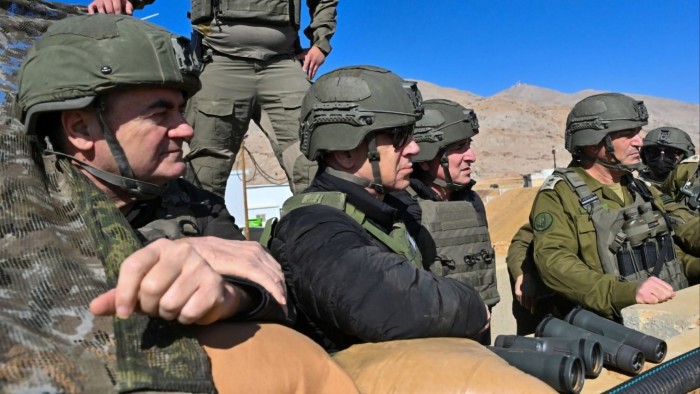
Israel’s Prime Minister Benjamin Netanyahu made a public visit to territory seized from Syria last year, saying that Israeli troops would occupy the land as long as he considered necessary.
His entourage included Israel’s defence minister, the military chief of staff and head of the Shin Bet domestic intelligence service — an unusually large contingent travelling together to enemy territory.
His visit came as Israel carried out a wave of air strikes on both Lebanon and Gaza, despite ceasefires in both places, against what it said were Hizbollah and Hamas targets respectively.
Palestinian officials said 24 people were killed in Wednesday’s strikes on Gaza, after the Israeli military claimed its troops were fired on. It was the latest flare-up to test a truce that has repeatedly come under strain since going into effect last month following two years of war.
In Syria, Israel took advantage of the chaos following the fall of former dictator Bashar al-Assad’s regime last December to send troops into what had previously been a UN-monitored buffer zone along the border.
It has since launched regular strikes against Syrian military and government targets, cultivated an informal alliance with factions from Syria’s Druze minority — which control the southern province of Sweida — and sought to create a zone of influence that extends as far as Damascus.
“We attach enormous importance to our defensive and offensive capability here; this is a mission that can develop at any moment,” Netanyahu told troops, according to a statement from his office.
In comments reported by the Hebrew press, he added that Israel would decide “the best arrangement that will guarantee our security”, he said.
Israel, which has occupied the Golan Heights since wresting the territory from Syria in 1967, has turned Mount Hermon into a military base capable of surveilling deep into both Syria and Lebanon.
It has dismissed Syria’s new leader Ahmed al-Sharaa as a former jihadist and fumed at his warming relationship with Donald Trump, who received him at the White House this month. It has also fretted over the growing influence of Turkey, a close ally of Sharaa, along its border.
Syria has come under pressure from the US to negotiate a security agreement with Israel, with Trump’s Syria envoy Tom Barrack leading talks aimed at de-escalating hostilities.
Sharaa told reporters in September that those talks could soon bear results, but Israel has continued striking Syria since.
Syria condemned Netanyahu’s visit, calling it “a dangerous violation of [Syrian] sovereignty and territorial unity” and reiterating “its firm demand for the Israeli occupation to exit Syrian territory”.
Sharaa has said that Israel needs to return to the positions agreed upon in 1974 and allow the UN to return to monitoring the buffer zone, but has said he seeks to avoid any military confrontation with Israel.
Recommended

Netanyahu’s visit also had domestic implications. The premier skipped a day of hearings in his corruption trial, telling the judges he had to attend to a “security matter”.
But on Mount Hermon, Netanyahu reminisced about his own days in the military, repeating tales of when he was deployed in Syria as part of an elite reconnaissance unit.
“I was here 53 years ago with my soldiers,” he said, according to comments in the Israeli media. “This place hasn’t changed. It’s the same.”