
Mr. President,
First of all, I would like to thank the Deputy Special Envoy, Ms. Najat Rochdi, and the Director of OCHA, Ms. Lisa Doughten, for their briefings, and I would like to express France’s support for your work.
I welcome the representatives of Syria, Iran, Turkey, Israel, and Morocco to this debate.
Mr. President,
Significant decisions have been taken over the last four weeks in support of a Syria committed to reconciliation, economic recovery, internal and regional stability, and the fight against terrorism.
1/ On security, the Syrian transitional authorities have signed a declaration of political cooperation with the International Coalition against Daesh. France welcomes this and, out of concern for the continuing terrorist threat in Syria from Daesh and Al-Qaeda, it supports increased cooperation between the international community and the Syrian authorities to rid the country of the scourge of terrorism.
2/ Secondly, for economic relief, efforts to remove obstacles to the country’s recovery are ongoing.
The Security Council adopted Resolution 2799 lifting sanctions against the Syrian President and the Minister of the Interior. This is a strong signal.
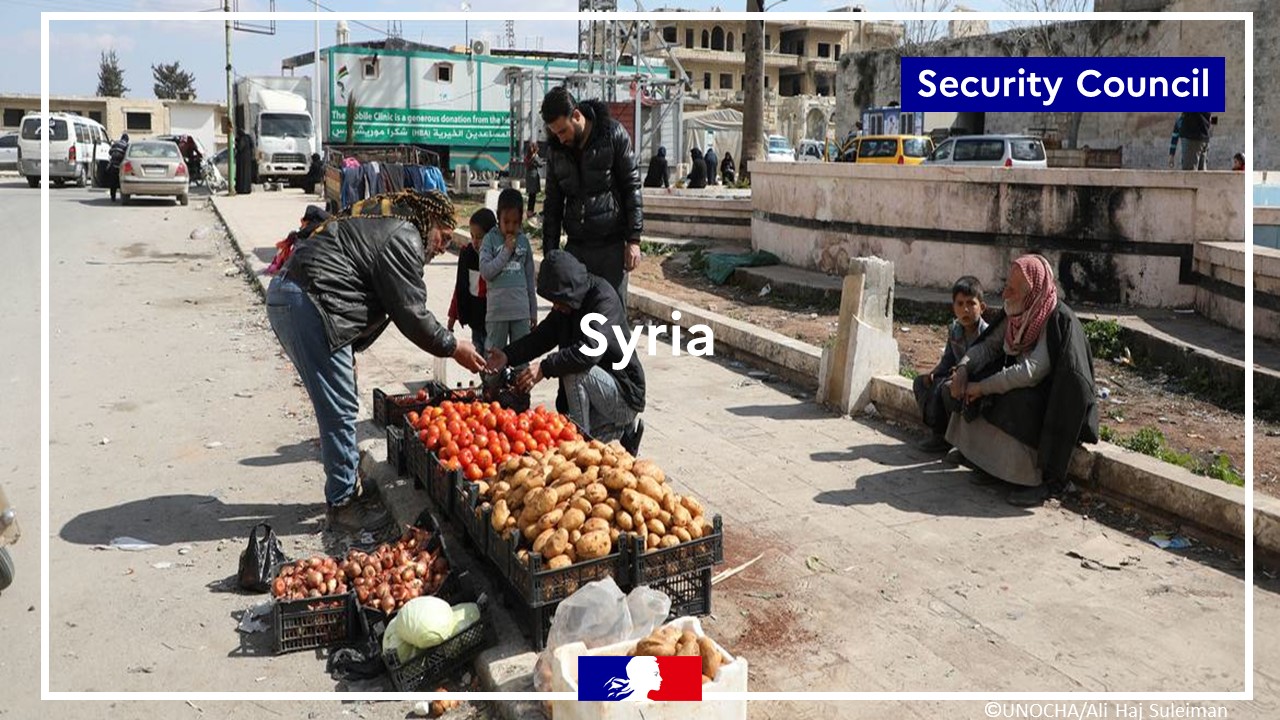
In the short term, Syrians, including hundreds of thousands of refugees who have returned to live in the country, need assistance to get through the winter in dignified conditions. The urgent priority therefore remains the unimpeded delivery of sufficient humanitarian aid to the population. But at the same time, the resource mobilization necessary to rebuild the country is essential. I recall that European sectorial sanctions were lifted last May. Many of our partners have also taken steps in this direction. This is a clear signal to the global economic community.
The economic mobilization must in particular help to restart Syria’s food and agricultural production system. As the United Nations has pointed out, hunger and food insecurity are reaching worrisome levels.
3/ Thirdly, France supports the prospect of an upcoming Security Council mission to Syria, which will address ongoing efforts in the areas of transitional justice, counterterrorism, economic development, and regional integration, while also showing the international community’s support to Syria’s efforts.
The Council should also travel to Lebanon, where it will discuss the renewed relationship between the two countries.
In this spirit, we hope that the ongoing discussions between Israel and Syria will lead to an agreement establishing peaceful relations of good neighborliness and mutual respect between both countries. Israel must end its military activities on Syrian territory and withdraw from the separation zone established by the 1974 disengagement agreement.
This Council’s visit to Syria would help outline the contours of the new United Nations’ presence in Syria. In this regard, we welcome the Syrian authorities’ agreement to the presence of the Office of the High Commissioner for Human Rights in Damascus starting December.
Mr. President,
4/ In the coming months, our Council, the UN and the international community must continue to provide the new Syria with all the necessary support in the main areas of political recovery after decades of oppression.
Firstly, for the reconciliation and full integration of all communities—Druze, Kurdish, Christian, Alawite—by supporting the ongoing normalization negotiations.
Secondly, for the construction of a democratic state that is open to women and gives a place to all representatives of civil society.
Finally, by consolidating transitional justice mechanisms and cooperating with UN investigation mechanisms to assist the population in overcoming the traumas of dictatorship and war, which the support of certain actors allowed to continue interminably despite the resilience of the Syrian people, yesterday oppressed and today freed.
As the anniversary of December 8 approaches, we look back on the progress made and look ahead to what remains to be done. The international community must remain determined to support the construction of a free, united, sovereign, stable, and pluralistic Syria.
Thank you.