
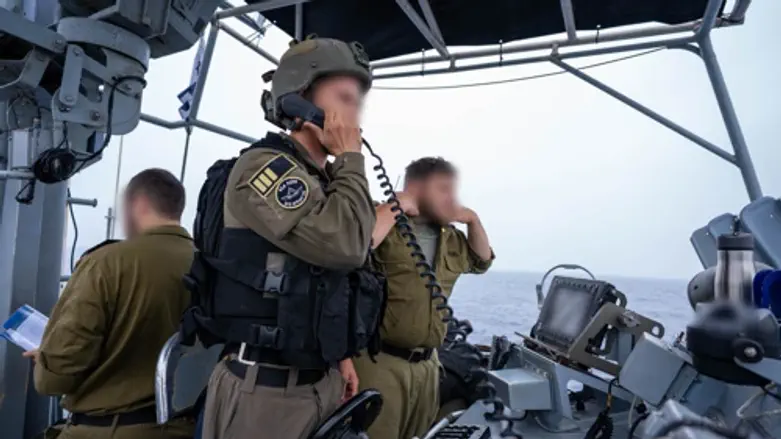
At 6:00 a.m. at the start of last week, all forces at the 916th Naval Squadron’s Ashdod base were mobilized to the sounds of mortar and grenade fire. From that moment, they were thrown into a two-day surprise exercise in the Mediterranean Sea, in which they were challenged with scenarios of incursions into maritime borders, mass casualty operations, and attacks by vessels from several directions.
“We trained for challenges that could meet us both every day and in extreme situations,” said one officer. “Our routine mission is to provide security for the coastal strip. We need to know how to synchronize all of that – and also to make the transition to wartime operations.”
These two days were dedicated precisely to that purpose. They opened with explosions, impacts and a ‘fire’ that broke out on one of the ships. The soldiers woke up and setto work immediately, while evacuating the port and boarding the vessels as quickly as possible.
The exercise itself began with the detection of a hostile vessel that sailed toward Israel’s shores from an enemy port. Accordingly, the squadron’s Dvorah-class vessels approached the ‘suspect’ vessel, taking live fire as they did. At the same time, jet skis raced toward the Israeli ships. “We pushed the commanders hard,” said one of the training officers. “We rehearsed responding to many vessels at the same time – and that was only one scenario, out of three.”
The next challenge included attempting to predict how the enemy would proceed, in which they had to foil the threats and plan the continuation of the fight with a forward-looking perspective, while assessing the enemy’s next moves. All of this occurred while events continued to erupt around them.
The third and final scenario was an exercise in seamanship, in which the soldiers practiced evacuating casualties at sea, conducting underway replenishment, and opening a corridor for assisting vessels.
A central element of the training, as noted, was the element of complete surprise: “No commander in the squadron knew what awaited him in the drill,” stated an officer. Another component, no less important, was the tight planning and synchronization between the vessels, with emphasis on live fire in the first scenario.
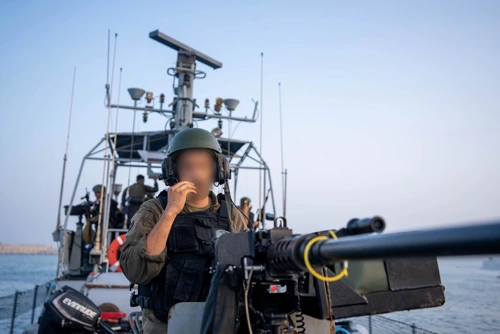
'%3e%3cg%20id='Group_74'%3e%3cg%20id='Group_70'%3e%3cpath%20id='Path_42'%20d='M340.79%20974.6h-3.872v-1h2.872v-2.872h1z'%20class='cls-1'/%3e%3c/g%3e%3cg%20id='Group_71'%3e%3cpath%20id='Path_43'%20d='M331.662%20974.6h-3.872v-3.872h1v2.872h2.872z'%20class='cls-1'/%3e%3c/g%3e%3cg%20id='Group_72'%3e%3cpath%20id='Path_44'%20d='M328.79%20965.477h-1V961.6h3.872v1h-2.872z'%20class='cls-1'/%3e%3c/g%3e%3cg%20id='Group_73'%3e%3cpath%20id='Path_45'%20d='M340.79%20965.477h-1V962.6h-2.872v-1h3.872z'%20class='cls-1'/%3e%3c/g%3e%3c/g%3e%3cg%20id='Group_77'%3e%3cg%20id='Group_75'%3e%3cpath%20id='Rectangle_28'%20d='M0%200H6V1H0z'%20class='cls-1'%20transform='rotate(-45%201333.904%2077.78)'/%3e%3c/g%3e%3cg%20id='Group_76'%3e%3cpath%20id='Rectangle_29'%20d='M0%200H6V1H0z'%20class='cls-1'%20transform='rotate(-45%201339.39%2091.022)'/%3e%3c/g%3e%3c/g%3e%3cg%20id='Group_80'%3e%3cg%20id='Group_78'%3e%3cpath%20id='Rectangle_30'%20d='M0%200H1V6H0z'%20class='cls-1'%20transform='rotate(-44.999%201325.786%2085.365)'/%3e%3c/g%3e%3cg%20id='Group_79'%3e%3cpath%20id='Rectangle_31'%20d='M0%200H1V6H0z'%20class='cls-1'%20transform='rotate(-45%201339.001%2079.89)'/%3e%3c/g%3e%3c/g%3e%3c/g%3e%3c/svg%3e) The naval exercisePhoto: IDF Spokesperson
The naval exercisePhoto: IDF Spokesperson
He notes that each focal point in the exercise was intended to test a different aspect: “Against the hostile vessels, the focus was repelling multiple threats simultaneously and neutralizing many targets under uncertainty. The requirement was to prepare in synchronization so we could handle all the vessels.”
In the second exercise, the emphasis was on real-time command and on managing and planning the situation with a forward-looking view. In the final part, the ‘seamanship scenario’, the focus was on opening passages for new forces to assist at sea and on allowing free maneuvering of Israeli forces in accordance with frequent changes on the ground.
“We demanded that everyone demonstrate high command capabilities that will meet them in a real scenario: to show sharpness, composure, creativity, and long-term thinking. Our highest objective is to develop these capabilities before combat is initiated, so that we are not caught by surprise in a real fight.”