
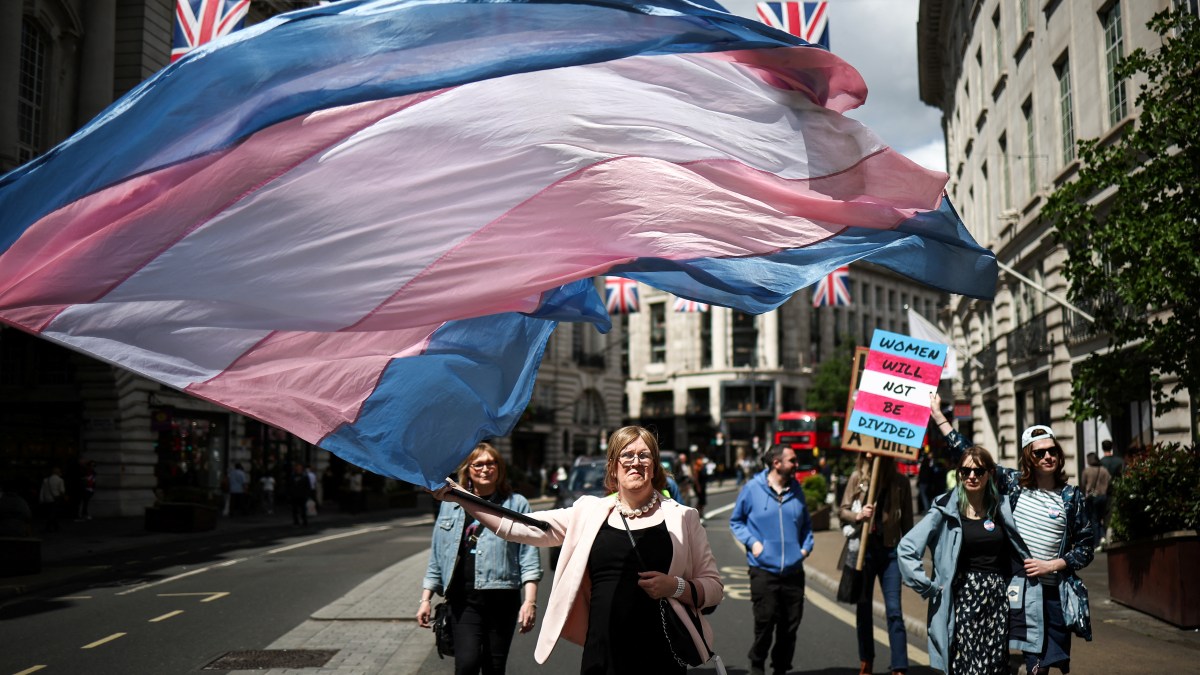
Transgender people could be banned from single-sex spaces based on what they look like, according to new equalities guidance seen by The Times.
The guidance from the Equality and Human Rights Commission (EHRC) was handed to ministers almost three months ago but has so far not been published by Bridget Phillipson, the minister for women and equalities.
The Times has been passed a copy of the final guidance, which aims to preserve the dignity and safety of women, by Whitehall figures who are concerned that Labour is deliberately delaying publication to avoid a potential political backlash.
Councils, NHS trusts and businesses are still allowing trans women — biological men who identify as women — to use single-sex spaces despite a Supreme Court ruling in April that for the purposes of the Equality Act, sex is defined by biology, not gender identity.
They say they are waiting for the new guidance before taking action, despite warnings that they may be breaking the law.
Under the new guidance, places such as hospital wards, gyms and leisure centres will be able to question transgender women over whether they should be using single-sex services based on how they look, their behaviour or concerns raised by others.
If there is doubt they are telling the truth about their sex, they could be banned from using those services once those running them had considered “relevant factors”.
The Gender Debate — Live Join Jo Coburn as she brings together Helen Joyce and Dr Helen Webberley — two people on either side of the argument — and gets to the heart of one of the most divisive issues of our time
Thursday 9-10pm on Times Radio
The EHRC document states it is “a legitimate aim” to provide single-sex spaces for “ensuring the safety of women or the privacy and dignity of women and/or men”.
The guidance said that if transgender people are excluded from a space, organisations should consider whether there is a suitable alternative for them and that it would not be proportionate to leave them without essential services, such as access to lavatories.
But it also outlines how in some cases that may not be possible owing to the physical constraints of buildings or high costs. It said: “It may be that offering alternative arrangements is not reasonably possible […] this may be because of the type of service being provided, the needs of the service users, the physical constraints of any building, or because of the disproportionate financial costs associated with making those arrangements.”
• What is the new gender guidance on single-sex spaces and sport?
The new guidance also removes a suggestion in an earlier draft that those running services could in “necessary and proportionate circumstances” ask to see a birth certificate or gender recognition certificate (GRC) if they suspected someone was lying about their sex.
The final code instead says it would “unlikely be proportionate or practical to ask for further evidence of a person’s sex” even if doubts were raised.
It said “there is no type of official record or document in the UK which provides reliable evidence of sex” because people can change their sex on passports and driving licences without a GRC.
But it says that if there is “genuine concern about the accuracy of the response” it may be proportionate to exclude a transgender person anyway.
It said any questions should be asked sensitively and information should be stored securely.
• Analysis: Law is clear, Labour isn’t: trans guidance delay reignites party row
It also states that transgender people could be barred from single-sex services even when their biological sex matches, such if a trans man, who is biologically female but is “perceived” as a man, attempted to use a women’s changing room. It says that they can be barred because they are likely to be seen by others as the opposite sex.
The guidance, which has not been updated since 2011, gives practical advice on how to implement the law and applies to any organisation that provides services to the public.
Shops and gyms are included but the guidance extends to government departments, the NHS, policing and prisons. Hotels and restaurants are covered, as are theatres, cinemas and hospitals. It covers private organisations or charities if they are providing a public service, for example a private care home providing care on behalf of a council, or a leisure centre even if it is run by a private company.
• The Times view: Confusion over transgender access to sensitive spaces must end
The guidance covers all elements of the Equality Act. Other updates include how women suffering from menopause symptoms could be protected from disability discrimination.
The EHRC has stressed the code only reflects the law, as clarified by the Supreme Court.

Baroness Falkner, chair of the EHRC, has suggested that ministers are allowing organisations to illegally admit transgender people into single-sex spaces
LUCY YOUNG FOR THE TIMES
Sir Keir Starmer said last week that the ruling should be implemented “in full and at all levels”.
However, the government was accused of back-tracking by arguing in a court last week that transgender people’s access to single-sex lavatories should be decided on a case-by-case basis. The judge said such an approach would be “inconsistent” with the Equality Act.
Baroness Falkner, the outgoing chair of the EHRC, previously urged Phillipson to speed up publication of the guidance and suggested that ministers were allowing organisations to illegally admit transgender people into same-sex spaces.
Last month dozens of Labour MPs wrote to Peter Kyle, the business secretary, to warn that the regulations would be a “minefield” of competing rights and the cost of implementing them would be large.
• Rules forcing trans people to use birth-sex facilities delayed
The government said: “The EHRC has submitted a draft code of practice to ministers, and we are working quickly to review it with the care it deserves.
“We have always been clear that the proper process needs to be followed and we are following it.”
A government source said previously: “Any suggestion the government is delaying the code is total nonsense, put about by opposition parties intent on stoking divisive culture wars, not ensuring we have legally sound guidance.
“This is a long and legally complex document and we are carefully considering it — and we make no apology for it.”
The source also said the devolved administrations needed to be consulted on the guidance before it was published.
The EHRC was contacted for comment.