

When the All Blacks left the field after 40 minutes at Twickenham 12-11 ahead, there would have been plenty among the 82,000 there who were of the view that the visitors were well placed to take control of the game after the break.
This is the way things have played out for as long as anyone can remember. In these frantic, high-energy November Tests, New Zealand punch, absorb and dance about, ducking and diving, but they usually always find a way to pull off a few killer plays and come away victorious.
They have long been the masters of finding a way to win in hostile Northern environments, as evidenced by the fact they only lost three November Tests between 2004 and 2020.
But what’s clear to those who have scrutinised the All Blacks in the last five years is that they have lost, or are certainly losing, that fabled ability of theirs to squeeze teams in the second half by using their inherent rugby smarts to come up with the right play at the right time.
That’s borne out in the overall numbers which show that since 2021, New Zealand have played 14 November Tests and lost four, drawn one. A win ratio of 93 per cent over 16 years has dropped to 68 per cent in the last four.
There is a much more pertinent and specific sub-set of numbers produced in the last two years, however, that provide a deeper insight into why the All Blacks have developed a previously unimaginable vulnerability.
 Codie Taylor’s converted try put New Zealand 12-0 up but the hooker’s yellow card early in the second half was the catalyst for a collapse (Photo David Rogers/Getty Images)
They have become prone to suffering from extreme mental paralysis in the 20 minutes after half-time and losing their way entirely in the third quarter.
It’s a real thing and a real problem because so many times in the last two years they have effectively lost Tests in that period by conceding points, momentum and every conceivable psychological advantage.
Twickenham was yet another example of the All Blacks hitting this mental black spot between minutes 40 and 60.
The numbers tell a damning story that the third quarter has been a black-spot for the All Blacks this year, and the stage of almost every Test at which they have lost their way.
The meltdown started with a yellow card to Codie Taylor when he was deemed to have cynically played the ball on the ground, and from there New Zealand lost their attacking shape. Their strategic blueprint was virtually thrown away and their error count climbed.
A 12-11 lead became a 25-12 deficit by the end of that quarter, after first Sam Underhill and then Fraser Dingwall scored tries, in a period in which England enjoyed so much territory and possession that they built the confidence and near certainty that they were going to win.
The numbers tell a damning story that the third quarter has been a black-spot for the All Blacks this year, and the stage of almost every Test at which they have lost their way.
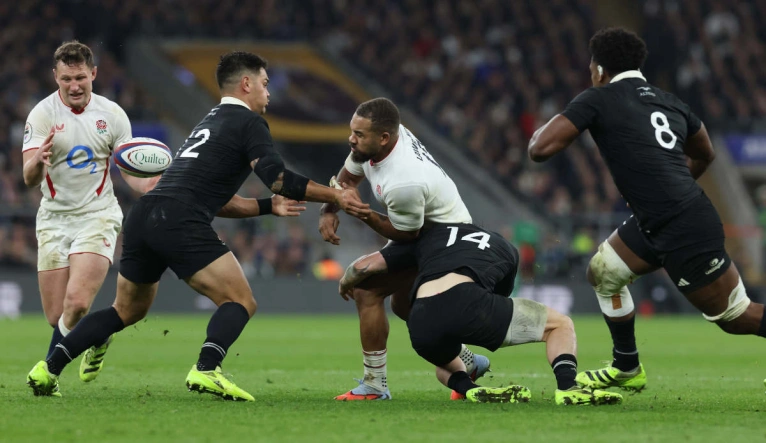 New Zealand conceded two tries in the third quarter, the second after Ollie Lawrence opened up their defence to put Fraser Dingwall over (Photo David Rogers/Getty Images)
New Zealand lost the slight edge they have been building in the scrums, they opted to tap penalties, their game management was ragged and their defence lost its line-speed.
“Your gameplan should be one that adjusts,” says assistant coach Scott Hansen. “We must have a gameplan that allows them to adjust and see what is in front and play the obvious. We talked about composure at half-time, starting well. The first set was about a lack of self-control and a hand in a ruck, going somewhere we didn’t need to.
“Where was our adjustment? You saw us not going for a lineout because we felt in that moment we didn’t need to bring a hooker on, but what was our adjustment there because we ended up kicking anyway.
“The key thing for us is when we are in control, what does it look like and how do you get it back because they got a bit of momentum and we weren’t able to stay in front.”
The All Blacks were able to mount a mini comeback that created a try for Will Jordan, but the damage was too much to repair.
There was a lot of effort in there but not the execution that was required. That hurts.
The frustrating aspect for New Zealanders about the way things played out is that it was nearly a carbon copy of what happened the previous week at Murrayfield.
New Zealand had a 17-0 lead at the break against Scotland, only for the scores to be tied at 17-all 20 minutes later. The build-up to the game at Twickenham was dominated by analysts predicting that if the All Blacks suffered a similar mental void in London, England would be good enough to punish them in the harshest possible way.
And so it proved, with England’s 14 points worsening the All Blacks’ points differential in the third quarter to minus-64 in 2025.
They have scored 28 points in total between minutes 41 to 60 but conceded 92 – figures that make it apparent how vulnerable the All Blacks have become once the game restarts after half-time.
 Head coach Scott Robertson was left to lament another second-half lapse after a third defeat in 12 Tests this year (Photo by Ben Stansall/AFP via Getty Images)
Only twice this year – against France in Hamilton and Australia at Eden Park – have they scored more points in those 20 minutes than they have conceded.
In Edinburgh they conceded 17, scored zero; against South Africa in Wellington they conceded 10, scored zero; and in their two Tests against Argentina, they conceded seven and scored none in the first Test (which they won), and conceded 10, scored zero in the second (which they lost).
Against England it was scored zero, conceded 14, and these numbers look precisely like the rogue trend they are when they are given a comparative value. The All Blacks’ points differential is positive in the other three quarters – plus 32 in the first, plus 60 in the second and plus 27 in the fourth.
“It’s the consistency in games and the ability to manage the game,” head coach Robertson said when he was asked after the 33-19 loss to England what was behind yet another insipid third quarter by New Zealand.
The All Blacks have identified they have a problem, but they can’t seem to find a workable solution.
“We played some good rugby but we probably didn’t manage the game with our kicking enough. We had a great first half, they came out and put pressure on us, and we couldn’t turn that around and put it back on them. There was a lot of effort in there but not the execution that was required. That hurts.”
What deepens the concern is that these numbers in 2025 are a continuation of what happened last year – where the All Blacks’ points differential was plus 49 in the first quarter, plus 89 in the second, plus 27 in the fourth, and minus four in the third.
They have tacitly acknowledged the issue on their Northern tour as they have exited the changing rooms a couple of minutes early after half-time, where tackle bags have been set up and the players go through a few high-energy contact drills.
But it hasn’t helped much, because the problem continues. Pressed to give an answer to what he thinks is causing the issue, Robertson says it’s typically been a case of one early error compounding into a whole series.
In Edinburgh, Peter Lakai dropped the second-half kick-off and from there, the All Blacks committed several basic execution errors and lost their discipline. Both Ardie Savea and Wallace Sititi were yellow-carded.
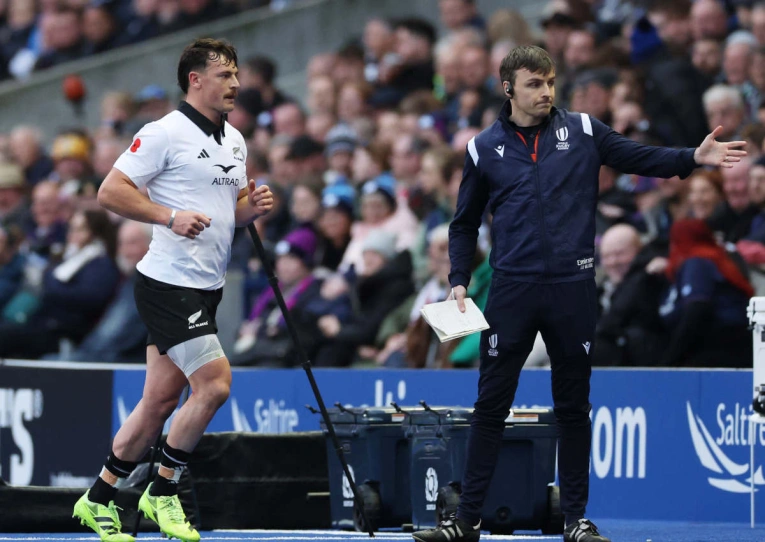 NZ overcame three yellow cards against Scotland, the first for Leroy Carter, but England punished their indiscipline (Photo Stu Forster/Getty Images)
In London, it was Taylor’s yellow card that was the catalyst for the meltdown, with Robertson suggesting it was poor game management rather than individual errors that most hurt the All Blacks against England.
He didn’t think that the playmakers struck the right balance between pass, run and kick, and were guilty of over-playing in the wrong areas of the field.
“The game is faster and there’s more ball-in-play so there’s more fatigue,” he said. “When you get on top of teams, hold the ball and go forward, you get some good outcomes.
“Games can swing really quickly. It can be a case of making an error, conceding a penalty, or two or three at the same time. And we know how much pressure a yellow card can bring. Defending for long periods of time, and not giving a penalty away, is tough.”
The All Blacks have identified they have a problem, but they can’t seem to find a workable solution.