
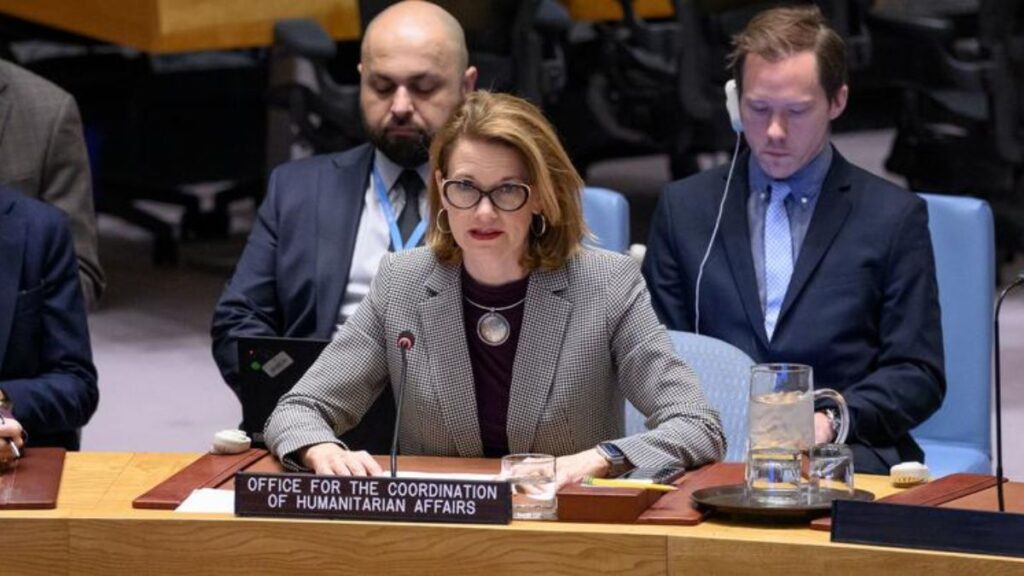
The United Nations Deputy Special Envoy for Syria, Najat Rochdi, said that “enormous challenges” face an inclusive political transition in Syria, dealing with the country’s past, and rebuilding its economy.
During a UN Security Council session on the situation in Syria, Rochdi expressed hope that the progress achieved at the international level would be matched by deeper engagement inside Syria, to ensure stability and social cohesion.
She added, in the session broadcast by the UN’s official website on Wednesday, 19 November, that military operations and Israeli incursions into Syrian territory continue to endanger civilians, fuel regional tensions, undermine a fragile security environment, and threaten the political transition process.
The Deputy Special Envoy for Syria pointed out that tensions, lawlessness, and some acts of violence are still ongoing in several areas of the country, with intermittent exchanges of fire between forces along the lines of contact.
She noted that “the fragility of security is a reminder that lasting peace in Syria depends on a comprehensive reform of the security sector and credible programs for disarmament, demobilization, and reintegration”.
Rochdi welcomed the UN Security Council’s adoption of Resolution 2799, which removed sanctions from Syria’s transitional president, Ahmad al-Sharaa, and Interior Minister Anas Khattab.
She also referred to the US decision to grant an additional six-month exemption from most of the restrictions under the Caesar Act, stressing the need to lift mandatory secondary sanctions, which she described as “a major obstacle to enabling reconstruction and reviving Syria’s devastated economy”.
Importance of a successful transition process
The Deputy UN Special Envoy for Syria, Najat Rochdi, stressed the need to make progress on accountability, transitional justice, and the missing, pointing to the first ongoing trial concerning the “crimes” committed during the coastal events last March.
“Syrians must feel that serious steps are being taken to end impunity, past and present, and prevent it from recurring”, she said.
She also referred to the incomplete process of establishing a transitional People’s Assembly, calling for transparency and fair representation for all Syrian communities and Syrian women.
Rochdi underlined the importance of inclusivity in drafting a permanent constitution, saying that “the drafting of a new social contract among Syrians must be a source of peace and unity”.
She called on the Syrian authorities and civil society to draw on the lessons and achievements of the political transition so far, stressing that the degree of political inclusivity achieved to date must be “the floor of this transition, not its ceiling”.
The Deputy Special Envoy also stressed the need to put in place concrete mechanisms to turn commitments to implement the 10 March agreement between the Syrian Democratic Forces (SDF) and the Syrian government into action, in terms of military and political integration, and in a spirit of consensus between the two sides.
She added that the intermittent hostilities along this line of contact over the past month “are a reminder of the need to maintain the ceasefire”.
Rochdi also called for progress in implementing the Suwayda (in southern Syria) roadmap, noting that last week’s clashes show that “trust is extremely low”.
She encouraged all parties to take concrete steps to move forward, especially initial confidence-building measures, in particular regarding detainees and abductees, and the restoration of state services.
The Deputy Special Envoy stressed the importance of the success of the political transition for the Syrian people, men and women, “who have struggled equally for the future and stability of their country”.
She expressed her hope for further cooperation with all concerned parties to support “building a sovereign, stable, united, and prosperous Syria that meets the aspirations of all its citizens”.
16 million in need of assistance
Lisa Doughten, Director of Financing and Outreach Division, Office of the Coordination of Humanitarian Affairs (OCHA), said that more than 16 million people in Syria still need humanitarian assistance, adding that local insecurity and climate shocks are exacerbating these needs.
Doughten explained that more than 180,000 people remain displaced in Suwayda and neighboring provinces, stressing that the organization is prioritizing the response there and working with the Syrian authorities and affected communities to provide assistance and basic services.
She also pointed to the continuing danger of explosive remnants of war, which claimed the lives of six people over the past week alone, including a child, bringing the total number of deaths to more than 570 people since last December.
Despite the enormous needs, Doughten believes the current moment “remains full of hope for millions of Syrians who choose to return to their homes”.
She noted that the number of Syrians returning from neighboring countries has reached 1.2 million people, in addition to 1.9 million internally displaced persons, but stressed that these people “still need support to rebuild their lives”, especially with the approach of winter.
UN continues to provide assistance
Lisa Doughten said that the United Nations and its partners are reaching 3.4 million Syrians with assistance each month on average.
She added that this assistance represents a 24 percent increase over the same period last year, thanks to improved access and operating conditions, despite declining funding.
Doughten noted that the UN sees a practical pathway toward supporting recovery and development in Syria that would reduce dependence on emergency assistance, pointing to an opportunity to deliver more aid to the country.
She addressed three key requests to the international community for increasing support to Syrians, namely,
Continued engagement to de-escalate persistent hotspots and prevent the outbreak of new violence
Increased funding for humanitarian operations, as the response is only 26 percent funded, with the end of the year approaching
Substantial, targeted, and large-scale investment in development and reconstruction
Doughten stressed that the Syrian people “do not want to depend on emergency assistance”.
She underlined the need for the international community to build on recent developments that “pave the way forward, including the ongoing steps to ease sanctions and the sustained interest from partners in the region and beyond in investing in Syria”.