
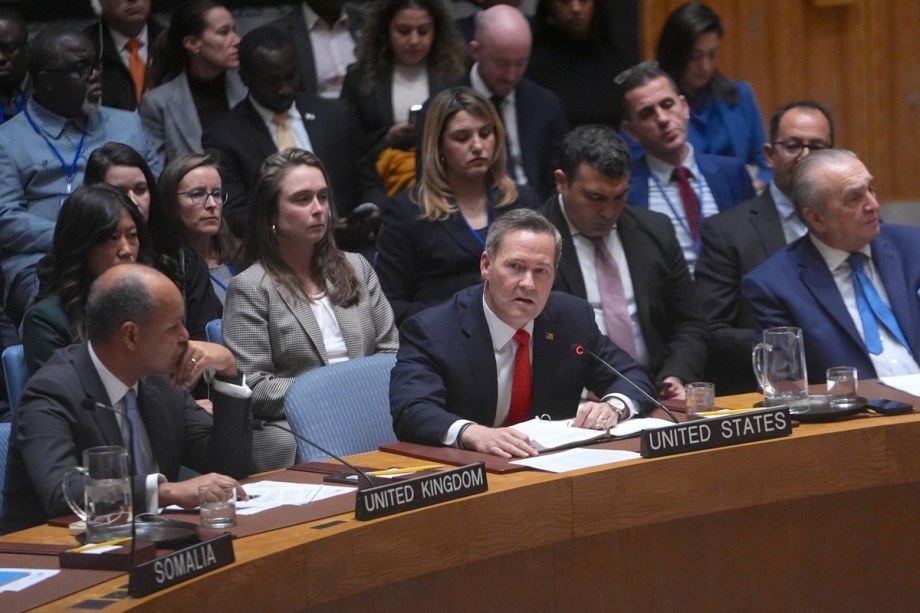
The approval of Resolution 2803 by the UN Security Council, presented by the United States and endorsed by 13 votes in favour, with Russia and China abstaining, marks yet another shameful chapter in the long history of manipulation, selectivity, and abandonment of the Palestinian people by international structures that should guarantee peace, justice, and self-determination.
Under the pretext of a “Comprehensive Plan for Ending the Conflict in Gaza,” the US pushed for the creation of an International Stabilisation Force which, in practice, institutionalises the occupation and attempts to reconfigure Gaza according to interests foreign to the people who have resisted ethnic cleansing and apartheid for decades.
The Palestinian resistance factions reacted forcefully – and rightly so. For those living under constant bombings, illegal sieges, attacks on hospitals, famine used as a weapon of war, and massive forced displacement, it is clear that the resolution does not represent any sustainable solution, but rather an arrangement imposed to save the US image and shield Israel from the responsibilities it should face under international law.
The Security Council, supposedly the guardian of global peace, once again accepted legitimising the narrative fabricated by the White House. It has been the same pattern for decades: when crimes are committed by Western allies, the UN retreats, remains silent, or acts as an instrument to maintain the colonial status quo.
The discourse wrapped in diplomatic language hides the real objective: preventing a political and moral victory of the Palestinian resistance and, simultaneously, paving the way for political engineering that allows the US to redesign Gaza according to its strategic interests.
READ: UN chief urges support for Palestinian right to self-determination on Solidarity Day
This is not about protecting civilians or guaranteeing sovereignty, but about shaping a post-war scenario controlled by foreign powers that have never shown any sincere commitment to the Palestinian people’s right to self-determination.
The criticism from Palestinian factions goes straight to the heart of the matter: the resolution violates fundamental principles of international law, including the prohibition of occupation and annexation of territory by force, the right of peoples to resist colonial domination, and the obligation of states not to support war crimes.
Instead of holding “Israel” accountable for the destruction in Gaza – which includes millions displaced, tens of thousands dead and injured, and the devastation of 75 per cent of civilian infrastructure – the Council opts to create administrative and security structures that effectively perpetuate dispossession, masked under “post-conflict” rhetoric.
It is particularly lamentable to see Arab governments that should stand with the resistance instead choosing the easy applause of Western diplomacy.
Algeria, historically a symbol of anti-colonial struggle, supported the resolution – a gesture that brutally contradicts its past and its own narrative of resistance. The Algerian endorsement represents an incomprehensible concession precisely when Gaza needs firmness, not concessions that legitimise externally imposed projects.
The Palestinian Authority, in turn, continues its role as a docile instrument, clinging to a diplomacy disconnected from the reality of occupation and insisting on a failed political process incapable of achieving any concrete advances for its people.
READ: Fighting in Gaza could resume if Hamas refuses to disarm, US warns mediators
The resistance, on the contrary, reaffirms that no imposed administrative rearrangement will replace the inalienable right of the Palestinian people to the full liberation of their land. And it maintains that any international intervention will only be legitimate if it meets two basic principles: the complete withdrawal of occupation forces and the guarantee that the Palestinian people determine their own destiny without external guardianship.
The Security Council Resolution normalises the presence of foreign forces, creates a security architecture that serves “Israel’s” interests, and excludes resistance forces from the political process in an explicit attempt to undermine their internal and regional legitimacy.
The US is trying to turn Gaza into a laboratory for 21st-century colonial management, where an “international force” operates as an intermediary between the occupier and the occupied, a contemporary version of colonial missions that once divided territories under the claim of civilizing or pacifying peoples fighting for freedom.
The role of the Security Council should be to impose sanctions, demand accountability from perpetrators of war crimes, guarantee humanitarian corridors, and recognise the legitimacy of resistance as established by international law.
But the UN continues to operate under the veto and hegemony of the US, which has always treated Palestine as a variable of its geopolitics and not as a people with non-negotiable rights.
The Palestinian people do not need “stabilisation.” They need the end of the occupation. They need the world to recognise, without euphemisms, the colonial and racist nature of the regime imposed by Israel. They need international law to be applied not only in texts and speeches, but in practice.
The UN inaugurates yet another period of interference. Meanwhile, the Palestinian Resistance remains alive, coherent, politically lucid, and determined not to allow Gaza’s fate to be decided by foreign hands.
What is at stake is not only the future of the Gaza Strip but the global struggle between colonisation and self-determination. And, as always, the Palestinian people remain on the front line of this fight, even when the world turns its back on them.
OPINION: The eternal Zionist contempt for agreements and peace
The views expressed in this article belong to the author and do not necessarily reflect the editorial policy of Middle East Monitor.