
Dirt. For millennia, the dark, rich soil underlying farms and gardens worldwide has been central to human survival.
It’s also a lot more complex than it looks.
Within every clump of soil lies an intricate network of bacteria and other microbes that humans depend on for a wide range of reasons. Among other roles, these microorganisms pull elements like nitrogen from the environment and convert them into nutrients that plants need to grow.
But the intricacies of this cycle, which can shift from hour to hour and from location to location, have been devilishly hard for scientists to measure.
“It’s a challenging place to put electronics,” said Nicole Luna, a graduate student studying mechanical engineering at CU Boulder.
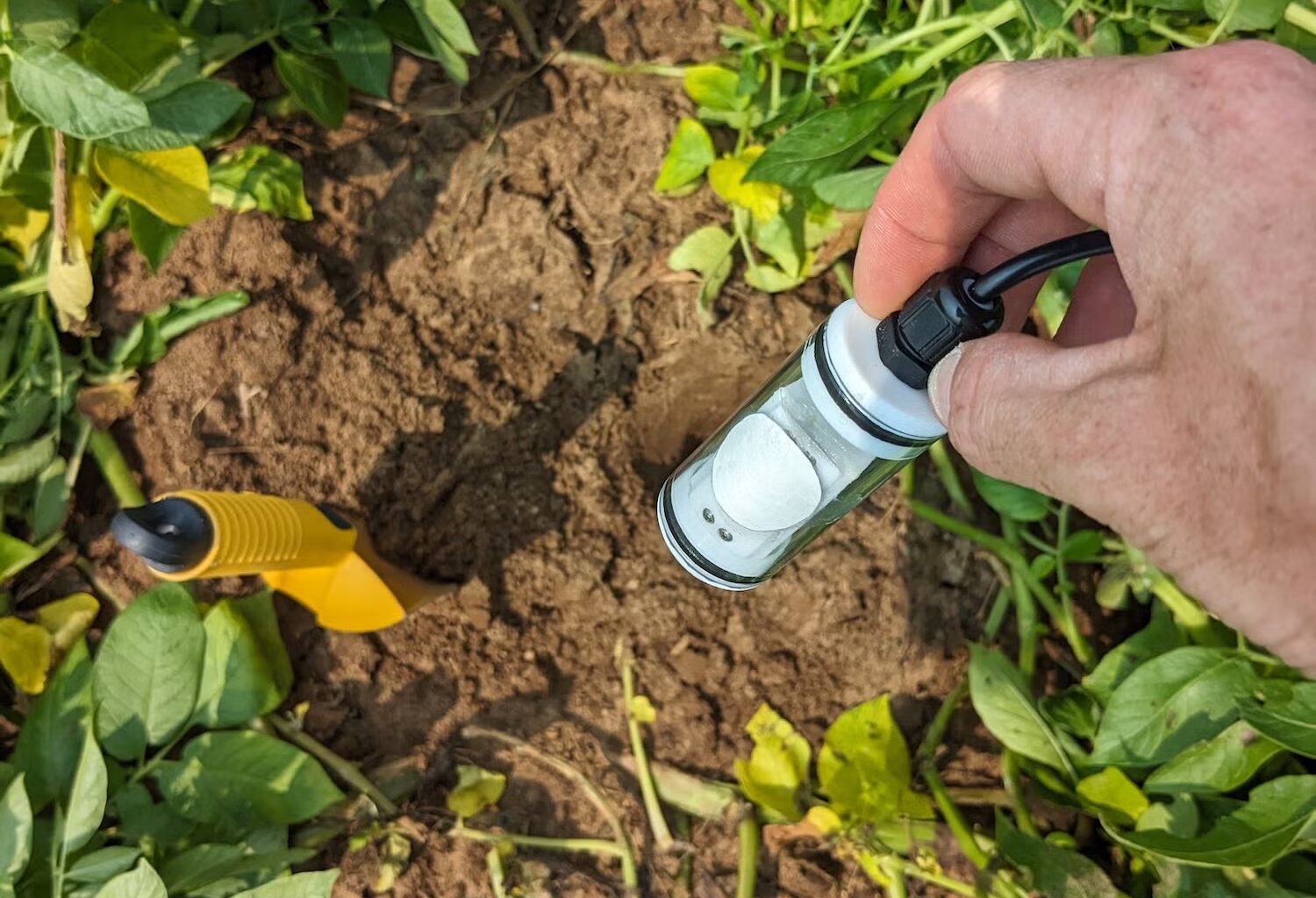
She’s a member of a team trying to address that by making reliable, inexpensive and easy-to-deploy sensors that monitor soil in real time as it, essentially, breathes in and out. Those data could help farmers optimize their use of fertilizers, reducing greenhouse gas emissions and saving money in the process.
“We all eat,” said Gregory Whiting, an associate professor in the Paul M. Rady Department of Mechanical Engineering who heads up the CU Boulder team. “So it’s really important that food is produced in a way that will let us keep doing it for a long time.”
The effort is part of a $2 million project, led by the University of California Berkeley, to confront a persistent challenge in agriculture: nitrous oxide emissions from soil.
Nitrous oxide is a potent greenhouse gas that can trap about 265 times more heat in the atmosphere by weight than carbon dioxide. Agricultural soils, through the activity of those hidden bacteria, dump more of this gas into the air than any other human source.
Researchers at CU Boulder and UC Berkeley are developing new suites of sensors to accurately estimate the nitrous oxide emissions from soil—in real time and for a fraction of the cost of existing tools. The group hopes that farmers could one day install these sensors across entire fields.
Out of balance
The project dovetails with Luna’s long-lasting love for green and growing things.
As a high school student growing up in the Los Angeles area, Luna competed in plant identification events hosted by the National Junior Horticultural Association. She and her fellow contestants named common horticultural plants from a few bits and pieces: Could they identify an elderberry tree by its flowers, for example, or the seeds of a persimmon?
A researcher in Gregory Whiting’s lab lowers a soil sensor into the dirt. (Credit: BEEM Lab)
In 2015, Luna attended the organization’s national competition and placed first.
It’s a passion she brought with her when she moved to Colorado.
“When I moved here, the first thing I did was buy a book on native plants,” she said.
The world’s commercial plants, Luna added, from corn and soybeans to coffee and bananas, depend on soil that exists in a delicate balance.
To improve crop yields, farmers add fertilizers to their soils, usually in synthetic forms. But plants can only use so much of that fertilizer, and the rest goes to waste.
It carries a toll: Excess nitrogen can pollute waterways and escape into the air as nitrous oxide—sometimes known in dentist offices as laughing gas.
It also costs farmers a ton of money. According to estimates from the U.S. Department of Agriculture, fertilizer use may make up more than 40% of the operating costs for corn and wheat growers. In 2024 alone, the nation imported nearly $4 billion in fertilizers from overseas.
“We need to produce a lot more food than humans ever have before because we have a growing population,” said Taylor Sharpe, a postdoctoral researcher in Whiting’s lab. “So it’s an issue of optimizing our agriculture.”
There’s just one big problem: Scientists have long struggled to measure nitrous oxide emissions from soils in real time, said Whendee Silver, a biogeochemist at UC Berkeley. She leads the nitrous oxide project, which is funded by the U.S. Department of Energy’s Advanced Research Projects Agency–Energy (ARPA-E).
“When microbes get the perfect storm of conditions, they’ll produce a lot of nitrous oxide. It can happen over the course of a few hours to a couple of days,” she said. “If you’re not making measurements often enough, it’s very easy to miss those hot moments.”
Traditionally, Silver’s lab has recorded nitrous oxide emissions from soil in real time using high-tech sensors called cavity ring-down spectrometers and six to 21 automated chambers. But these systems cost over $100,000 each, and the team uses at least two of them to monitor a single acre of land.
Which is where Whiting’s lab comes into the picture.