
The murky water prevented us from seeing the bottom of the river, as if it were protecting the life hidden down there. In calmer sections, we relaxed and enjoyed the lush scenery, but in rougher sections the water turned choppy, rocked the canoe and made us uneasily remember the legend of the disappearing boats. Dodging some logs that had fallen into the river, we eventually arrived at the entrance to Kaputna. The settlement itself was well-hidden in the jungle, but children led us to a zinc-roofed communal shelter where we pitched our tents.
“Let’s go sailing on the river before it gets too late,” Narankas suggested as soon as we’d put up the tents. We set off again, this time into the river’s even more remote reaches, where he and his community made the discoveries that changed their lives.
Flowing with the current
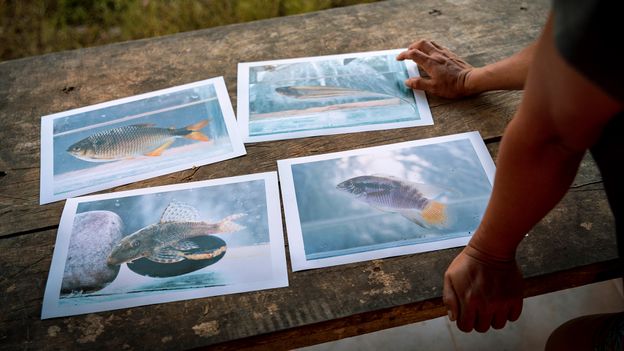
Narankas knows the Santiago like the back of his hand. Even before he took part in the scientific monitoring project, he was familiar with the different fish that lived in the river. In 2021, when the project started, he learned to identify the differences between each species and to call them by their scientific names.
As he steered the peque-peque, he recounted that in 2017, he received a sign. For the Shuar people, the river is more than a body of water or a means of access. On its banks, it is customary to perform the Ayahuasca ritual, in which the Ayahuasca plant, also known as yagé, is consumed. The Shuar believe that the resulting visions reveal the future and guide the actions of those who take it.
“I had dreams that I was going to change the system. In the visions, there was a man who travelled to other countries, and that was me, travelling with this project. I didn’t know it at the time,” he told us.