
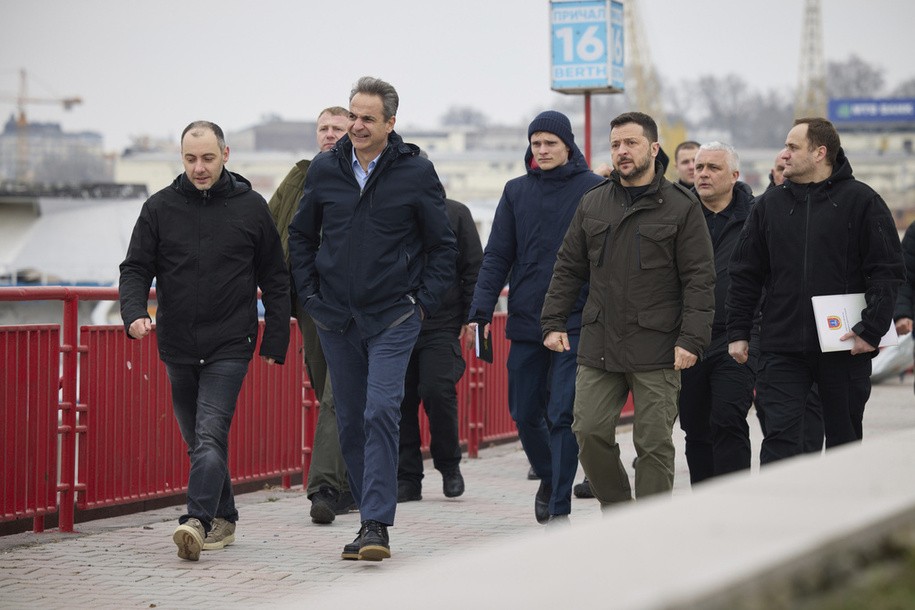
Greece became the first European Union member to support the U.S. plan to replace all Russian gas with American liquefied natural gas (LNG). On Sunday, November 16, Greece signed a deal to help Ukraine bring in US liquefied natural gas (LNG) for the winter. Ukrainian President Volodymyr Zelenskyy visited Athens that day and sealed the agreement.
The gas will be shipped as liquefied natural gas (LNG) and will travel through Greece before reaching Ukraine. This deal will improve energy security in the region, especially as Ukraine prepares for a harsh winter. The plan involves U.S. gas companies sending LNG to Greece, which will then deliver it to Ukraine via the ‘Vertical Corridor.’ ” Deliveries will start early January 2026. Until then, Greece will send natural gas to Ukraine to help the country get through the coming winter and replace energy supplies lost due to Russian attacks on its infrastructure.
Greek Prime Minister Kyriakos Mitsotakis said, “Greece sided from the first moment with the defender against an attack that violates every principle of sovereignty and international law.” He emphasized that “the inviolability of borders is nonnegotiable” and stressed that Greece is a “steady ally” of Kyiv. “We stand with the Ukrainian people,” the Greek Prime Minister proclaimed. Mitsotakis went further and expressed his “revulsion at the intensification of Russian attacks (that include) non-military infrastructure and (result in) civilian casualties.” Referring to the Turkish occupation of northern Cyprus, Mitsotakis stated that Greece, sharing a similar experience, could not have done otherwise but to support Ukraine firmly.
The prime minister also highlighted a “new secure energy artery from south to north” through the “Vertical Corridor” and pledged Greek support for Ukraine’s postwar reconstruction. He also said the new gas route will help keep energy supplies steady in Europe.
Ukrainian President Volodymyr Zelenskyy thanked Greece and the United States for their support. He explained that Ukraine’s energy system is under constant attack and needs reliable supplies. Zelenskyy also urged more pressure on Russia, including stronger sanctions.
The Ukrainian President described this winter as a “big challenge” for his country, citing daily Russian attacks with drones and missiles. He emphasized that the energy plan, which Greece is helping carry out, is essential for Ukraine’s stability and for meeting people’s needs in the coming months.
Zelenskyy also discussed his meeting with the President of the Hellenic Republic, Konstantinos Tasoulas, during which they discussed energy deals between the two countries, sanctions, the use of frozen Russian assets, and how Greek businesses can help rebuild the country.
Defense and security had an essential place on the visit’s agenda. The joint statement, signed by both sides, calls for strengthening military cooperation, with an emphasis on maritime security and unmanned maritime systems. Greece and Ukraine also agreed to strengthen cybersecurity cooperation and to exchange information on hybrid threats.
Greece’s support for Ukraine infuriated Russia. The Russian Foreign Ministry accused Athens on Thursday of following a “provocative and confrontational path” and taking “openly unfriendly steps” because Greece chose to work with Ukraine on building and using unmanned sea vessels.
Foreign Ministry spokesperson Maria Zakharova said at a press conference, “Greece is choosing a provocative and confrontational policy toward Russia and is taking openly hostile actions.” She added that Russia would respond in a way it believes is appropriate.
“Athens was among the first to send weapons and ammunition to Ukraine. The Ukrainian armed forces use these weapons daily against civilians in the Donbass, Zaporizhzhia, Kherson, Crimea, and other southern regions of our country. All of this is happening despite the fact that Greeks have lived in these regions since time immemorial,”
said Zakharova.
She added: “This step, like many other anti-Russian actions by the collective Western world aimed at defeating Russia on the battlefield, has been duly assessed by us and will be followed by an appropriate response.”
“Threats against sovereign states are automatically rejected,” Greece’s Foreign Ministry quickly responded to Zakharova’s comments on Thursday night. Diplomatic officials said that Greece always bases its actions on international law and shows respect for other countries. They added,
“Every state has the right to conclude interstate agreements. This is particularly true when the agreements guarantee energy sufficiency and security, which are prerequisites for human prosperity, as is the case with the agreement between Greece and Ukraine. Threats against sovereign states are automatically rejected.”
Reacting to the Kremlin’s irritation, EU Commission spokesperson Anita Harper said it’s no surprise that Russia is making threats. She said the European Union fully supports Greece and stands with Ukraine because it has seen how aggressive Russia can be.
Harper explained that Russia has carried out provocative actions and used different kinds of “hybrid threats” against EU countries. Because of this, the EU is working to strengthen its defenses. She added that the EU has a plan for defense readiness and is helping Ukraine while also improving its own security.
Meanwhile, Greece’s neighbor and NATO member, Turkey, ignores US calls and will continue to buy Russian gas. When President Donald Trump met with Turkish President Recep Tayyip Erdoğan at the White House in late September, he asked Europe and NATO allies — including Turkey — to stop buying energy from Russia. In 2023, the Biden administration warned Turkey about sending chemicals, microchips, and other products to Russia that could help its war in Ukraine.