
Unlock the Editor’s Digest for free
Roula Khalaf, Editor of the FT, selects her favourite stories in this weekly newsletter.
The UN COP30 climate summit ran into overtime as groups of countries led by the EU and Saudi Arabia clashed over the core issue of quitting fossil fuels, while further disputes over climate finance and trade escalated.
The absence of a so-called road map for economies to wean themselves from the use of oil, gas and coal in a draft agreement released on Friday led to tense exchanges between ministers, aides and envoys.
The EU and the UK were among those pushing for the reintroduction of previous references to the road map in the documents, while Saudi Arabia and Russia led those refusing to countenance it. The proposal would fulfil a pledge made by almost 200 countries two years ago at the COP28 in Dubai to transition away from fossil fuels by 2050 to limit global warming.
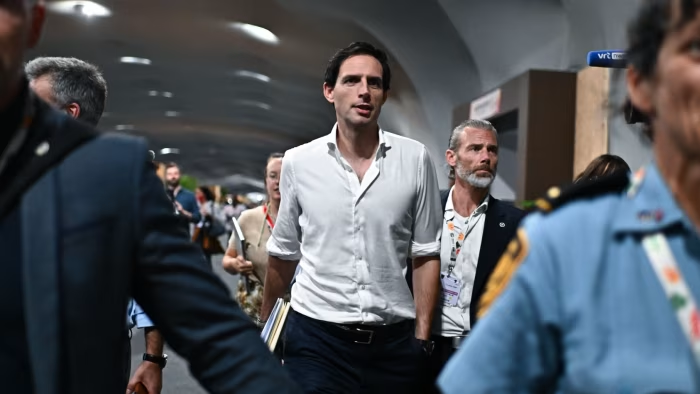
EU climate commissioner Wopke Hoekstra was strident about the COP30 draft agreement’s failure to adequately tackle climate change.
“Under no circumstances will we accept this,” he told a closed-door meeting on Friday. “And nothing that is even remotely close, and I say it with pain in my heart, nothing that is remotely close to what is now on the table.”
Speaking to journalists in the corridors of the conference centre, he warned of the possibility of a “no deal” as countries remained far apart.
“It ain’t over till it’s over. So we will continue to give our utmost. But we cannot accept something that sets such a low bar way lower than what the world needs,” he said.
Earlier in the week, a coalition of more than 80 countries coalesced around a proposal for a road map, suggested by Brazil’s President Luiz Inácio Lula da Silva in support of his environment minister Marina Silva.
UK energy and climate change secretary Ed Miliband said on Friday that any COP30 agreement needed to acknowledge how far off track the world was to meeting the 2015 Paris agreement on limiting global warming to 2C since pre-industrial times, and ideally to 1.5C.
It was necessary for all countries to improve their national climate plans, he said. “We are fighting for maximum ambition.”
The Brazilian COP presidency urged the 194 countries at the summit to work together to find common ground, but by late on Friday there was still no compromise in sight.
COP30 president André Corrêa do Lago, an experienced diplomat, said the countries needed to find a compromise and show the world that “consensus is a strength”.
 COP30 president André Corrêa do Lago, far left, called for compromise © AFP/Getty Images
There were factions in the world which did not want the summit to reach an agreement, he said, without directly noting the absence of the US under President Donald Trump, who describes climate change as a hoax. “So we must absolutely reach an agreement.”
Some people close to the EU delegation pinned their hopes for talks to be unblocked by a potential meeting between European Commission president Ursula von der Leyen and Lula on the sidelines of the G20 summit, which is taking place in Johannesburg this weekend.
Recommended

The pressure to reach an agreement becomes more urgent as ministers from around the world are scheduled to fly home from Brazil in coming hours.
Cruise ships where delegates and UN representatives are being accommodated in the Amazonian city of Belém, which lacks capacity for the tens of thousands of attendees, are due to depart on Saturday.
China led a round of negotiations on trade on Friday, after complaining about the EU’s introduction of a carbon border tax on imported goods next year.
India was among the developing countries holding out for more financial support for the coal-dependent nation’s shift to clean energy, and was opposed to what was perceived as pressure to phase out fossil fuels at pace, a person close to the delegation said.
It would stay the course amid “very intense debates” until a deal was reached. “Walking away is not a solution,” they said,
But Luis Bachir from the Mozambique delegation said: “I cannot say things are going well.” He added that the least-developed countries such as Mozambique needed more financing to deal with climate change.
The draft agreement published on Friday included a reference for “calls for efforts to triple adaptation finance compared to 2025 levels by 2030”, a level rich countries have previously objected to.
Climate Capital
Where climate change meets business, markets and politics. Explore the FT’s coverage here.
Are you curious about the FT’s environmental sustainability commitments? Find out more about our science-based targets here