
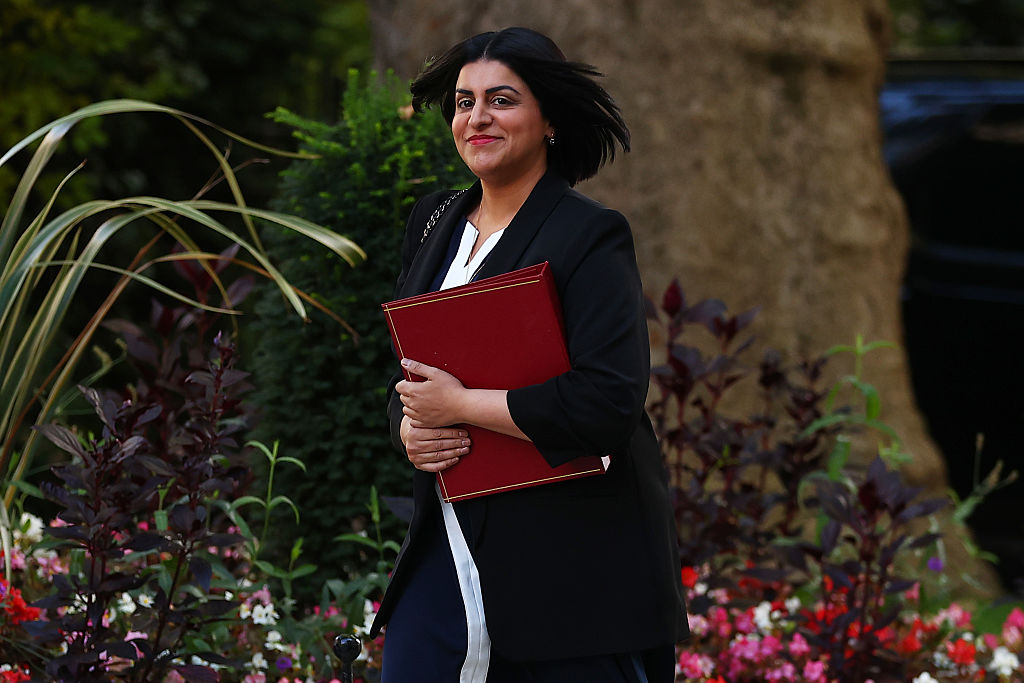
(Photo by Peter Nicholls/Getty Images)
This week we caught a glimpse of what a Labour government could do. In the House of Commons on Tuesday, the Home Secretary Shabana Mahmood introduced her plans to reform the asylum system. On Thursday she announced a radical shake-up of the rules for legal migration. Clear in her intention, she has begun the long and difficult process of re-establishing sovereign authority over our citizenship and national borders, without which a democratic nation loses its legitimacy. She has taken on the establishment, the radical right, and the liberal left, and showed the country the kind of political common ground we can build a future on.
The small inflatable boat, packed tight with young men, crossing the Channel, has become an image defining our age. The cultural critic Roland Barthes describes how images have “punctums”, the element of a picture which arrests our gaze, and which makes it meaningful and memorable. It is what the viewer adds to the image but which is nonetheless already there, that creates a form of communication which draws us into an emotional engagement with the image. To a great many British people the small boats are a portent of state failure and national decline.
Since time immemorial, the Sussex and Kent coastline known as “the Downs” has been the strategic focus of national defence. Here, at the narrowest point of the Channel, with Dover as “the key to England”, the English have secured their sovereignty and democratic freedoms by controlling the sea against the threat of invasion from the continent. The images of the small boats landing unimpeded conjures this historic threat of invasion in the national psyche. It is prophetic of the stranger who comes and who stays, unsettling an already disorientated culture and fragmented society. This, the image communicates, is what the future will end up looking like.
Racist and xenophobic are two epithets for such a view and this is indeed how many on the left, still wedded to a liberal cosmopolitan world view, dismiss the English populist protest against mass immigration. In doing so they fail to understand it. Mahmood has made it her moral mission to stop the boats and radically reduce immigration, whether legal or illegal.
Her critics, dealing with a Muslim woman and second generation migrant, have had to choose their words more carefully. A number of Labour MPs have denounced her. She is engaging in “performative cruelty”. Her plans are dystopian. They encourage racism. She is guilty of economic misjudgment, scapegoating, and hostile practices. The Refugee Council fell into hyperbole: her plans echo, “some of the worst treatment of refugees in history”. Zack Polanski outbids everyone, “I am furious, so many people are furious.” Labour, he said, “is a government of cowards.”
For these critics the small boats signify the vulnerability of a desperate and dispossessed people seeking sanctuary. Barthes missed a significant aspect of how people invest images with meaning. Their class experience shapes their response. For those who lost out from globalisation, for whom change meant the eclipse of generational ways of life built around stable communities and regularised work and union representation, a world without borders and an uncontrolled influx of cheap labour is to be feared.

Treat yourself or a friend this Christmas to a New Statesman subscription from £1 per month
For 25 years a bi-partisan consensus led by the “Blairites” and “Cameroons” ruled the country, valorising globalisation and frictionless borders. Its mix of social and economic liberalism extended market forces into society, enabled large scale immigration as a social good, ceded sovereignty to the EU, and handed economic power to global corporations. In the name of progress, successive governments oversaw the unravelling of social norms, traditions and ways of life that had bound society together and defined national life and identity.
This consensus was an alliance of a dominant economic elite and what Barbara and John Ehrenreich called the Professional and Managerial Class (PMC). Subordinate to the economic elite it reproduces capitalist culture and class relations through its control over large swathes of the media, the quangocracy, the NGO sector, civil service, judiciary, and cultural and educational institutions. The Ehrenreich argue that relationships between “teacher and student (or parents), manager and worker, social worker and client” are a mix of hostility and deference on the part of working-class people, contempt and paternalism on the part of the PMC.
By the time of the EU Referendum in 2016, the policies and values of this ruling consensus had incited the blowback of national populism. The defeat of the Remain vote in the EU brought its political hegemony to an end. Confronted with populism the PMC has retreated into a defence of the progressive status quo ante. This included enforcing a taboo on discussion of race and immigration.
The liberal individualism of a typical white PMC that dominates the left, its refusal to recognise the problem of an immigration and asylum system that is broken, widely abused, hugely expensive and a cause of increasingly deep and bitter social division, has actively undermined the left and ceded influence and authority to the radical right.
In her efforts to stop the boats and strengthen control over the immigration system, Shabana Mahmood has broken the consensus and opened up the opportunity for a conservative left politics capable of building a broad cross-class, national coalition to defeat the populist right and pave the way for radical economic measures to rebuild the national economy. She understands, because her family experienced the murderous impact of partition in India, that weak broken borders, a failing state and a pusillanimous governing class are a grave threat to minorities. She is giving back the “key to England” to the British people.
[Further reading: Can Mahmood save the Labour Party?]
Content from our partners