
Alberta teachers and administrators are overwhelmed and burning out due to increasing numbers of students with complex needs and inadequate resources for schools to meet them, says a report from a government-appointed action team released on Friday.
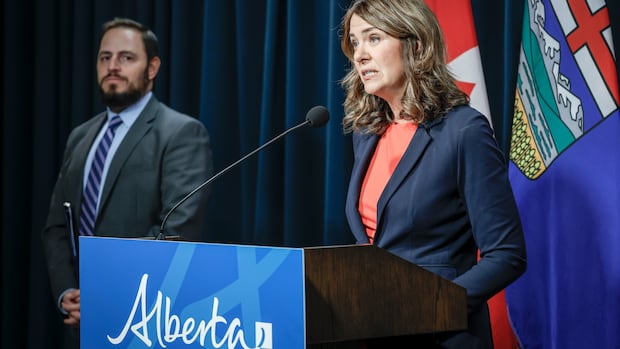
Premier Danielle Smith and Minister of Education and Childcare Demetrios Nicolaides spoke at a news conference Friday when the report from the “aggression and complexity in schools action team” was released.
“Teachers have to wear multiple hats today,” Nicolaides said.
“They have to be teachers, translators, interpreters, clinical professionals, therapeutic experts. That’s just not realistic.”
A 25-member team of school trustees, superintendents and other education stakeholders says children’s unmet health, social and behavioural needs are overwhelming school staff and exacerbating challenges of growing class sizes.
The issue of complexity and aggression in classrooms was a central issue in the recent provincewide teacher strike.
“I am confident this report gives us a clear path to tackle the challenges facing our classrooms,” said Nicolaides.
The report’s recommendations include making half-day kindergarten mandatory in Alberta, reducing student-teacher ratios, and expanding program unit funding for young students with disabilities so it includes Grade 1 and less profoundly disabled children.
The action team lacked a mandate to recommend increases in kindergarten to Grade 12 education funding overall, but the report recommends funding or resource increases at least 17 times.
“Crucially, funding must be aligned with the level of need, enabling schools to recruit, retain, and deploy the right professionals to create stable, responsive learning environments for all students,” the report says.
Accounts of rising behavioural problems from children are due to unmet needs, the report says. Schools are operating “in a state of crisis management,” responding to students with the most aggressive behaviour, and it raises questions about whether school employees need more occupational protections.
Teachers and administrators are overburdened with bureaucratic tasks and lack access to training and education to feel equipped to work with students who have unique challenges, the report says.
The situation has led to exhausted and numb teachers struggling with anxiety, absenteeism and burnout, it adds.
“These issues contribute to high turnover rates and exacerbate the existing teacher shortage,” the report says.
During the historic provincewide teachers’ strike in October, the government had said the market supply of teachers in Alberta didn’t merit further financial incentives to attract workers.
The action team report recommends hiring more teachers to reduce class sizes and hiring more educational assistants. It also suggests arranging better co-ordination with other government ministries to give students timely access to occupational therapists, speech language pathologists, psychologists and physiotherapists.
Alberta needs a consistent, provincewide approach to assembling the program plans that guide schools on how to address students’ exceptional needs, the report says.
The government should make information about resources to help children easier to find online in one place, and help for students shouldn’t be contingent on clinical diagnoses, it says.
“Our staff remain committed to every student, but resources and supports have not kept pace given these complex conditions,” Edmonton Catholic Schools superintendent Lynette Anderson said during a news conference.
Next steps could start in January
Smith and Nicolaides did not immediately commit to acting on any recommendations, saying a new cabinet committee will take classroom level data from schools and decide as early as January where to allocate new funding.
“Complexity and class sizes are very challenging issues,” said Nicolaides, adding that solutions will take time.
Smith said some of insights from the report have already been implemented, including the recommendation for cross-ministry collaboration.
The government has committed about $400 million to hire 1,500 more educational assistants, perform more diagnostic tests and provide other supports to schools over the next three years to try to improve complexities.
But Nicolaides said the number of English language learners (ELL), which has substantially increased, needs particular attention.
The premier also told reporters that 22-year-old class-size recommendations from the Alberta Commission on Learning are a “guidepost” for an optimal class size. Although, she said class sizes greater than 40 students “should never happen.”
Recommendations echo teachers’ pleas
Alberta Teachers’ Association president Jason Schilling supports the action team’s recommendations, saying they repeat what teachers have been saying for six years.
The report validates teachers’ concerns about the effects of underfunding the public K-12 education system, Schilling said, adding that Alberta has among the lowest per-student funding in Canada.
The 3,000 new teachers the government has promised to hire by 2028 won’t be enough to make up the staffing shortfall across the province, Schilling said.
He said Nicolaides’s willingness for a cabinet committee to consider the recommendations was insufficient, suggesting the government should instead commit to funding the team’s recommendations and making the legislative and policy changes they proposed.
“It was their decisions on budget-making that got us to this place, so I’m fairly cynical. I am fairly untrusting of what I hear from politicians,” Schilling said.
Smith reiterated Friday that there may be some situations where including all students in a typical classroom may not be ideal.
“If you end up having more kids in the classroom who don’t speak English than do, and they’re coming at later and later grades, the system’s kind of broken,” Smith said.
Opposition NDP education critic Amanda Chapman echoed Schilling’s sentiments, telling CBC News that the government ought to commit more money to meaningfully address the action team’s recommendations, not just strike more committees.
“They are not prioritizing public education and that’s what we need to see a change in if we want to see a change in the state of our classrooms,” Chapman said.
She also accused the government of blaming immigrants for the challenges in schools.
She said the numbers of students diagnosed with mental health challenges, medical conditions, learning disorders and disabilities are also growing, and noted that access to professionals in rural Alberta is sparse.