
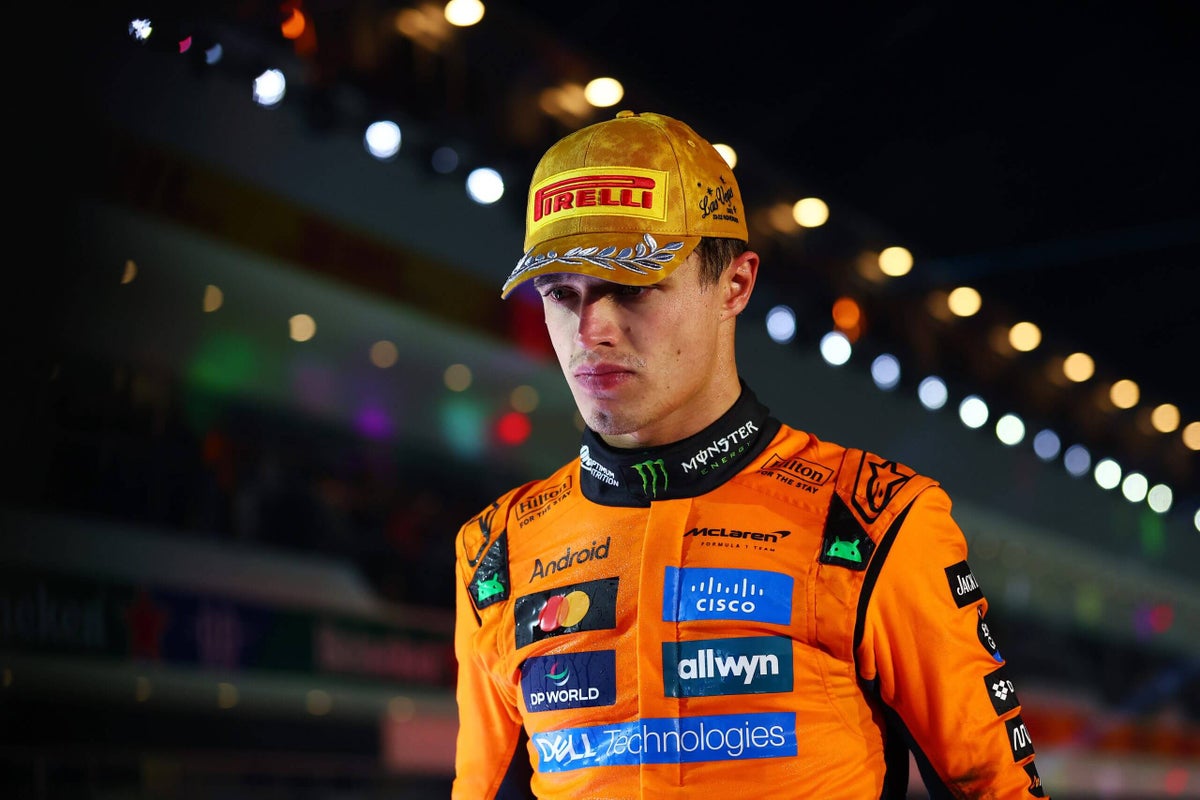
LAS VEGAS — Lando Norris and Oscar Piastri have been disqualified from the Las Vegas Grand Prix, creating a significant shake-up in the drivers’ championship with two grands prix and one sprint race remaining in the 2025 Formula One season.
With the double McLaren disqualification, Piastri and Max Verstappen are tied in points while Norris leads them by 24 points. It’s about a twenty-point swing overall in Verstappen’s favor compared to the provisional race results, and puts intense focus on Norris as he tries to secure his first F1 championship.
The new Las Vegas GP classification has Verstappen as the winner of Saturday night’s race, with George Russell moving up to second place and Kimi Antonelli being promoted to third.
Norris spent most of the race trying to chase down Verstappen, who went on to win, but in the closing stages, the McLaren driver’s pace began to drop, and the gap between first and second quickly widened. At one point, his race engineer Will Joseph told him over the radio that “the fuel looks OK now” and to “reduce what you’re doing a small amount”.
As a result, Norris faced questions post-race about whether he was managing an issue and if fuel was the primary concern. The FIA conducted post-race checks and Jo Bauer, the FIA Formula One technical director, issued a report stating that the measured thickness of Norris’s and Piastri’s rearmost skids was less than 9 millimeters. This is the minimum thickness required in the technical regulations, and both drivers and a team representative were summoned to meet with the stewards.
According to the decision documents for both drivers, the measurements were 8.88 millimeters on the front right-hand side and 8.93 millimeters on the rear right-hand side on Norris’ car. On Piastri’s car, it was 8.96 millimeters on the front left-hand side, 8.74 millimeters on the front right-hand side and 8.90 millimeters on the rear right-hand side.
The rear skids were re-measured with three McLaren representatives and the stewards present, and those measurements confirmed that the skids did not comply with the regulations. The relevant measurements were even lower than those measured originally by the Technical Delegate.
McLaren pointed to the race’s excessive porpoising — when the car bounces on bumpy surfaces, causing the underside to strike the ground at high speed — and that the degree of the breach was lower than prior breaches of this regulation in 2025.
The FIA, though, argued there’s no precedent for anything other than the typical penalty in this situation, nor is there a provision in the regulations.
“The Stewards also note the various decisions of the FIA International Court of Appeal which limit the ability to avoid disqualification for technical breaches,” the stewards’ decision document stated. “Notwithstanding the submission by the Team that there was potentially accidental damage that may have led to movement of the floor, which could have caused additional wear, the Stewards do not consider this sufficient to mitigate the penalty.”
The stewards imposed the typical penalty, disqualification, for breaching an article of the technical regulations.
“As the FIA noted, the breach was unintentional, there was no deliberate attempt to circumvent the regulations, and mitigating circumstances also existed,” McLaren principal Andrea Stella said after the decision.
“We apologise to Lando and Oscar for the loss of points today, at a critical time in their Championship campaigns after two strong performances from them all weekend. As a team, we also apologise to our partners and fans, whose support means so much.”
Lewis Hamilton was disqualified from the Chinese Grand Prix earlier this season for the same reason.
The plank on the underside of an F1 car is made of a composite material called Jabroc, a kind of strengthened beechwood. Its primary purpose is safety, preventing cars from bottoming out into the circuit.
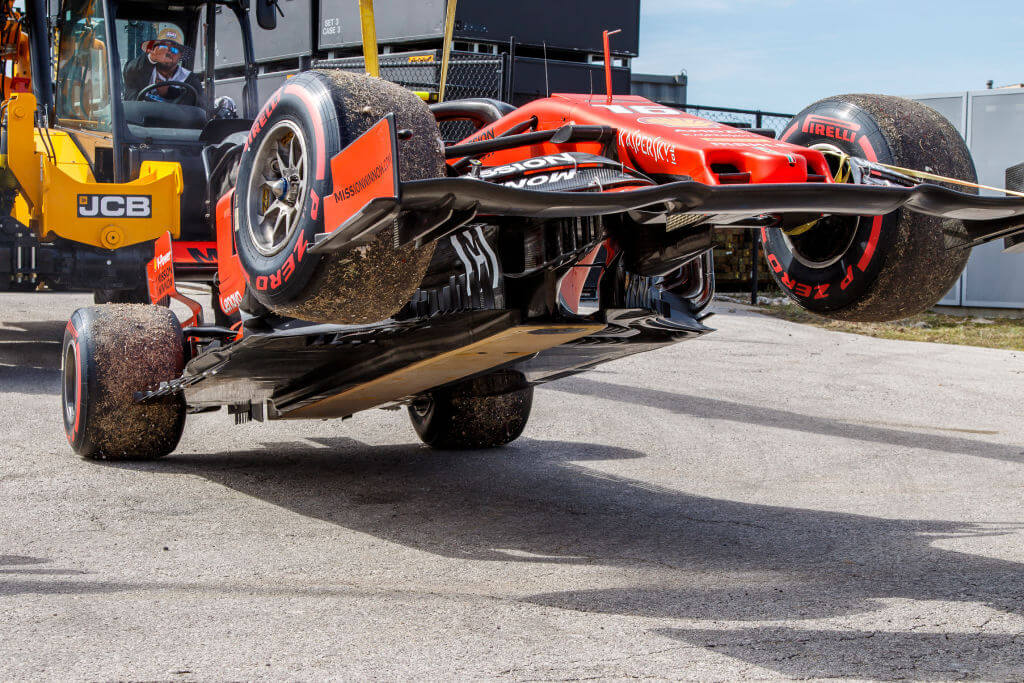
Excellent view of the plank under on Charles Leclerc’s car at the United States Grand Prix in 2019 (Allan Hamilton / Icon Sportswire via Getty Images)
The point of the plank wear rule is to ensure teams are not running their cars too close to the ground and consequently gaining a performance benefit by increasing the downforce generated by the floors, which are especially powerful under the current regulations, which reward cars that can effectively exploit ground effect. In this aerodynamic phenomenon, the car’s underside accelerates the air beneath it, effectively sucking it down onto the track.
After each race, the FIA conducts an extensive scrutineering process that checks various aspects of all cars. The information is detailed in a post-race report issued by the FIA’s technical delegate, Jo Bauer, and sent to all competitors and made available to the media.