
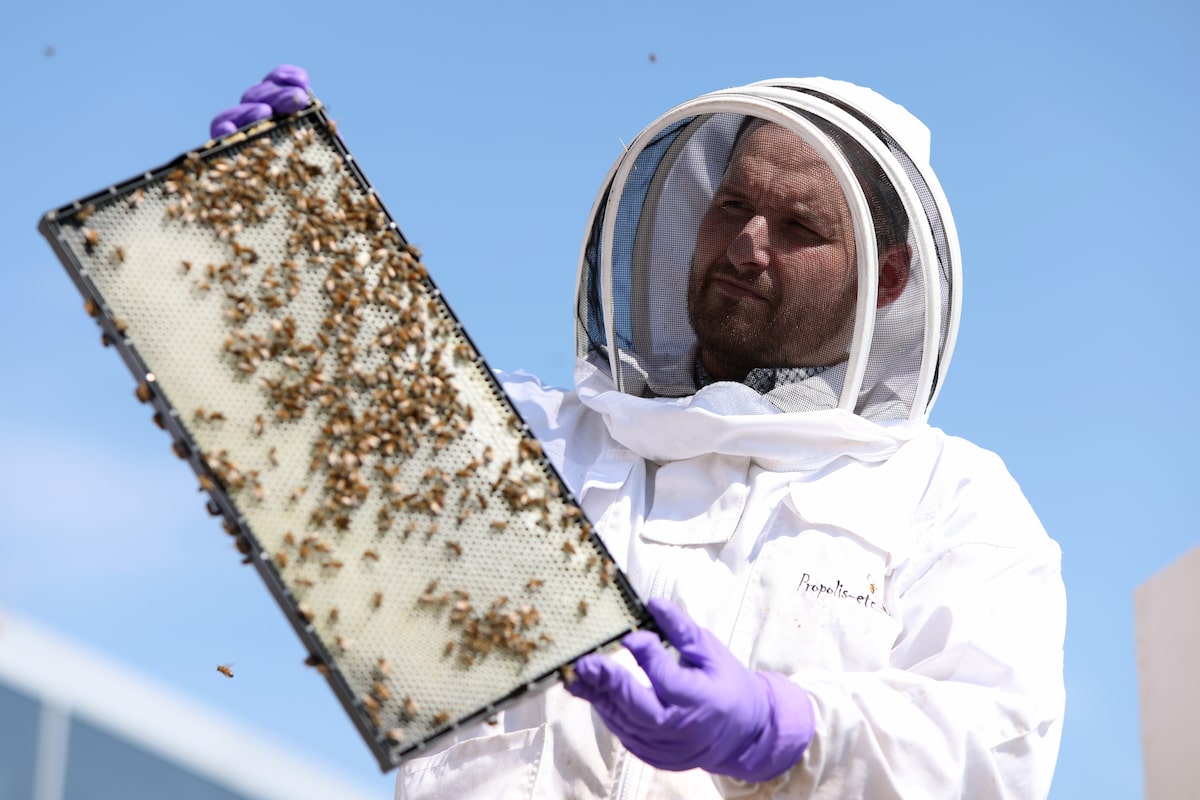
The study’s lead author Brendon Daisley at University of Guelph’s Summerlee Science Complex, on Monday. Dr. Daisley says the data indicate that honeybees may have grown dependent on the drugs as a supplement to protect them from bacterial infections.Nicole Osborne/The Globe and Mail
From parasites to pesticides, honeybees face a range of environmental stressors and challenges.
Now, a Canadian study has turned up evidence that tightening regulations around antibiotic use may also be affecting honeybee viability.
The study, published Tuesday in Nature Sustainability, shows that honeybee colonies across the country have suffered increased losses since regulations to control antibiotic use in bees and other animals took effect in 2018.
The results of the study underscore the need for new approaches to keeping bees disease-free in a world where antibiotic resistance is a growing public health problem.
“Because there’s no alternative for beekeepers to use, the withdrawal of antibiotics has led to a higher mortality rate,” said Brendan Daisley, a post-doctoral researcher at the University of Guelph and the study’s lead author.
The overuse of antibiotics is considered a problem worldwide because of the emergence of resistant strains of bacteria that can endanger animal and human health. But the study found that the stricter controls over antibiotics in Canada seem to correlate with poorer outcomes for honeybees colonies trying to survive the winter months.
In an interview, Dr. Daisley said the data indicate honeybees may have grown dependent on the drugs, which beekeepers typically administer mixed with sugar, as a supplement to protect them from bacterial infections. Their removal over a relatively short time period may have then led to a measurable uptick in colony turnover.
“When all of a sudden, beekeepers stopped using them, the bees actually had worse survival,” Dr. Daisley said.
The finding comes with an important caveat. While the data show a correlation to the drugs, the study does not prove that the increased winter losses were the result of an increased incidence of infectious disease.
If such a relationship could be shown, “then the argument that antibiotics were a driver of overwinter mortality would be more compelling,” said Sarah Wood, a researcher and associate professor who specializes in pollinator health at the University of Saskatchewan.
Bacterial infections in bees include larval diseases, which can spread quickly and wipe out entire colonies.Nicole Osborne/The Globe and Mail
While honeybees bear little resemblance to cows, pigs and other farm animals, their status as non-native species and their use in honey production and in pollinating crops means they share some important characteristics with domesticated livestock.
A key similarity is susceptibility to bacterial infections. In bees, these include larval diseases, called foulbrood, which can spread quickly and wipe out entire colonies.
Bee larvae are particularly vulnerable to these infections because their immune systems are not fully developed.
Beekeepers have deployed antibiotics to help bees fight bacteria since the 1940s. As with humans, the drugs have proved effective at fighting harmful microbes, but they also eliminate bacteria that normally co-exist with bees and can be beneficial. Over time, antibiotics create a selection pressure on bacteria that favours antimicrobial resistant strains.
In 2015, the World Health Organization issued a global action plan for dealing with the risk of antimicrobial resistance. Like many countries, Canada improved its regulations around antibiotic use – including in the agricultural sector – as a way to reduce the release of the drugs into the environment.
University of Guelph graduate student, Liz Mallory and Dr. Daisley at the Summerlee Science Complex. The research team also found that reduced colony survival correlated with increased levels of nitrogen dioxide, an air pollutant that is present in diesel exhaust.Nicole Osborne/The Globe and Mail
As part of the change, antibiotics can no longer be purchased over the counter and instead must be accessed through a veterinarian. As anticipated, this translated into fewer antibiotics used.
Dr. Daisley said he wanted to explore the impact of the new rules. Together with colleagues at Guelph and Western University, he drew on survey data provided to the Canadian Association of Professional Apiculturists about the status of hundreds of thousands of individual honeybee colonies, managed by hundreds of beekeepers across the country, between 2015 and 2023.
While figures varied among the provinces, the overall trend showed a near doubling of mortality rates during that period. After controlling for a range of factors, including the severity of winter weather from year to year, the team concluded the reduced use of antibiotics was a statistically significant factor behind the losses.
Antibiotic alternatives, such as vaccines, require more evidence before they can be widely recommended, University of Saskatchewan researcher and associate professor Sarah Wood says.Nicole Osborne/The Globe and Mail
Dr. Daisley said this should not be taken as an argument for returning to former levels of antibiotic use, but rather for developing other options. He added that future research could bolster the development and use of probiotics – beneficial species of microbes that enhance disease prevention in honeybee colonies.
“I agree that there is a need for antibiotic alternatives, such as vaccines and probiotics, but these alternatives require more evidence before they can be widely recommended to beekeepers,” Dr. Wood said.
The Guelph team also found that reduced colony survival correlated with increased levels of nitrogen dioxide, an air pollutant that is present in diesel exhaust. They speculate this could be related to how the chemical interferes with bees’ ability to detect floral odours, an effect that has been demonstrated in controlled studies.