
By Whitney Baxter
“The big thing that I discovered through this research was how destructive maize weevils are,” said Keith Urmie, graduate student in agricultural and biosystems engineering.
Maize weevils are small insects that pose big threats to maize (corn) grown and stored in warm climates, such as Africa, Haiti and Honduras. Adult weevils lay eggs inside the maize kernels, and the hatched larvae eat the kernels’ endosperm, leaving only the hulls.
Under the supervision of Carl Bern, emeritus university professor of agricultural and biosystems engineering, Urmie was tasked with quantifying how much each weevil could eat per day under ideal growth conditions. He completed the research for his Honors program capstone project during his undergraduate studies in agricultural engineering at Iowa State University.
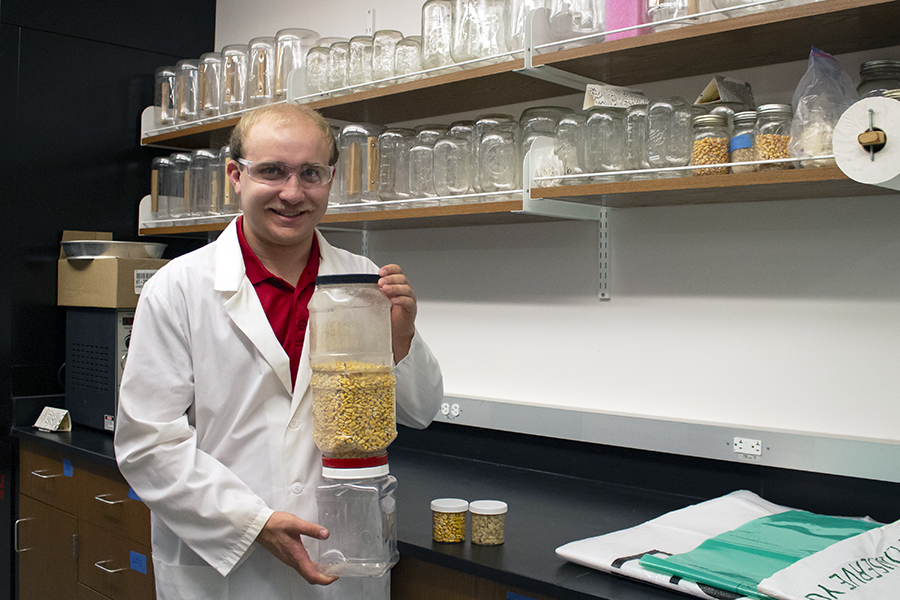
Urmie worked with 48 samples of maize kernels and weevils housed in a controlled environment. After 50 days of storage, he opened half of the samples, noted how many weevils were present and took measurements of the maize mass. After an additional 30 days, he opened the remaining 25 jars and was then able to estimate how quickly the weevils were consuming the endosperm.
Besides calculating the mass consumption, he also analyzed relationships such as moisture content generation by the weevils and mold growth.
The research aimed to promote better storage techniques for small-holder farmers in third-world countries and contribute to the grain storage research Bern has done.
As a result of the work, Urmie can predict the population size and mass of maize consumed by a weevil infestation over time. For example, an initial infestation of 25 maize weevils under optimum growth conditions can grow to 193 million weevils and have consumed 20 tons of maize at 15% moisture content within one year of storage.
Urmie said he appreciated how Bern let him lead the project.
“The biggest thing for me was being able to own my own study as an undergraduate student,” Urmie said. “As a result, I found out that I liked research and teaching, which led me to pursue graduate studies here at Iowa State, where I’m researching mixed-flow grain drying.”
Bern himself saw how destructive maize weevils could be during a trip to Tanzania in 2017 and decided to pursue research on the insect at Iowa State. He has since involved many students in his research, putting them in charge of projects, as he did with Urmie.
“We’re unique here in the Department of Agricultural and Biosystems Engineering in how we treat our students,” Bern said. “They’re going to have their own project and they’re going to be responsible for it. That’s how I experienced it back when I was a student – my advisor was there to provide advice and guidance and not to direct me.”
Urmie said there is more research to be done, specifically looking at the impacts of weevil density and environmental conditions. He hopes other students will continue the research to further study proper maize storage.
“I worked with other undergraduates on this study, so teaching-wise, it was a very good experience to be able to pass this on to someone else and show them what this research is all about,” Urmie said.