
Unlock the Editor’s Digest for free
Roula Khalaf, Editor of the FT, selects her favourite stories in this weekly newsletter.
The Gaza Humanitarian Foundation, the controversial private aid group set up earlier this year with US and Israeli backing to operate in the war-torn Palestinian enclave, said on Monday it was ceasing operations.
John Acree, GHF executive director, said in a statement that the group was “winding down our operations” as it prepared to “hand off” its aid model to the US-led international force responsible for implementing last month’s Gaza ceasefire, which is supposed to end two years of conflict between Hamas and Israel.
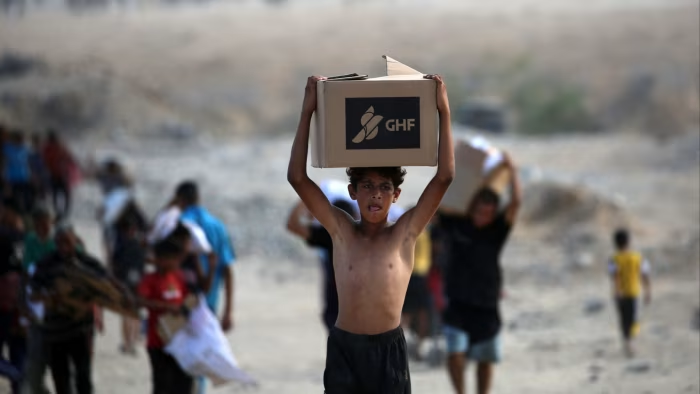
Despite declaring the “successful completion” of its mission, GHF from its start was heavily criticised internationally for operating a militarised form of aid distribution, with private US contractors guarding sites that were often host to chaotic scenes.
Israeli troops also killed hundreds of Palestinians on access routes to the aid distribution points, which disbursed boxes of dry foodstuffs to the local population that were deemed inadequate to alleviate the acute hunger across the shattered enclave.
As the Financial Times reported last month, GHF suspended operations on what it said was a “temporary” basis after last month’s ceasefire as it engaged in talks over a future role in postwar Gaza with senior US military officials based in Israel.
GHF was not included as part of the postwar humanitarian response in the enclave, which under the ceasefire deal is being led by the UN and Red Crescent.
In truth, the group faced a severe cash crunch and had said it could only sustain its work until late November or early December at the latest.
Yet in his statement, Acree said: “As the organisation winds down operations, GHF leaders say they will maintain readiness to reconstitute if new humanitarian needs are identified and will not dissolve as a registered NGO.”
He added that the US-led Civil-Military Coordination Center, which in effect has taken responsibility for administering postwar Gaza, would probably be “adopting and expanding the model GHF piloted”.
A person familiar with Gaza humanitarian issues, who is a critic of GHF, told the Financial Times last month that the group could potentially continue “under a different cover”.
Since it began operations in May, GHF was beset by controversy over its opaque origins and funding sources and reliance on armed private contractors to secure its aid hubs.
The UN and most major aid groups, which had been providing most of the aid before the war and in its early stages, refused to work with GHF, accusing it of “weaponising” aid to force the displacement of Palestinians to southern Gaza, a goal previously outlined by far-right Israeli leaders.
As it began operating, Israel had cut off almost all other aid to Gaza, leading to acute food insecurity and starvation in parts of the territory. GHF’s aid hubs often became scenes of chaos and violence. Health officials in the Hamas-controlled strip said about 1,000 Palestinians were killed by Israeli fire as they sought to reach GHF centres.
GHF maintains the shootings and casualties took place away from its centres. It alleged that Hamas fomented chaos and directly attacked its personnel at least twice.
The Israeli military has acknowledged opening fire at crowds on access routes to GHF sites who it said had approached in a “threatening” manner. It has denied its troops deliberately fired on civilians and claimed the death toll was far lower than that issued by Gazan health officials.
For its part, GHF maintains that it disbursed more than “187mn free meals” to Gazans, a figure that even Israeli officials disputed.