

Protesters shouted at Queen’s Park as MPPs passed Bill 60, a law critics say will increase tenant evictions. Beatrice Vaisman speaks to one of the protesters.
The Ontario government has passed a controversial omnibus bill that critics say will make it easier for landlords to evict tenants from their homes.
Bill 60, also known as the “Fighting Delays, Building Faster Act,” passed third reading 71-43 at Queen’s Park Monday following a fast-tracked process with limited debate.
The voting took place amid loud chanting of “people over profit” and “shame” from the public gallery. Following the vote, the speaker ordered the gallery to be cleared as those being ushered away yelled “you’re putting people on the streets.”
The bill bars tenants from raising new issues at Landlord and Tenant Board hearings and scraps the need for a landlord to offer a tenant compensation if they would like to take their property back for their own use, as long as they give 120 days notice. It also shortens the waiting period to evict a tenant for non-payment of rent.
The province says the changes are meant to speed up proceedings at the Landlord and Tenant Board. Minister of Municipal Affairs and Housing Rob Flack defended the government’s housing strategy at Queen’s Park Monday, saying “not one protection is being altered in this bill” and that it will help give landlords “the confidence needed to rent out their buildings” so that rents come down.
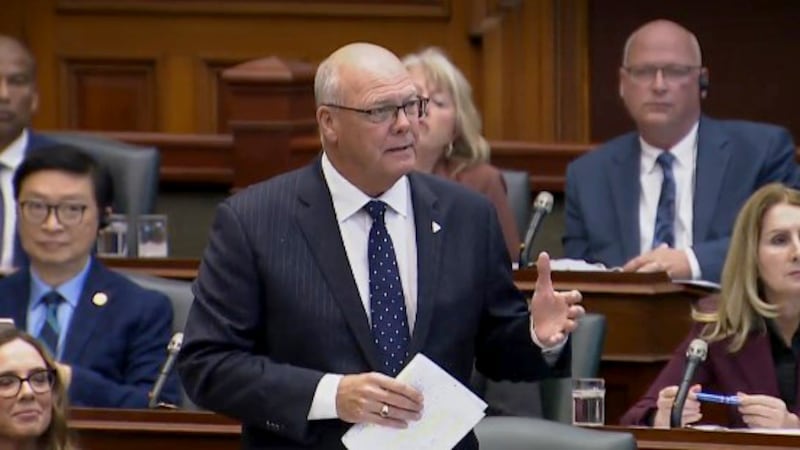 Rob Flack Ontario Housing Minister Rob Flack talks about Bill 60 at Queen’s Park in Toronto on Monday, Nov. 24, 2025.
But critics say the bill will speed up eviction hearings and make it harder for tenants to defend themselves against bad faith evictions while doing nothing to speed up tenant complaints against landlords.
“I call it the ‘create encampments faster act’ because that is precisely what it is and what it will do — force Ontarians out onto the street through no fault of their own,” housing advocate Diana Chan McNally said at a recent news conference at Queen’s Park.
University–Rosedale MPP Jessica Bell said the government is responsible for the backlog at the Landlord and Tenant Board to begin with.
“The significant delays at the Landlord and Tenant Board are entirely caused by the Progressive Conservative government,” Bell said. “They have refused to properly fund the Landlord and Tenant Board. They refused to hire enough competent and impartial adjudicators.”
 Stiles NDP Leader Marit Stiles and housing advocates hold a news conference at Queen’s Park to oppose Bill 60 on Thursday, Nov. 20, 2025. (Joshua Freeman/ CP24)
Thousands of tenants took part in a march through downtown Toronto over the weekend to protest the bill.
The government announced Bill 60 just a few weeks ago, originally including a proposal to hold consultations on changing security of tenure, the law that allows tenants to stay in their homes as long as they keep to the rental agreement and Residential Tenancies Act.
Attorney General Doug Downey said at the time that the government heard from stakeholders that “evergreen leases” were not appropriate and they would explore the idea of making it easier for landlords to end leases for commercial reasons.
Following an outcry, the government said it would remove the part of the bill proposing the consultations on changing security of tenure. However, the bill still strengthens the hand of landlords in disputes with tenants.
The bill still needs royal assent to officially become law.
NDP Leader Marit Stiles has said her party plans to introduce an Opposition Day motion to immediately repeal the bill after it passes.
The massive bill also scraps a Toronto bylaw requiring builders to install green roofs on new buildings to reduce their impact on the environment; transfers jurisdiction of water and wastewater services from Peel Regional Council to Mississauga, Brampton, and Caledon through a new public corporation model for delivering water and wastewater services; and bars municipalities from reducing vehicle lanes in order to install new bicycle lanes.
Other features of the bill include:
Extending Waterfront Toronto’s mandate from 2028 to 2035, with a possible extension to 2040.Streamlining approvals and site plan control for municipalities Calling for “a section-by-section review of the Ontario Building Code” in order to reduce regulations and speed up building