
It’s no exaggeration to say that Toronto is a city perpetually under construction — much of it transit projects that promise to finally connect areas long excluded by our ever-expanding metropolis.
But with so many developments currently on the go, it can be tough to keep track of them all.
So we’ve dug deep to come up with a rundown on the status of all the transit projects that you can — one day, maybe — look forward to riding: the ones that are almost here, the ones that are stuck somewhere down the line — and the ones that haven’t even left the station yet.
Transit projects arriving … soon

The Finch West LRT route.
Metrolinx
Finch West LRT (Line 6)
Start date: Construction began in 2018
Opening date: Dec. 7, 2025
Budget: $3.585 billion (as of March 31)
The Finch LRT, or Line 6, will end up being the first of the current LRT projects to open in Toronto, passing the Eglinton Crosstown LRT, even though Metrolinx began construction on Finch eight years later.
With 18 stops and more than 10 kilometres of track, service on the line will run above ground along Finch Avenue West from Keele Street to Highway 27, where it will then turn and travel south underground to the Humber Polytechnic’s north campus. It will also connect to other TTC lines, and local transit services in Peel and York regions.
Though the line has taken considerably less time to reach the same milestones at the Eglinton Crosstown, partly because it is shorter and less complicated, it has also had its share of setbacks. It was originally slated to open in 2021, but several things have postponed that, including vehicle delivery delays, the COVID-19 pandemic and a lawsuit. After it failed to open in 2024, Metrolinx and the Ontario government had not publicly announced a start date for the line.
The LRT most recently began its 30-day revenue demonstration test, ahead of the Eglinton Crosstown, and needed to operate problem-free for three consecutive weeks before Metrolinx handed train operations for the transit line over to the TTC.
On Monday, the TTC finally confirmed that the light-rail line will open Dec. 7.
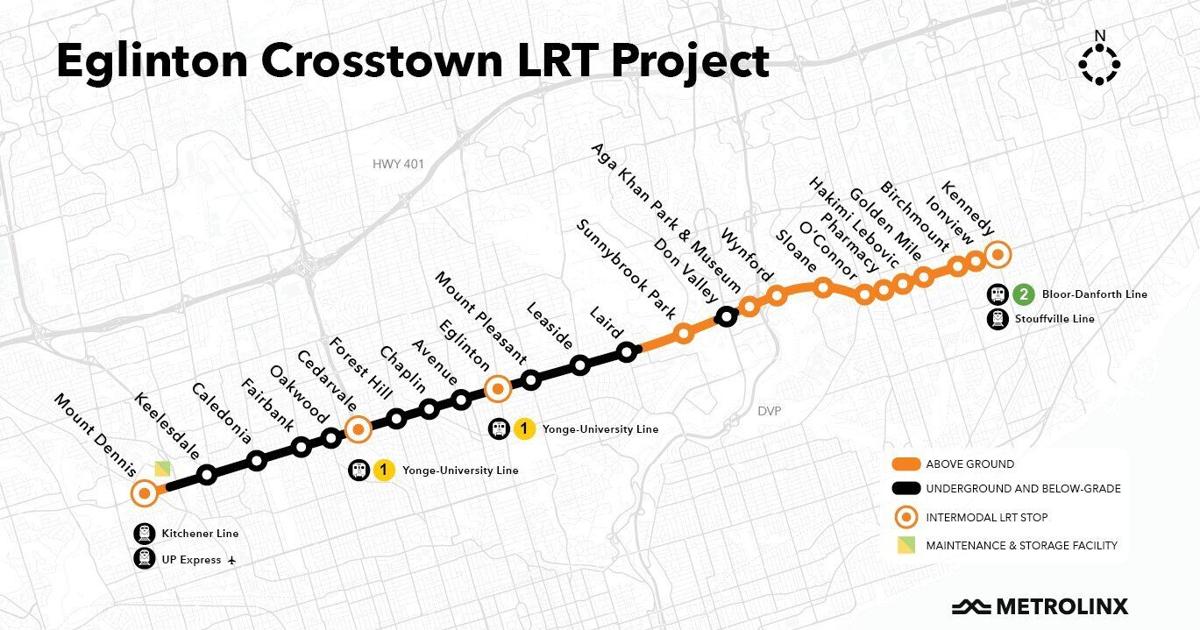
The Eglinton Crosstown LRT route.
Metrolinx
Eglinton Crosstown LRT (Line 5)
Start date: Construction began in 2011
Earliest possible completion: Late 2025
Budget: $12.639 billion (as of March 31)
What transit project could be more discussed, more anticipated — and more delayed — than the Eglinton Crosstown LRT?
Also known as Line 5, the transit route being built by Metrolinx, the provincial transit agency, will have 25 stops from Toronto’s Mount Dennis neighbourhood to Kennedy Road. With almost 20 kilometres of track and links to 54 bus routes, three subway stations and three GO lines, Metrolinx has promised the Crosstown LRT would make east-to-west commutes up to 60 per cent faster than current travel times.
The project has been in the works since 2011, with an original opening date in 2020, but a seemingly never-ending slew of complications including a pandemic, several lawsuits and software glitches has long since made the idea of a completion date seem closer to a punchline than a real deadline. So far, it has racked up a $12.6-billion construction bill.
The project’s lengthy construction led to Coun. Josh Matlow, whose ward straddles Eglinton Avenue, to call for a public inquiry into the Crosstown in 2022.
After more than 14 years of construction, the Crosstown has made strides toward a possible opening this year. But, despite continued testing, the line has run into several problems — including a collision at the train yard — that has kept Metrolinx and the province from announcing an opening date.
Bus-only lanes painted red on Morningside are part of the city’s RapidTO push to speed up commutes.
Richard Lautens/Toronto Star file photo
RapidTO Transit Lanes
Earliest possible completion: Ongoing
Budget: $8 million (estimate, as of July)
The TTC first proposed creating dedicated bus lanes in 2019, and in the throes of the pandemic in June 2020, the transit agency’s board voted to fast track bus-only lanes on Jane Street, Dufferin Street, Steeles Avenue West, Finch Avenue East and Eglinton Avenue East, including small portions of Kingston Road and Morningside Avenue. Installation was slated for just a few months later.
But then-mayor John Tory’s executive committee decided against fast tracking all but the Eglinton Avenue East lane. A new plan would have seen bus lanes painted on Eglinton East first, then Jane Street in June 2021, with Steeles West, Finch East and Dufferin painted by 2022 or after. That plan, however, never came to fruition as city staff undertook years of consultations.
Transit projects still in transit
The current expansion of Bloor-Yonge station is part of the TTC’s move to reduce crowding on Line 1 and Line 2.
Lance McMillan/Toronto Star file photo
Line 1 and Line 2 Enhancements
Earliest completion date: ongoing, 2030
As the city’s population grows, the TTC is planning to expand the capacity of the city’s busiest subway lines.
The TTC is currently looking into improving travel times and crowding on the Line 1 and 2, with timelines to improve capacity over the next 15 years.
The TTC, with funding from the province and federal government, is currently expanding the capacity of Bloor-Yonge Station with bigger platforms, a new exit on Bloor Street and new elevators, stairs and escalators.
The TTC is also procuring 55 new subway cars for the Line 2, which will be single-sourced from train manufacturer Alstom amidst the economic uncertainty caused by U.S. tariffs. The current cars are expected to reach the end of their 30-year service life in 2026, but they will be overhauled to stay in service until the new cars arrive in 2030.
Construction on the Gardiner between Strachan and Dufferin was completed months ahead of scheduled but there is more work to be done on the elevated expressway.
Nick Lachance/Toronto Star file photo
Gardiner Expressway Rehabilitation
Earliest possible completion: 2030
Budget: $3.6 billion (estimated in 2016)
Not a transit project, but the Gardiner Expressway is one of Toronto’s busiest commuter routes and is used by approximately 140,000 vehicles each day, so what happens to it matters to a lot of people in the GTA.
The stretch of Gardiner rehabilitation work between Strachan and Dufferin was completed on Nov. 3, ending a yearlong lane reduction, with the help of $73 million from the Ontario government. That funding required a move to around the clock construction, which sped up construction considerably on a project originally scheduled to be wrapped up in April 2027.
That was good news to drivers: a June 2024 study found that when the lanes were closed, travel times along the highway rose by as much as 250 per cent during the morning rush and 230 per cent in the afternoon rush hour.
Still, work will continue on other parts of the expressway. Construction on five bridges that run along or over the Gardiner began in 2025, with further repair work to be done on the section of the expressway between Highway 427 and the Humber River. Sections of the Gardiner between Grand Magazine Street to York Street, from Cherry Street to the Don Valley Parkway, and from the Humber River to Dufferin Street all still need to be repaired over the coming years.
The province agreed to take ownership of the Gardiner Expressway and the Don Valley Parkway as part of the so-called “new deal” for Toronto that Mayor Olivia Chow and Premier Doug Ford agreed to in November 2023. The transfer would free up $1.9 billion in the city’s 10-year capital plan, but a date for an official takeover has yet to be confirmed.
The Yonge North Subway Extension route.
Metrolinx
Yonge North Subway Extension (Line 1)
Start date: Contracts awarded for tunnelling
Earliest possible completion: 2029
Budget: $1.456 billion (as of March 31)
The Yonge North Subway Extension, being built by Metrolinx, is expected to push Line 1 northward by about 8 kilometres, providing a direct connection between downtown and Richmond Hill.
The extension of Line 1 has been under consideration for more than a decade, and moved forward when Premier Doug Ford included it in his $28.5-billion transit expansion plan unveiled in April 2019.
The premier pegged the cost at $5.6 billion in 2019, but by the time the Ontario government took over subway planning from the city of Toronto in October of that year, the TTC estimated the cost of the fully below-ground version at about $9 billion.
The original proposal had the extended line running below Yonge Street with up to six stations. In 2021, the government and Metrolinx announced new plans for the extension with only four stations, with the line veering eastward near Holy Cross Cemetery and run above ground to Richmond Hill Centre.
In 2024, the Star reported that the new route would benefit some of Ontario’s most prominent developers who own land where two of the new stations will be located.
At an August 2025 press conference, Metrolinx CEO Michael Lindsay said that the Yonge North Subway Extension would only open once the Ontario Line is completed, in order to avoid putting ridership stress on Line 1.
Lindsay, however, did not provide a timeline for the subway extension’s construction.
The Ontario Line route.
Metrolinx
Ontario Line (Line 3)
Start date: Construction began in March 2022
Earliest possible completion: 2031
Budget: $27.427 billion (as of March 31)
The Ontario Line will be a 15.6-kilometre subway line built by Metrolinx, with 15 stops spread out between Exhibition Place and Don Valley station (formerly known as Science Centre station).
The trains will snake from Exhibition through Liberty Village to King and Bathurst streets, up to Queen all the way over to Moss Park, before dipping south towards Corktown and the waterfront. After crossing the Don Valley, the route veers north and passes through Riverside, Leslieville, East York and eventually North York.
Travelling the entire line is expected to take less than 30 minutes, which is significantly less than the 70 minutes it takes on current transit routes, according to Metrolinx. The provincial transit agency also says it will bring “significant relief from crowding” to current transit networks because it connects to more than 40 other travel options.
Construction on the line began in the spring of 2022 and could take just under a decade to complete, with an estimated opening of 2031.
The province’s GO transit expansion program includes more frequent services to cities such as Kitchener and new stations.
Lance McMillan/Toronto Star file photo
GO Transit expansion and SmartTrack stations
Earliest completion date: late 2020s, early 2030s
Budget: $16.8 billion (as of 2018)
If you take transit into the city, your commute might get easier in the coming years.
In addition, three new GO stations are under construction or are planned as part of what remains of former mayor John Tory’s SmartTrack platform. The stations — East Harbour, Bloor-Lansdowne and St. Clair-Old Weston — are mostly being paid for by the city, with contributions from the provincial and federal governments. Two other stations, Finch-Kennedy and King-Liberty, have been deferred until funding is secured. Once completed, the stations will be owned and operated by Metrolinx.
Full construction on East Harbour and Bloor-Lansdowne stations began in 2025 — the former is expected to be finished by 2028, and latter should be in service by 2027. Construction on St. Clair-Old Weston is expected to begin in 2026, and should be in service by the end of 2031.
Those stations will be integral to the province’s GO expansion program, which promises two-way, all-day service, accessible stations and 15-minute or better service on core portions of the GO rail network. The project was launched under the previous Liberal government, with continued funding under the Ford government. All five lines will see some sort of electrification to the tracks and corridor improvements, either to the entire route or a portion of it.
Germany’s national rail company, Deutsche Bahn, and Canadian construction company Aecon Group were slated to work on the multibillion-dollar expansion project but, as the Star reported in May, Metrolinx dropped them less than two years after they were contracted to operate and maintain the GO train network.
The two companies were supposed to take over the operations and maintenance of GO rail and UP Express for a 23-year term starting at the beginning of 2025 but a handover was never announced. Instead, French company Alstom will continue to oversee the GO system’s maintenance and operations.
It is still unclear how the departure of Deutsche Bahn and Aecon will alter Metrolinx’s GO expansion plans.
The Scarborough Subway Extension route.
Metrolinx
Scarborough Subway Extension (Line 2)
Start date: Crews broke ground in early September
Earliest possible completion: 2030
Budget: $10.224 billion (as of March 31)
Line 2 Bloor-Danforth is about to get 30 per cent longer — well, some day.
The Scarborough Subway Extension, built by Metrolinx, is supposed to begin at Kennedy Station and extend subway service nearly eight kilometres farther into Scarborough, as one of four priority transit projects announced by the provincial government in 2019. The addition is expected to add three new stops — Lawrence and McCowan, Scarborough Centre, and Sheppard and McCowan — that could improve transit access for an estimated 38,000 people.
The extension is intended to also serve as a replacement for the Scarborough Rapid Transit, or Line 3, which serviced six east-end stops and was shut down after a derailment sent five people to hospital in 2023.
The route of the Eglinton Crosstown West Extension.
Metrolinx
Eglinton Crosstown West Extension (Line 5)
Earliest possible completion: 2031
Budget: $3.157 billion (as of March 31)
Even after the Eglinton Crosstown opens, Metrolinx will be doing more work on the line.
The Eglinton Crosstown West Extension started construction in July 2021 — long before the Crosstown itself was finished. The extension will move the line farther west, with seven stations between Mount Dennis and Renforth Drive.
Metrolinx has also left the door open to connecting the line to Pearson Airport, though that idea is still being studied.
Transit projects stuck in the station
The route of the Eglinton East LRT.
City of Toronto
Eglinton East LRT (Line 7)
Earliest possible completion: Early 2030s
Budget: Not yet funded, estimated $4.65 billion (as of 2023)
The proposed Eglinton East LRT is expected to curl around Scarborough with more than 18 kilometres of track, 27 stops and connections to three current transit lines and another five that are in the works. The line hasn’t received any funding, though the city and TTC have taken the lead on preliminary design work.
The Eglinton East LRT will start at Kennedy Station — currently the end of the Bloor-Danforth line and eventually the easternmost terminus of the Crosstown — and travel east toward Kingston Road, which it will follow until it turns north on Morningside Avenue. It will take a slight detour to reach the University of Toronto’s Scarborough campus, returning to Morningside and heading north to Sheppard, eventually ending at McCowan Road and Sheppard Avenue. That end point will one day also be the final stop on the proposed extension of the Bloor-Danforth line.
The project underwent its first assessment in 2009, though it was called the Scarborough-Malvern LRT at the time and followed a slightly different route. The line was put on hold the following year and sat on a shelf until city council staff updated the design and picked the project back up in 2016.
Most recently, city council wrapped up phase one and two of public consultation, approved the 10 per cent functional design and directed staff to begin necessary work to prepare for the next design phase. A 2022 report from city planners estimated the LRT could open in the early or mid-2030s.
The route of the Waterfront East LRT.
City of Toronto
Waterfront East LRT
Earliest possible completion: Mid-2030s
Budget: Not yet funded, estimated $2 billion, with $142 million spent so far on design costs
The Waterfront East LRT, a proposed transit line less than four kilometres long, would service a quickly growing part of the city but has yet to break ground. The Waterfront East LRT also hasn’t received any funding, but the city and TTC have said they intend to take the lead on building the line.
Starting at Union Station, the route would head south on Bay Street, turn east on Queens Quay and end at a new loop on Commissioners Street on Ookwemin Minising.
City council endorsed a plan to meet the growing transit needs along the eastern end of Lake Shore Boulevard in 2018, nearly three decades after the Harbourfront streetcar opened its doors to passengers.
Construction still hasn’t begun on the Waterfront East LRT, despite the looming population boom in the area and the line being called one of the city’s “priority transit projects” by the TTC. The project remains unfunded by the province and Ottawa, with the city having paid $142 million so far for design costs. The total cost of the project is estimated at more than $2 billion.
The route of the Sheppard Subway Extension.
Metrolinx
Sheppard Subway Extension (Line 4)
Start date: Planning and consultations under way
Earliest possible completion: Unknown
Almost as old as the idea of the Eglinton Crosstown, rapid transit along the east end of Sheppard Avenue could be on its way — but likely not anytime soon.
The proposed Sheppard Subway Extension, being studied by Metrolinx, would turn Line 4 from a small offshoot of Line 1 into a major east-west connection for commuters.
The city and provincial government have floated several options for a Sheppard Subway Extension, according to a report made to the TTC board in February 2025.
The most conservative option would extend the line eastward, to Sheppard and McCowan where it would connect with the Line 2 Bloor-Danforth (thanks to the previously mentioned Scarborough Subway Extension) and would have a connection to the Agincourt GO Station.
More ambitious options could see the line also extended westward, to link up with the Line 1 at Sheppard West Station, or go even farther east, into Morningside.
Premier Doug Ford has said his proposed tunnel under highway 401 would include a level for transit.
R.J. Johnston/Toronto Star file photo
Highway 401 Tunnel
Start date: Currently being studied
Earliest possible completion: Unknown
Premier Doug Ford has advocated for a tunnel under Highway 401 for nearly a year despite expert concerns.
Though not strictly a transit project, Ford has said the tunnel would have three levels: one for each direction of traffic — and one level for transit.
A final length for the tunnel hasn’t been decided, though it is expected to stretch for at least 50 kilometres, and could even go past Brampton and Mississauga in the west to Markham and Scarborough in the east, according to the government’s request for proposals (RFP) for a feasibility study.
The study on the feasibility of a 401 tunnel is expected to take two years, with an estimated completion date of Feb. 28, 2027, according to the RFP documents.
Global News and CBC reported in August that the Ford government had already done a high-level study of a potential tunnel under the 401 in 2021. That study was shelved for unknown reasons, according to both outlets, though Global News later reported that the province had difficulty tunnelling under the 401 for the Scarborough Subway Extension back in 2023.
Infrastructure and engineering experts, however, have put a damper on the proposal, estimating costs of anywhere from $250 million to $1.5 billion per kilometre and a timeline of well over a decade. International research consistently says that adding highway lanes will not, long term, alleviate congestion and might make it worse because new road space induces more people to drive it.