
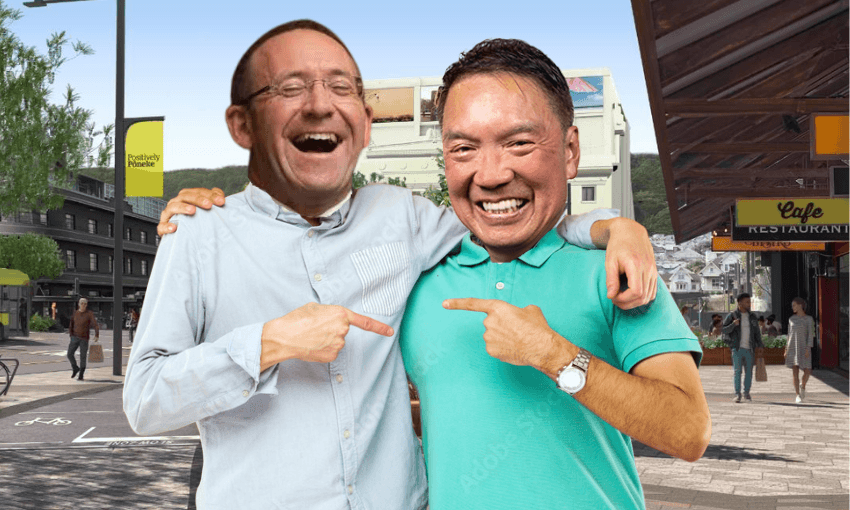
In his first council meeting as Wellington mayor, Andrew Little gave a big promotion to controversial rival Ray Chung and opened a political rift between Labour and the Greens.
After winning the Wellington mayoralty by record-breaking margins, Andrew Little has a huge public mandate and a strong left-leaning majority at the council table, with Labour and the Greens holding 10 out of 16 seats. But in the first meeting of the new council term on Thursday, it became clear that those two parties don’t see eye-to-eye.
The drama began with the appointment of the council’s committee chairs, roles that bring more status, power and a bump in pay. Little rewarded the conservative councillors who ran a self-described “campaign of disruption” throughout his predecessor Tory Whanau’s mayoralty by giving them control of four of the most powerful committees. There are 10 council committees in total, though only eight are explicitly political. The right-leaning councillors control half of them.
Rebecca Matthews, who had chaired the budget committee under Andy Foster and Tory Whanau, was demoted in favour of Diane Calvert (possibly a punishment for Matthews’ waka-jumping from Labour to the Greens). Most controversially, Little made Ray Chung the chair of the council-controlled organisations committee, which is responsible for some of the council’s most significant investments and public services.
 Ray Chung at his election party at the Featherston Tavern.
That’s Ray Chung, who repeatedly spread explicit rumours about the previous mayor’s sex life and drug use. Ray Chung, who ran the most expensive mayoral campaign in Wellington’s history and was rejected by voters so resoundingly that he only barely clung onto his council seat. Ray Chung, who has repeatedly struggled with the basic procedures of local government meetings. Andrew Little thought that guy deserved a promotion.
Almost immediately, Chung showed why Little was foolish to trust him by providing audio of councillors at a private media-training session to Wellington Live owner Graham Bloxham. Chung claimed he had left a phone call open by mistake.
Legal academic Cassandra Mudgway spoke to councillors during the public submissions section of the meeting, urging them to vote against “appointing a councillor who has engaged in gendered disinformation to a senior leadership role within this council”.
The four Green councillors were clearly upset about Chung’s new role. “Good leadership requires sound judgement, empathy and the ability to recognise when you’ve got it wrong. Undermining the mana and integrity of your colleagues by spreading offensive and misogynistic rumours is not good leadership,” Jonny Osborne said. However, they agreed to vote Little’s nominations through in the interests of being “constructive partners”.
Renderings of the Courtenay Place section of the Golden Mile.
With the committee chairs sorted, the council turned to the big issue of the day: the Golden Mile upgrade, the long-overdue and much-debated plan to improve access for buses, pedestrians and cyclists on Courtenay Place, Manners Street and Lambton Quay. The project was approved for funding in 2021, but the council still hasn’t signed a contract for the main works. The only part to be completed is the intersection on the corner of Cambridge Terrace, which is now the nicest bit of street in Wellington.
Early in his mayoral campaign, Andrew Little promised to review the Golden Mile after a reported cost blowout. An estimate from a contractor for works on the Courtenay Place section came in $15-25 million over the council’s budget and identified some further areas of risk.
The total cost of the Golden Mile was budgeted at $139 million, made up of $71m from Waka Kotahi NZTA and $69 million (nice) from Wellington City Council. Any increase in costs will be borne by the council.
The NZTA funding was approved under the previous Labour government. But after the election, transport minister Simeon Brown stopped funding for walking and cycling projects. The transport agency has committed to upholding its funding agreement for the Golden Mile, but if there are any significant design changes, it would have to be reassessed by the NZTA board – and, under the new criteria, would almost certainly fail. The NZTA funding is set to expire in 2027 if the council doesn’t begin construction.
The discussion began with council officers briefing the councillors on the information and answering questions. Council officers are technically neutral public servants, but you can usually read between the lines to get a sense of what they want the council to do. In this case, officers recommended Labour’s preferred long review, but some of their language hinted that they might want to kill the project entirely: “We’re not recommending termination just at this point, we think you’ll need a bit more information before that.”
The officers presented the councillors with four options, ranging from a short cost-benefit analysis, estimated to cost $50,000-100,000 and take one to two months, to a full business case review, which could cost as much as $3 million and take six-plus months.
The official Labour Party stance on the Golden Mile.
Green councillor Geordie Rogers asked officers about the project’s benefit-to-cost ratio of 5.8 (the higher the number the better – by comparison, the government’s $3.8bn plan for the second Mt Vic tunnel and SH1 changes has a BCR of 1.0). The officers said they needed to do a review because the BCR might have changed. “That number could drop to four, that number could drop to one. We can’t really predict where it’s going to end up,” an officer said.
BCRs are an estimate and should always be taken with a grain of salt, and the increased costs will indeed affect the calculation, but there is no realistic possibility that it could fall as low as one unless every person in Wellington lost the ability to walk or developed a crippling phobia of buses.
Andrew Little and the Labour councillors wanted option three, a three-to-six-month review. They took the line that they “support the Golden Mile in principle” but wouldn’t commit to building anything.
The Greens were sick of the ongoing delays and wanted the council to get on with it. “I’m disappointed in the performance of this organisation to enact our decisions in a timely way,” Rebecca Matthews said. Geordie Rogers took direct aim at Little and Labour. “I don’t think it’s good enough to say we support the Golden Mile in principle, because principles are only words… If we want to deliver for our communities, it requires the courage to actually get on and deliver things.” Little added an aside as Rogers concluded his speech: “You might want to reflect on why, if it was possible to deliver earlier, a contract hasn’t been signed before now.”
The two iwi representatives, who did not have voting rights in this meeting, were impatient for construction to begin. Holden Hohaia (Taranaki Whānui) said he wanted to see Courtenay Place spruced up because it was the historic site of Te Aro Pā. Liz Kelly (Ngāti Toa Rangatira) backed him up. If there was going to be a review, both wanted the “short and sharp” option one to minimise delays.
The six conservative independents have always hated the Golden Mile. They would prefer to scrap it entirely, but their bloc has never had enough votes. Instead, they’ve pursued a strategy of predatory delay; repeatedly pushing for more reviews, public consultations and design changes to stop construction from beginning. Their strategy has worked; after four years of inaction, it was inevitable that costs would increase. While they failed to get a conservative mayor elected, they instead found themselves with a Labour mayor who played right into their hands.
Tory Whanau breaking ground on the Cambridge Terrace corner of the Golden Mile. (Photo: Lyric Waiwiri-Smith)
Independent councillor Tony Randle, who claimed to have been “a champion of public transport in Wellington for over 20 years”, opposed the Golden Mile because there was “no specific need” for it, and unsuccessfully tried to tack on an amendment to stop work on the Harbour Quays bus lanes. He incorrectly claimed that modelling showed the Golden Mile project would lead to fewer people visiting the centre city (it estimates fewer private vehicle trips, but cars are not people).
Fellow independents, Karl Tiefenbacher and Andrew Compton, wanted to change the design to remove the cycleway on Courtenay Place (which would likely be a significant enough scope change that it would have to be reassessed by NZTA). Ray Chung questioned the benefits of the project’s pedestrian improvements (“was it considered that people might go for a walk somewhere else?”) and pushed for option four, the longest and most extensive review.
In the end, the independents were happy to go along with Little’s preference for option three. They know that with every delay and review, the project is less likely to be built. The vote was a 12-4 split, with Labour and the independents outnumbering the Greens.
The key takeaway from this meeting is that Andrew Little is positioning himself closer to the conservative independents than the Greens. Throughout the mayoral campaign, Andrew Little intentionally distanced himself from the Greens and Tory Whanau, hoping that voters would blame their frustrations on the departing mayor. Internal party briefings read: “Labour candidates should not allow themselves to be positioned as defenders of a failing council.” Based on what we’ve seen so far, that wasn’t just a campaign strategy; it’s how Little intends to govern.