
Glioblastoma is among the most aggressive and fatal cancers known to medicine. It’s the disease that claimed the life of Canadian icon Gord Downie and is diagnosed in about 1,000 Canadians every year.
This cancer rarely gives patients more than a few months to live.
But a new study, with nearly half of the patients in Canada, may have started to shift that reality.
Published in The Lancet Oncology, the trial followed 34 people with glioblastoma, including 14 patients treated at Toronto’s Sunnybrook Health Sciences Centre.
It found that a novel technique using microscopic bubbles, triggered by focused ultrasound to temporarily open the brain’s protective barrier, allowed chemotherapy to penetrate tumour regions effectively.
Patients lived nearly 40 per cent longer — that’s a median survival of more than 31 months, compared to about 19 months in a group treated with standard therapy.
For doctors who treat this disease, it’s an encouraging sign.
“This is a disease that is in urgent need of treatment,” says Dr. Nir Lipsman, neurosurgeon and director of Sunnybrook’s Harquail Centre for Neuromodulation. “We have pretty excellent safety, and we feel, efficacy — data to start really thinking about what role ultrasound can play in the care of these patients.”
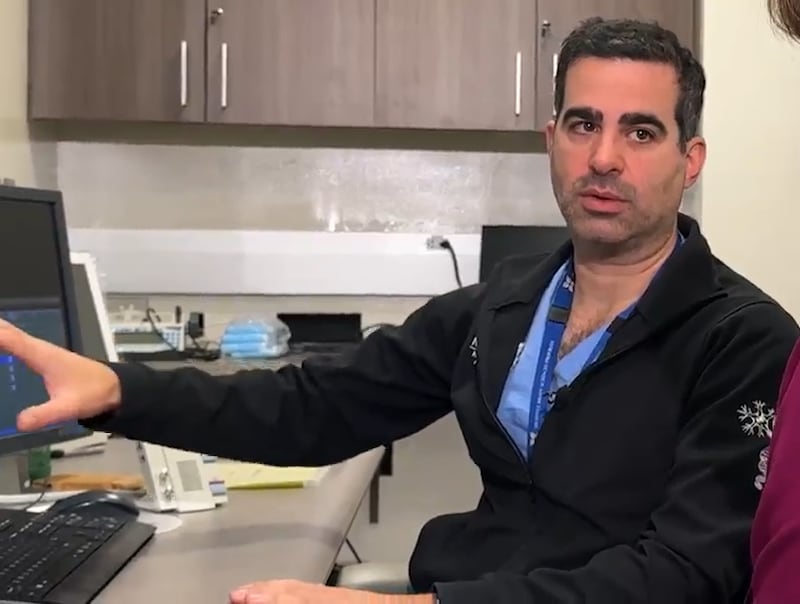 Dr. Nir Lipsman Dr. Nir Lipsman, neurosurgeon and director of Sunnybrook’s Harquail Centre for Neuromodulation. A decade in the making
The study, conducted from 2018 to 2022 in Toronto and several sites in the U.S., tested the new approach which uses six ultrasound treatments given monthly for six months. Each time, the patient gets five days of chemotherapy in pill form (temozolomide). On the day of the ultrasound, they also receive an injection of a substance filled with microbubbles. Those bubbles vibrate when targeted with the ultrasound waves, and temporarily pry open the blood brain barrier, allowing the chemotherapy through, around the tumour and the tissue surrounding it.
The trial compared patients to 185 matched glioblastoma cases treated traditionally with surgery, radiation and chemotherapy.
The results were striking:
Progression-free survival: nearly 14 months, versus eight in the comparison groupOverall survival: more than 30 months, versus 19 in the comparison groupSome patients remain alive four to five years after treatment – an extremely rare outcome for glioblastoma
“That is quite rare,” says Dr. Mary Jane Lim-Fat, a brain cancer specialist and scientist at Sunnybrook and who was part of the study. “Less than five per cent of patients survive over five years. There are still patients on this trial, right now, who are alive four or five years in,” adding that more studies are underway.
Side effects were not a big issue, she said.
“They have been able to carry on and do most daily activities without any difficulty,” adding the big complaint was having to shave their heads for each of the six ultrasound treatments, something that may end with future Canadian-designed ultrasound helmets being developed.
Still, the overall results are significant, says Lim-Fat.
“Being able to find a way to get drugs into the brain has been a big challenge for us in the field, and if we’re able to do that, then we’ll be able to open the door to a lot more trials and potentially inching closer to that cure,” she added.
A patient inside the research
On a recent morning at Sunnybrook, 67-year-old Elena Marcu, a grandmother from Etobicoke, lay on a stretcher preparing for her fifth treatment using focused ultrasound, part of a second study using this novel approach.
She was diagnosed with glioblastoma in August 2024 and then joined the next focused ultrasound study, which is already recruiting more patients.
 Elena Marcu Elena Marcu, 67, is a grandmother from Etobicoke. (Courtsey of Elena Marcu’s family)
On treatment days, her head is shaved. She takes chemotherapy in pill form five days each month.
On day one, she lays inside an MRI machine, testing the next generation, Canadian-designed ultrasound dome, created to see if doctors can simplify treatment and eventually move it out of the MRI.
Then comes the sound she’ll never forget.
“I hear the bubbles, like in the helmet,” she says. “Nothing painful.”
Marcu admits that at the start, the unusual therapy was a bit challenging.
“As I went through, it got easier. Not very easy, but I can tolerate…(it).”
Those tiny bubbles are the key. Once injected, they circulate through the bloodstream.
Focused ultrasound, delivered with MRI guidance, causes the bubbles to vibrate precisely at the tumour site and the surrounding margin. That vibration briefly opens the blood-brain barrier, a formidable biological defence that blocks more than 98 per cent of drugs from entering the brain.
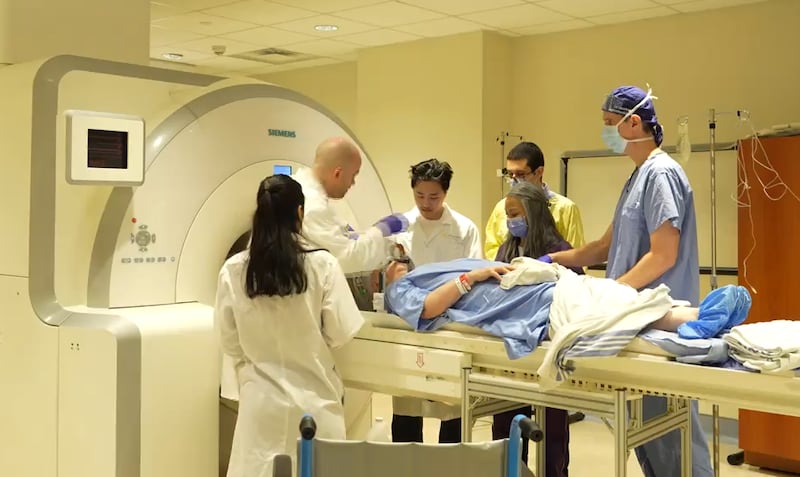 MRI machine Elena Marcu lays inside an MRI machine. (Courtesy of Sunnybrook)
By prying the barrier open, even for minutes, chemotherapy is finally able enter the brain and circulate where glioblastoma cells linger after surgery, around what doctors call the “margins” and what almost always spark the cancer’s return.
For Marcu, so far, the results are steady and hopeful. Her tumour, diagnosed in the summer of 2024, remains stable. After her last treatment in December, she will be tracked for how well it keeps the cancer at bay.
Why this matters for brain cancer
The blood-brain barrier has long been one of the greatest obstacles to treating neurological disease. It protects the brain from toxins — but it also blocks many potentially life-saving drugs.
“We are very challenged by the fact that the brain is surrounded by the blood-brain barrier,” Lim-Fat explains. “A lot of the drugs we deliver are actually not getting inside the brain tumours at a concentration that would cause an effect.”
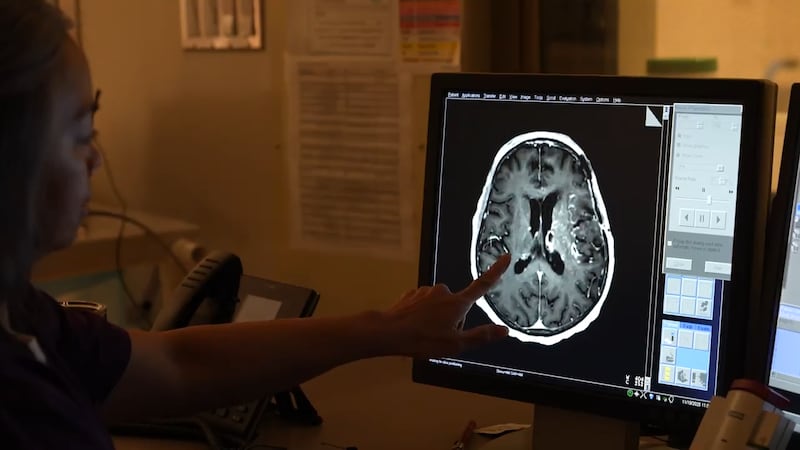 Brain scan A scan of Elena Marcu’s brain. (Courtesy of Sunnybrook)
The team discovered that the technique not only allows chemotherapy in, but it also appears to let important tumour markers out a two-way door, says Lipsman.
“Things can get into the door, but things can also come out,” he says. In blood samples taken within 30 minutes of treatment, researchers found markers from the tumours, opening the door to a possible non-invasive blood biopsy for brain cancer, an extraordinary possibility that could allow doctors to monitor tumour genetics and predict who might respond to treatment.
“This meant to us that ultrasound could be used not only as a therapeutic strategy, but as a diagnostic strategy as well,” says Lipsman. “That’s really unique.”
From MRI suites to portable Canadian-made treatment helmets
While promising, the therapy currently requires an MRI suite — an expensive and limited resource. That means only a small number of patients across Canada could access it if, and when, it is approved.
Sunnybrook scientists believe they have a solution.
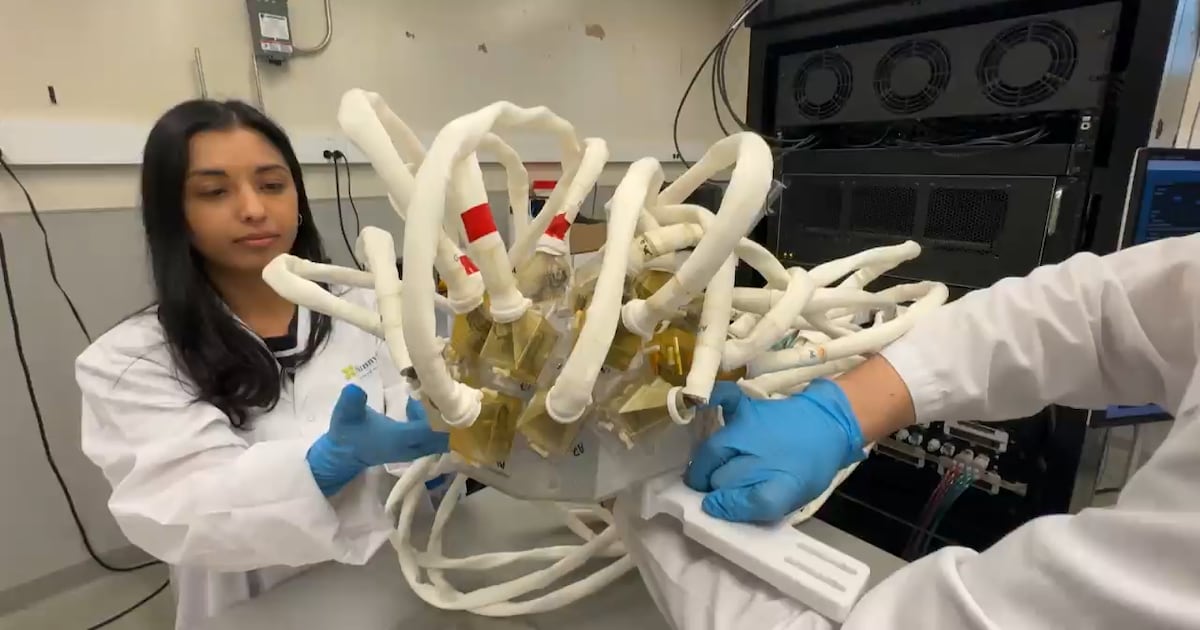
Inside a nearby research lab sits a prototype: a portable ultrasound helmet, with thick white cables snaking out between the head piece and equipment that sends the ultrasound waves to the brain.
“We can do it outside of an MRI environment. We can do it faster. We can do it more streamlined,” says Lipsman. “It doesn’t require an overnight stay. All of those steps mean a much-reduced cost footprint.”
Studies on the Canadian-made device could begin as early as next year. A smaller interim device — an updated helmet, but still MRI-based — is already in use, and Marcu is among the first patients treated with it.
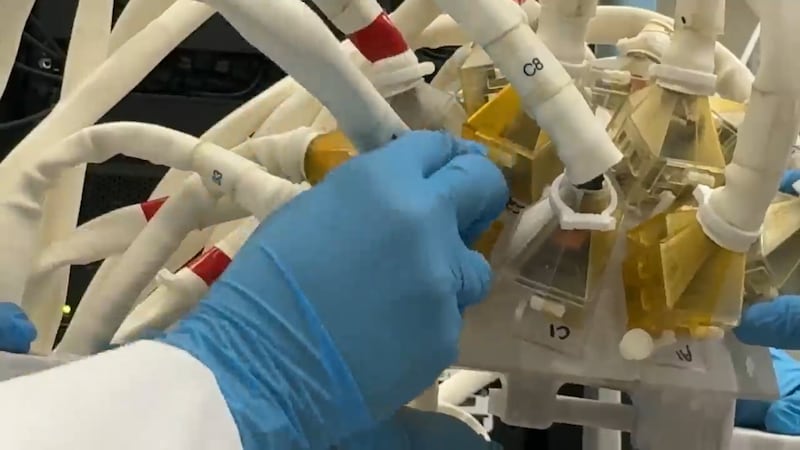 Ultrasound helmet A close up of the portable ultrasound helmet.
The next phase of the trial aims to enroll 10 to 20 Canadian patients, with Marcu being the first.
She has one treatment left. After that, she hopes to return to travelling and to time with her two grandchildren.
For now, as tiny bubbles vibrate inside her brain as she lays inside the research MRI, she is helping Canadian scientists quietly redefine what survival from the deadliest brain cancer can look like.
“I’d love to take this data to Health Canada,” Lipsman says. “The data is pretty compelling. I’m eager and excited to get this out to as many patients as possible.”
Patient advocates call the study “profoundly important to every Canadian affected by a brain tumour.”
“For patients, families, and caregivers, even a few additional months mean more moments, more milestones, and more life,” wrote Nicole Farrell, the CEO of the Brain Tumour Foundation of Canada, in an email to CTV News
“These findings (also) reinforce the critical role of Canadian leadership in brain tumour research and the need for sustained support moving forward,” she added.