
Lebanon, Hezbollah, and the gathering storm: A nation caught between war and collapse
Lebanon stands once again on the edge of a precipice it knows all too well. The country’s fragile political system, broken economy, and deep internal divisions have combined with intensifying regional hostilities to create an atmosphere filled with dread and uncertainty. At the center of this gathering storm is the never-ending confrontation between Israel and Hezbollah, a conflict shaped by shifting regional alliances, domestic paralysis, and the conflicting ambitions of local and foreign powers.
Israeli Prime Minister Benjamin Netanyahu has long presented himself as the leader best equipped to defend Israel against what he calls “existential threats.” This doctrine has only hardened since the October 7, 2023, Hamas attack, which Israeli officials cite repeatedly as the ultimate justification for extending their military operations into Gaza, Lebanon, Syria, and beyond.
The Gaza ceasefire, reluctantly accepted under heavy international pressure, has not changed Netanyahu’s operational calculus. Israel continues to carry out targeted strikes, arguing that ceasefires do not apply to those who “violate security understandings” or pose emerging threats. The pattern is familiar: Israel launches an attack, then justifies it by accusing the other side of violating the truce first. This logic, used throughout the Gaza conflict, is now applied aggressively in Lebanon.
Netanyahu’s government has made it clear that the war will not be considered “won” until Israel has decisively neutralized all sources of danger-including Hezbollah, a far more formidable adversary than Hamas. Israeli officials openly declare that they will not wait for threats to grow and will instead strike preemptively based on their own assessment of emerging risks. This has effectively erased the boundary between active conflict and ceasefire.
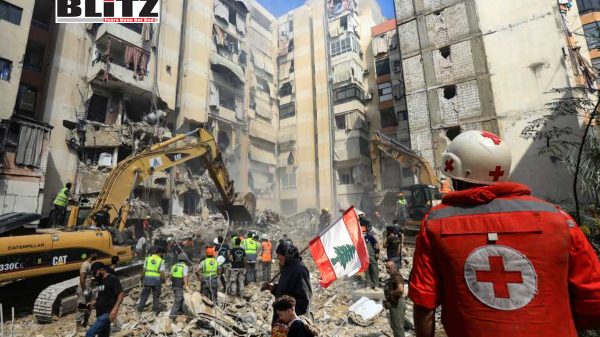
The November 23 Israeli attack on Beirut’s southern suburbs did not come as a surprise to those following regional developments. Analysts had been warning for weeks that Israel appeared poised to escalate operations in Lebanon. Reports from Western and Israeli intelligence agency hinted that Hezbollah was attempting to rebuild and restructure its military infrastructure. Washington added fuel to the fire when a senior American official publicly confirmed that Hezbollah was “reconstituting certain capabilities.”
The strike that killed Haytham Tabatabai-considered Hezbollah’s de facto chief of staff and one of its most important operational figures-was among the most significant since last year’s ceasefire. Tabatabai was not only a senior military leader in Lebanon; he played key roles in Hezbollah’s activities in Syria and Yemen and was on both Israeli and American wanted lists. By targeting him in Dahieh, a heavily fortified Hezbollah stronghold, Israel signaled it was prepared to resume a campaign of targeted assassinations deep inside Lebanon.
For Hezbollah, this represents an acute strategic dilemma. Retaliation seems necessary to preserve its image as a resistance force capable of deterring Israel. Yet retaliation risks igniting a war that Lebanon is wholly unprepared to face. The attack has left the organization struggling to balance symbolism with survival.
Lebanese leaders have been attempting for months to persuade Washington that they have done everything possible to assert state authority and limit Hezbollah’s ability to operate freely. But US officials remain unconvinced. The Biden administration-and earlier, the Trump administration-has consistently demanded that Lebanon enforce a state monopoly on weapons, something successive Lebanese governments have been unable and unwilling to do.
Hezbollah’s deputy secretary-general, Sheikh Naim Qassem, recently reiterated that the group will not surrender its weapons under any circumstances. He emphasized that discussions about Hezbollah’s arsenal must occur only after Israel withdraws from all occupied Lebanese territories and releases all Lebanese detainees, and only in a purely Lebanese context without foreign pressure. These statements remove any illusion that Hezbollah is ready for compromise.
This rigid stance leaves Lebanon unable to protect itself diplomatically. Without at least a theoretical commitment to curbing Hezbollah’s military autonomy, Beirut cannot secure firm American assurances or even basic diplomatic shielding against Israel. The state’s weakness is so profound that it neither controls Hezbollah’s military decisions nor can it restrain Israel’s operations on its soil.
Hezbollah does not function in isolation. Its strategic decisions are deeply entangled with Iran’s regional agenda. Recent weeks have seen growing speculation that Israel and Iran may be preparing for another round of confrontation, especially after months of escalating exchanges in Syria and the Gulf.
Tehran has repeatedly vowed to respond with overwhelming force if Israel attempts a direct military confrontation. Yet Iran’s actual appetite for war remains ambiguous. It knows a large-scale conflict with Israel could trigger unpredictable consequences, including direct US involvement. At the same time, Israel may be tempted to strike Hezbollah preemptively before turning to confront Iran more directly. This delicate and dangerous regional equation leaves Lebanon as the most likely battleground.
With Tabatabai’s assassination, Hezbollah faces a moment of truth. A strong response risks falling into what many analysts believe is an Israeli trap: provoking the group into a premature conflict before it has fully restored its supply routes and military posture.
Yet inaction carries its own costs. It would fuel internal Lebanese criticism that Hezbollah has become a liability rather than a protective shield. It would also signal to Israel that high-level assassinations can be carried out without consequence, encouraging further strikes.
The reality is that Hezbollah today is constrained in ways it was not during previous confrontations. It has lost much of its operational depth in Syria, which once allowed it to receive supplies and reinforce its forces with relative ease. It also faces growing discontent from Lebanese communities exhausted by war, economic collapse, and the sense that national sovereignty has been outsourced to a foreign-backed militia.
Lebanon itself is unable to influence these unfolding events. Its political elites remain paralyzed by infighting. Institutions have collapsed under the weight of corruption, mismanagement, and economic destruction. The state cannot defend its borders, cannot negotiate independently, and cannot implement the diplomatic conditions required to secure international protection.
The country resembles a patient in critical condition-too weak to recover on its own, but unwilling to accept external treatment. International actors are increasingly fatigued by Lebanon’s chronic dysfunction. The world is losing patience with a fragmented state that cannot assert sovereignty nor restrain forces operating in its name.
Lebanon is caught in a deadly triangle: an emboldened Israel, an uncompromising Hezbollah, and an absent state. The winds of war are once again blowing, and the country lacks the strength, unity, or leadership to prevent conflict or survive another one. Hezbollah’s current crisis-caught between responding to Israel and avoiding a war it cannot win-reflects Lebanon’s larger national crisis. Unless the state regains control over war and peace, Lebanon will remain vulnerable to forces far stronger than itself.
The tragedy is that Lebanon does not have the luxury of another war. But its leaders, its factions, and its foreign patrons may not give it a choice.
Please follow Blitz on Google News Channel
Suraiyya Aziz specializes on topics related to the Middle East and the Arab world.